
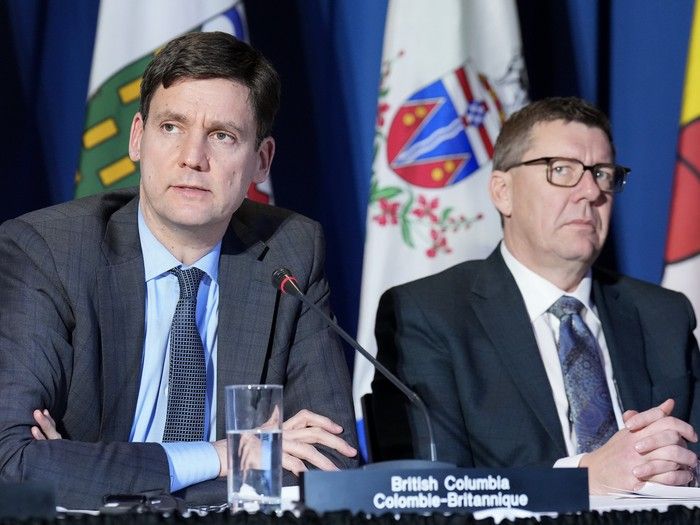
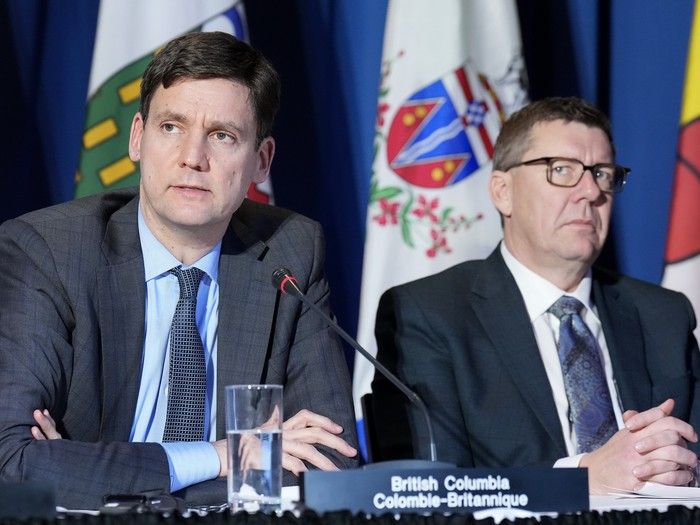
VICTORIA — Premier David Eby expressed dismay on Monday that Saskatchewan-based Nutrien Ltd. has chosen Washington state over B.C. for a $1 billion potash export terminal.
“I was really disappointed,” the premier told reporters when asked about Nutrien’s decision to go with Longview, Washington, on the Columbia River over Prince Rupert or Vancouver.
The premier said the whole country would benefit from the investing in port expansion on the West Coast.
Plus the U.S. location means that Saskatchewan potash will be hostage to the “whims” of President Donald Trump, who could impose tariffs on the exports or shut them down altogether.
“It is the worst of both worlds,” said the premier.
The premier first cited a concern about Nutrien’s decision last week.
He was responding to the news that Saskatchewan Premier Scott Moe had been in discussions with Prime Minister Mark Carney and Alberta Premier Danielle Smith about an oil pipeline through B.C.
Talks from which Eby was excluded.
“I almost fell out of my seat when I heard Scott Moe say that he was part of these conversations — which I was completely unaware of — about what happens in B.C.,” Eby told the CBC’s David Cochrane, Thursday.
“I was especially surprised because there’s a lot we should be doing with Saskatchewan,” the premier continued, noting the news about the potash terminal, which had broken the day before.
“Nutrien, one of their big potash producers, just announced that they want to ship potash out of Washington state,” Eby told the CBC audience.
“He (Premier Moe) and I should be working together to make sure that potash moves out of West Coast ports in Canada to protect Saskatchewan residents and Canadians.
“Instead, he’s having secret conversations with Danielle Smith and, allegedly, the prime minister about what’s happening in B.C. Why Scott Moe is not focused on getting potash out of B.C. ports instead of Alberta’s oil is beyond me. I guess he can explain that to people in Saskatchewan.”
The B.C. premier revisited his Saskatchewan counterpart’s lapse on Monday. Eby told reporters that he has had many conversations with Moe. Never once did the Saskatchewan premier bring up the need to work with Nutrien on its choice of locations for the potash terminal.
Another controversy, not mentioned by Eby, is why the $1 billion potash terminal did not make it onto the list of major projects promoted by Prime Minister Mark Carney.
When the Nutrien news broke last week, the federal government voiced “surprise” and “disappointment” over the company’s decision to go to the U.S.
“Saskatchewan potash should be moved out of a Canadian port,” federal Transport Minister Steven MacKinnon told a news conference Friday.
He sought an immediate meeting with company executives to try to “convince them to change their mind.”
The company said it had been in contact with the relevant federal authorities all along and the lines of communication remained open. It won’t make the final investment decision on the terminal until 2027.
However, the decision to go with Longview was not lightly taken, according to company’s chief commercial officer, Chris Reynolds. He told the Globe and Mail that Nutrien weighed 30 factors including rail rates and the cost of construction. The site in Washington “came out on top” every time.
Longview was able to offer the company exclusive access to an unused berth at the Columbia River terminal, one formerly used for grain shipments. Nutrien has an established relationship in the U.S. Pacific Northwest as it already ships potash out of nearby Portland.
Other factors cited by the company in making its decision were congestion and transportation bottlenecks on the Canadian side of the border. Nutrien also noted recent labour disruptions at B.C. ports. Longview, by comparison, was seen as more efficient and reliable.
Transportation rates. Access to the port. Labour relations.
Those are federal responsibilities.
Eby did not say if the province had made efforts on its own to persuade Nutrien to invest in B.C. But the province has already added port expansion to its list of preferred projects.
Worth noting, too, that a rival potash firm with operations in Saskatchewan is already building an export terminal in B.C.
BHP Ltd., the Australian mining giant, is spending $1 billion on the Westshore terminal at Roberts Bank. It is the intended destination for the output of a $9 billion potash mine BHP is working to bring on stream two years from now in Jansen, east of Saskatoon.
I spoke with BHP’s president of North American operations, Brandon Craig, when he visited the B.C. capital last month.
He asked whether the B.C. government was serious about attracting further investment in resource development and mining. I said the government was serious about growing its way out of a fiscal crisis.
But I was struck that his company had already made a $10 billion commitment to this country and to Saskatchewan and B.C.
Looking back, I have to wonder if Longview would still have been Nutrien’s first choice, had the country as a whole acted sooner and with greater resolve to promote ports in B.C.