
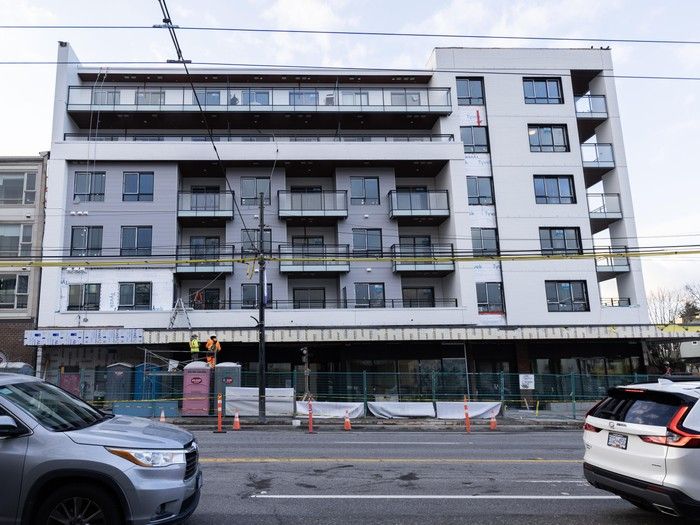
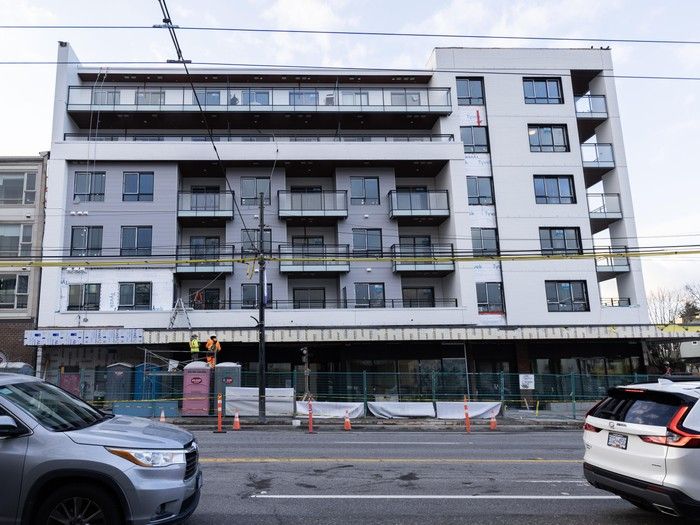
For many years, the City of Vancouver’s planning department and successive councils have grappled with a persistent problem: rents and home prices rising too fast and too high.
Now, they face the opposite scenario, which presents its own challenges.
Recent declines in home prices and rents will be welcomed by many. But city planners say the trend, when coupled with increased costs of housing production, threatens to strangle the future supply of homes.
That is why Vancouver’s planning department is proposing a suite of changes, stemming from council’s directions to staff, aiming to boost the viability of housing development. The suggested actions include reducing fees paid by developers to City Hall and softening requirements for below-market units.
Such measures would mean trade-offs. They could mean below-market apartments are less affordable in the future, less money is invested in public art, and some infrastructure and amenity projects need to be delayed or reduced, according to a city staff report going to council next week.
But city planners believe these moves are needed to keep the pipeline of housing projects moving in a challenging market.
A failure to make changes now will mean fewer developments come to City Hall, fewer homes will be built, and more projects will be abandoned before completion, Vancouver’s general manager of planning Josh White said in an interview.
And that will mean housing shortages in the years to come, and prices for renters and buyers will rise again.
“We need to act,” White said. “If we don’t, if we’re not getting those units built, we’re just going to be running into the same shortage a few years from now.”
Evidence of the challenging market can be seen all over town with
on some high-profile projects,
at major real estate companies, and an increasing number of
Many factors impeding development are outside of a municipal government’s control, such as rising costs of materials, labour, and financing. But the 50-page report by Vancouver staff includes a range of proposed changes to things within the city’s control.
They are proposing a temporary 20 per cent reduction to the levies developers pay City Hall to fund infrastructure, and providing more flexibility on the timelines for when developers must pay those fees to the city.
The staff report estimates these changes could mean a $320 million funding gap for infrastructure and amenities in the next four-year capital plan. To mitigate that impact, staff recommend the city could borrow funds or draw from capital reserves.
Although the proposed reduction to development levies would mean the city collects less money on each project, White said, “We don’t collect it unless the project proceeds.”
“Eighty per cent of a good volume is a heck of a lot better than 100 per cent of nothing,” White said. “We probably would never have gotten that $300 million in the first place, because more projects would struggle to get from approval into actual construction.”
The city hopes to make up at least some of that revenue through the federal government’s commitment in last month’s budget to help fund “housing-enabling infrastructure” for municipalities that reduce development charges.
Many municipalities are waiting to see how that federal funding will work, said Beau Jarvis, president of Wesgroup, a major Vancouver-area developer. In the meantime, the City of Vancouver deserves credit for trying to work with the housing industry, he said, and he hopes other cities will follow.
But, Jarvis said, there needs to be better coordination between different levels of government.
Jarvis cited an 87-unit rental project Wesgroup has planned for Vancouver, where the total municipal levies are expected to be $2.6 million. A 20 per cent reduction could save about $520,000.
Although the municipal levies only represent about five per cent of the total project cost, not including land costs, that reduction could be enough to make a material difference in viability, Jarvis said. That is, if those savings were not almost entirely wiped out by Metro Vancouver’s 35 per cent increase to development cost levies set to take effect in January.
“It’s really unfortunate,” Jarvis said. “The City of Vancouver moves to reduce DCLs, and Metro just absorbs it all.”
In June, Wesgroup
12 per cent of its workforce, which Jarvis described at the time as “an absolute last resort.” Then in September, Wesgroup cancelled a multi-building condo project for the River District in Vancouver.
“We are not crying wolf,” Jarvis said. “To be dramatic about it, the industry is bleeding out.”
Statistics Canada data
shows a 5.9 per cent year-over-year decrease in the average asking rent for a two-bedroom apartment in the Vancouver region, the third-largest decline among Canada’s largest metropolitan areas. Decreases in asking rents coincided with slower population growth and a higher number of homes added to the market.
Those falling rents in Vancouver are “unequivocally good news,” White said. “We’ve had nothing but upward pressure on rents for a very long period of time, so relief from that is a good thing.”
But there’s a flip side, White said. If the cost of producing homes does not also decrease, many projects will not be viable.
If, a few years from now, projects become viable again solely because housing scarcity forces rents to rebound, “then we will have accomplished nothing from an affordability standpoint,” he added.
Meanwhile, the city is also eyeing other changes to enable different kinds of development. The city is seeking public input on proposed zoning changes to make it easier to build rental apartment buildings and small hotels of up to six storeys along major arterials and in more neighbourhoods. The city is hosting an
Dec. 11.
The city is also looking at reducing the depth of affordability in below-market rental homes required as a percentage of many larger developments. Whereas rents for below-market homes are currently secured at a 20 per cent discount below city-wide average rents as determined by Canada Mortgage and Housing Corp., staff are proposing to allow eligible projects to set those rents at the city-wide average, which would still be below the average market rent in new buildings.
White says he is optimistic the proposed changes will move many projects from “unviable to viable.”
In recent years, Vancouver City Hall has been approving a “huge volume of projects,” White said. “We want those projects to move into construction, and these are the actions that will help us get there.”
With files from Joanne Lee-Young