
Avian flu: How do veterinarians and wildlife rescues fit into the picture?
A Maple Ridge vet reports trapping, euthanizing and testing sickly cackling geese for influenza. What is the role of CFIA in that scenario?
Last updated 2 days ago
You can save this article by registering for free here. Or sign-in if you have an account.
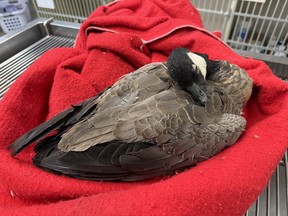
An animal hospital in Maple Ridge has gone public with news that several cackling geese tested positive last month for avian flu.

Subscribe now to read the latest news in your city and across Canada.
- Unlimited online access to articles from across Canada with one account.
- Get exclusive access to the Vancouver Sun ePaper, an electronic replica of the print edition that you can share, download and comment on.
- Enjoy insights and behind-the-scenes analysis from our award-winning journalists.
- Support local journalists and the next generation of journalists.
- Daily puzzles including the New York Times Crossword.
Subscribe now to read the latest news in your city and across Canada.
- Unlimited online access to articles from across Canada with one account.
- Get exclusive access to the Vancouver Sun ePaper, an electronic replica of the print edition that you can share, download and comment on.
- Enjoy insights and behind-the-scenes analysis from our award-winning journalists.
- Support local journalists and the next generation of journalists.
- Daily puzzles including the New York Times Crossword.
Create an account or sign in to continue with your reading experience.
- Access articles from across Canada with one account.
- Share your thoughts and join the conversation in the comments.
- Enjoy additional articles per month.
- Get email updates from your favourite authors.
Create an account or sign in to continue with your reading experience.
- Access articles from across Canada with one account
- Share your thoughts and join the conversation in the comments
- Enjoy additional articles per month
- Get email updates from your favourite authors
Sign In or Create an Account
It’s not an uncommon occurrence, as migratory birds moving through B.C. and across Canada are sometimes exposed to the H5N1 virus that spreads in wild populations.

tap here to see other videos from our team.
Avian flu: How do veterinarians and wildlife rescues fit into the picture? Back to video
tap here to see other videos from our team.
The difference is that Dewdney Animal Hospital usually gets one or two birds a month during the fall migratory season — whereas this cluster all happened in November.
“We have always got birds in the fall with suspected avian influenza and have for all 17 years I have been here,” said Dewdney’s head veterinarian and owner, Dr. Adrian Walton.
“We work with the B.C. Wildlife Rescue Association and OWL Rehab to see if the birds should be euthanized or can safely be sent to them. This year, WRA were closed to wildlife due to the disease and they … recommended that we send them for testing. That’s why there is an increase in us testing this year.”
The tally from last month alone at the animal hospital:
• Three cackling geese — a smaller subspecies of Canada goose — one of which died at the wildlife rescue and two that were euthanized at the animal hospital and sent for testing. Both those birds tested positive.
• One kestrel that died at OWL and came back positive for H5N1.
• One crow that wasn’t tested and one seagull that is currently out for testing.
Most of the infected birds were found in the Pitt Meadows and Pitt Marsh area, a haven for dozens of native and migrating bird species.
-
Advertisement 1Story continues belowThis advertisement has not loaded yet, but your article continues below.
“The seagull was in a Coquitlam parking lot and a vet clinic there brought it to us,” said Walton.
So how does this monitoring and testing work in connection with the Canadian Food Inspection Agency (CFIA), which is the lead agency keeping tabs on avian influenza?
A joint response from the CFIA and Environment and Climate Change Canada explains the role of vets, wildlife rescues and the public.
What is the role of private veterinarians?
“Veterinarians in Canada play a key role in protecting animal health and preventing the spread of foreign animal diseases (diseases not normally found in Canada),” said a spokesperson from the CFIA.
Vets provide early detection and are often the first to see signs of diseases like avian flu in domestic animals. By law, they must immediately report any suspicion of a reportable disease like avian influenza or foot-and-mouth disease to the CFIA.
They also help limit disease spread by helping producers apply strict biosecurity measures and advice on how to reduce risks. They can also educate pet and animal owners about disease risk and prevention.
Veterinarians also collect samples that go to specialized labs like the National Centre for Foreign Animal Disease in Winnipeg. For more on the role of private vets and the kinds of animal diseases they help detect and mitigate, go to inspection.canada.ca.
In Dewdney hospital’s case, the vet followed protocol and reported the sick birds to the provincial and federal agencies that carry out tests on wild birds, said the CFIA. In this case, the tests were done at the B.C. Agriculture and Foods Ministry’s animal health lab.
Private veterinarians don’t have a formal role in monitoring for avian influenza in wildlife, said the CFIA. But members of the public sometimes bring sick and injured wildlife to a vet, who are expected to report it.
Positive test results are compiled at a B.C. dashboard, which currently shows 16 positive tests for highly pathogenic avian influenza in wild birds in the past month. A Canada-wide dashboard showing detections since late 2021 is also available.
How are wildlife rescues involved?
Operations that take in wild birds and other avian species are by definition vulnerable to avian influenza. In early November, Critteraid in Summerland reported an outbreak at its sanctuary and began working with the CFIA on mitigating it.
Dr. Scott Weese, a veterinarian and educator with the University of Guelph in Ontario, praised the non-profit for its transparent, co-operative approach to dealing with the bad news.
Similarly, OWL Rehab said it has had cases of avian flu in several rescued raptors since September and that quarantine rooms, personal protective equipment and other biosecurity protocols are in place to protect their birds. That’s in contrast to the sensation and controversy that erupted over an avian flu outbreak at a B.C. ostrich farm and a CFIA order to kill hundreds of birds there.
What is public’s role in monitoring for avian flu?
Surveillance of wild birds with avian flu is key to keeping small and commercial poultry flocks and other domestic animals from becoming infected. This includes domestic cats, which are susceptible to avian flu and can get sick or die if they catch an infected bird.
“Members of the public are not required to report routine test results,” said the CFIA spokesperson. “However, the public is encouraged to report sick or dead wild birds to their provincial or territorial wildlife authority so that appropriate assessments can be made and, when necessary, samples can be submitted through official surveillance channels.”
Do not touch a dead, injured or sick bird; instead, report it immediately. In B.C., that’s the wild bird reporting line at 1-866-431-2473, which is monitored by provincial and federal wildlife agencies. Reporting bird carcasses helps to track avian influenza and allows the relevant wildlife agencies to provide advice.
Is this fall outbreak worse than usual?
In the fall migration period, “it is normal to see a higher number of avian flu detections,” said the CFIA. Thus, the risk of avian flu for domestic poultry increases during the fall and spring migration of wild birds. While it circulates naturally in wild birds, it always poses a risk of spreading from migratory birds to backyard and commercial poultry.
Are humans at risk?
Though there are cases of the virus being transmitted to humans, they are exceedingly rare and usually involve people dealing with a large number of infected birds. There was a single case in November 2024 involving a B.C. teen who became critically ill but recovered — the first confirmed case in Canada. In the U.S., there have been 71 cases of avian flu in humans and two deaths since 2024.