
Was B.C. Premier David Eby really surprised by DRIPA court decision?
Vaughn Palmer: Independent MLA Elenore Sturko expressed doubt that the premier was all that surprised by the outcome
You can save this article by registering for free here. Or sign-in if you have an account.
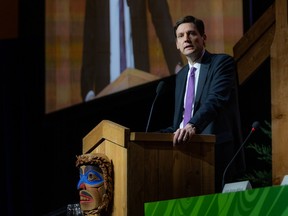
VICTORIA — Premier David Eby says the B.C. Court of Appeal encroached on “the territory of government” when it ruled that B.C.’s mineral claims regime is “inconsistent” with the UN Declaration on the Rights of Indigenous Peoples.

Subscribe now to read the latest news in your city and across Canada.
- Unlimited online access to articles from across Canada with one account.
- Get exclusive access to the Vancouver Sun ePaper, an electronic replica of the print edition that you can share, download and comment on.
- Enjoy insights and behind-the-scenes analysis from our award-winning journalists.
- Support local journalists and the next generation of journalists.
- Daily puzzles including the New York Times Crossword.
Subscribe now to read the latest news in your city and across Canada.
- Unlimited online access to articles from across Canada with one account.
- Get exclusive access to the Vancouver Sun ePaper, an electronic replica of the print edition that you can share, download and comment on.
- Enjoy insights and behind-the-scenes analysis from our award-winning journalists.
- Support local journalists and the next generation of journalists.
- Daily puzzles including the New York Times Crossword.
Create an account or sign in to continue with your reading experience.
- Access articles from across Canada with one account.
- Share your thoughts and join the conversation in the comments.
- Enjoy additional articles per month.
- Get email updates from your favourite authors.
Create an account or sign in to continue with your reading experience.
- Access articles from across Canada with one account
- Share your thoughts and join the conversation in the comments
- Enjoy additional articles per month
- Get email updates from your favourite authors
Sign In or Create an Account
The Declaration Act, passed unanimously by the legislature six years ago, established a framework for the province and Indigenous leaders to work together over time to reconcile laws with UNDRIP principles.
It was never intended to put the courts “in the driver’s seat,” says Eby.
Last week, a B.C. Court of Appeal panel ruled two-to-one that the mineral claims legislation violated the UN declaration, with its sweeping grants to Indigenous nations of rights to consultation, accommodation and consent.
“We’re going to review the decision and, if necessary, amend the Declaration Act to ensure that our original intention when we introduced it is clear,” Eby said Friday.
“Clearly amendments are needed,” he added this week. “This is the territory of government, negotiating with First Nations, setting the pace and choosing the laws to bring into alignment.”
The premier rejected a call from the Opposition Conservatives to recall the legislature and amend the Declaration Act straightaway. Rather, he said, the government will take its time and consult Indigenous leaders.
He also offered “to do that work if necessary to assist the courts in understanding this is work for British Columbians to do, not the courts.”
-
Advertisement 1Story continues belowThis advertisement has not loaded yet, but your article continues below.
Eby’s indignation at the court’s encroachment on government territory is difficult to reconcile with a related piece of legislation he introduced during his last year as attorney-general before becoming premier.
He introduced an amendment to the Interpretation Act in November 2021 which directed that henceforth all provincial laws and regulations “must be construed as being consistent with the UN declaration.”
The change was a product of “a deeply collaborative co-development process with Indigenous organizations,” Eby told the legislature. It was also the first law of its kind in Canada.
“It takes another step forward on the alignment of laws by making it explicit that the province’s preferred approach to interpretation of provincial acts and regulations requires consistency with the UN declaration,” he assured the legislature.
“This amendment underscores the importance of consistency with the UN declaration on the rights of Indigenous peoples when there are questions about the interpretation of provincial acts and regulations.”
The change did include a caveat: “If a court considers a provincial law to be inconsistent with the UN declaration, this amendment does not allow the court to read in, read down, or find that law to be of no force or effect.”
Rather, it was “consistent with the understanding that the substantive work of amending existing laws in our province, or introducing new laws to be consistent with the UN declaration, must be done in consultation and cooperation with Indigenous peoples.”
The New Democrats this week cited the latter passage as evidence that the amended Interpretation Act, like the Declaration Act itself, was not intended to allow the courts to overturn laws for being at odds with UNDRIP.
Yet B.C. Appeal Court Justice Gail Dickson, writing for herself and colleague Nitya Iyer, chose to focus on the “must” in the amendment to the Interpretation Act.
As in: “Every act and regulation must be construed as being consistent with the declaration.”
Meaning: “The government MUST (her emphasis) take all measures necessary to ensure that all the laws of B.C. are consistent with UNDRIP.”
If one accepts Eby’s version, the appeals court decision to overturn the mineral claims regime looks like a case of an activist judiciary overriding a politician’s statement of good intentions.
But the change in the Interpretation Act was also invoked by B.C. Supreme Court Justice Barbara Young in awarding Aboriginal title to the Cowichan Tribes over hundreds of acres of public and private land in Richmond.
She cited Eby’s amendment to the act in ruling that private land titles, awarded under the Land Act, were not immune from findings of Aboriginal title. “To construe it otherwise would be inconsistent with UNDRIP.”
That passage in the Cowichan decision prompted Independent MLA Elenore Sturko to introduce a bill to repeal Eby’s amendment to the Interpretation Act, thereby precluding similar action by the courts in other cases.
The New Democrats allowed Sturko’s measure to pass first reading on Nov. 19. It was the same day they used their legislative majority to kill a measure from Independent Jordan Kealey to repeal the Declaration Act altogether.
The government took no further action on the Sturko bill, allowing it to languish on the order paper.
Now that another court has seized the opening provided by Eby’s amendment to the Interpretation Act, Sturko expressed doubt that the premier was all that surprised by the outcome.
“Eby is a master of pretending that these are unintended consequences, these things that the government set out to do,” she told Mike Smyth on CKNW radio. “But this (outcome) was the entire agenda and point of the legislation that they put in.”
Given the Eby government’s record of secrecy and coverup on Indigenous relations, I prefer Sturko’s version.
Details on Thursday.
Get the latest from Vaughn Palmer straight to your inbox