
New Brunswick ruling highlights worries about reconciliation in B.C.
Vaughn Palmer: Judge in that province rejects Aboriginal title over private, fee-simple lands, saying it would ‘sound the death knell of reconciliation’
You can save this article by registering for free here. Or sign-in if you have an account.

VICTORIA — It took a judge from the other side of the country to put a finger on the challenge posed by the designation of Aboriginal title for the Cowichan Tribes over private land in Richmond.

Subscribe now to read the latest news in your city and across Canada.
- Unlimited online access to articles from across Canada with one account.
- Get exclusive access to the Vancouver Sun ePaper, an electronic replica of the print edition that you can share, download and comment on.
- Enjoy insights and behind-the-scenes analysis from our award-winning journalists.
- Support local journalists and the next generation of journalists.
- Daily puzzles including the New York Times Crossword.
Subscribe now to read the latest news in your city and across Canada.
- Unlimited online access to articles from across Canada with one account.
- Get exclusive access to the Vancouver Sun ePaper, an electronic replica of the print edition that you can share, download and comment on.
- Enjoy insights and behind-the-scenes analysis from our award-winning journalists.
- Support local journalists and the next generation of journalists.
- Daily puzzles including the New York Times Crossword.
Create an account or sign in to continue with your reading experience.
- Access articles from across Canada with one account.
- Share your thoughts and join the conversation in the comments.
- Enjoy additional articles per month.
- Get email updates from your favourite authors.
Create an account or sign in to continue with your reading experience.
- Access articles from across Canada with one account
- Share your thoughts and join the conversation in the comments
- Enjoy additional articles per month
- Get email updates from your favourite authors
Sign In or Create an Account
“A declaration of Aboriginal title over privately owned lands — which, by its very nature, gives the Aboriginal beneficiary exclusive possession, occupation, and use — would sound the death knell of reconciliation with the interests of non-Aboriginal Canadians.”
That’s Justice Ernest Drapeau of New Brunswick Court of Appeal in ruling this week against a claim of Aboriginal title over private land in his province.
There are differences between the New Brunswick case and the one in B.C. Both are likely to end up on the docket of the Supreme Court of Canada sooner or later.
But for now, the New Brunswick judge did highlight the potential threat to reconciliation here in B.C.
When I first wrote about the B.C. government’s determination to appeal the Cowichan title case, I heard back from former NDP Premier Mike Harcourt.
“Good on the government to quickly appeal this case,” he told me by email. “The judge’s reasoning is terrible in fact and law.”
“My great fear (is) that if this decision is upheld, it will seriously damage public support for reconciliation.”
In launching modern-day treaty-making in B.C. more than 30 years ago, the Harcourt government declared point blank: “Private property is not on the table.”
Then there’s the language used by Premier David Eby in his reaction to the Cowichan title case.
-
Advertisement 1Story continues belowThis advertisement has not loaded yet, but your article continues below.
“These are profound issues that are hard to consider in the absence of the real people — the homeowners, the business owners who will be affected by this decision,” said Eby in explaining the urgency of an appeal.
“I want the court to look into the eyes, metaphorically speaking, of the people who will be directly affected by this decision and understand the impact on certainty for business, for prosperity and for our negotiations with Indigenous people.”
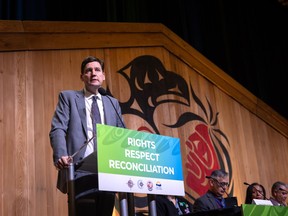
This week, the premier suggested there could be no Indigenous reconciliation without protection for private property.
“Reconciliation must respect private property,” he told the B.C. Chamber of Commerce. “Private, fee-simple property rights are non-negotiable. Whether a family home or an industrial park owned by a business, we will go to the wall to defend private property — full stop.
“The uncertainty this case creates is toxic to the work we have to do, and the economy we have to grow,” added the premier, expanding the perceived threat to the NDP government’s economic agenda.
(Eby has promised to help private property owners affected in the Richmond-area ruling and on Friday told The Canadian Press the government would offer up to $150 million in loan guarantees. He says that could include $100 million in guaranteed financing for Montrose Properties, the biggest private owner in the Aboriginal title area and one that has already run into trouble getting construction loans, and a further $54 million for smaller owners.)
Whatever else one might say about the B.C. NDP government, it has been the most progressive in the country on Indigenous relations. If it fears that agenda is going off the rails, it ought to be taken seriously.
The B.C. Conservative Opposition argues that Eby should have seen this coming, yet failed to take the necessary legal, and litigation steps to head it off. The NDP’s pattern of secrecy and coverup also makes it hard to trust Eby’s good intentions.
Still, on one point this week, Conservative house leader A’a:liya Warbus, a member of the Stó:lō Nation, said much the same thing as the judge in New Brunswick: “I believe that reconciliation is doomed unless we bring a majority of British Columbians along with us.”
Public support is already fraying, evident in the angry comments over the government’s choice of an Indigenous name for the replacement for the Pattullo Bridge. (But as one wag noted, the English translation — Riverview — is that of the former mental hospital, located nearby.)
All these comments about the threat to reconciliation ought to provide a check to Indigenous leaders, their lawyers, and advocates lest they go too far in claiming private property.
The court record here in B.C. raises some concerns as well.
In an early stage of the Haida Aboriginal title claim, B.C. Supreme Court Justice Barbara Fisher turned down an application to notify owners of private property because, “It would be overly burdensome and counterproductive to reconciliation.”
It surely would be counterproductive if people were to discover that their homes and property were at stake. But it is hard to see why a court would choose to keep them in the dark.
In the Cowichan case, Justice Barbara Young rebuked Richmond for claiming that the case risked overturning the entire land registry system, saying the argument “inflames and incites.”
Yet her finding that little remains of the status of private land under Aboriginal title has done more to inflame and incite public opinion in Richmond than anything the city’s lawyers said.
Young also indicated that in the court’s hands reconciliation would be nothing like a win-win proposition.
“To achieve reconciliation, the status quo must change,” she wrote. “In the process of that change, some will bear the brunt.
“Sometimes the hardship will be borne by Indigenous Peoples and First Nations and sometimes it will be borne by non-Indigenous Canadians.”
It was her way of putting private property owners on notice about what could happen if they and their property are delivered into the hands of an activist court.
Get the latest from Vaughn Palmer straight to your inbox