This Day in History, 1927-2025: Stanley Kwok changed Vancouver with Concord Pacific and B.C. Place
Stanley Kwok was a force in developments from Hong Kong to Vancouver
By John Mackie
Last updated 1 day ago
You can save this article by registering for free here. Or sign-in if you have an account.
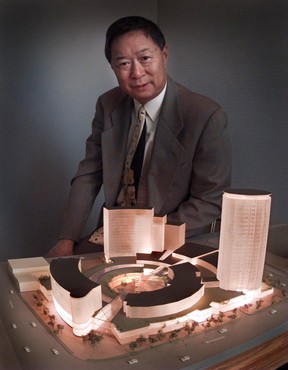
Stanley Kwok didn’t move to Vancouver until he was 41. But he made up for lost time, becoming one of the key players in the redevelopment of the city.

Subscribe now to read the latest news in your city and across Canada.
- Unlimited online access to articles from across Canada with one account.
- Get exclusive access to the Vancouver Sun ePaper, an electronic replica of the print edition that you can share, download and comment on.
- Enjoy insights and behind-the-scenes analysis from our award-winning journalists.
- Support local journalists and the next generation of journalists.
- Daily puzzles including the New York Times Crossword.
Subscribe now to read the latest news in your city and across Canada.
- Unlimited online access to articles from across Canada with one account.
- Get exclusive access to the Vancouver Sun ePaper, an electronic replica of the print edition that you can share, download and comment on.
- Enjoy insights and behind-the-scenes analysis from our award-winning journalists.
- Support local journalists and the next generation of journalists.
- Daily puzzles including the New York Times Crossword.
Create an account or sign in to continue with your reading experience.
- Access articles from across Canada with one account.
- Share your thoughts and join the conversation in the comments.
- Enjoy additional articles per month.
- Get email updates from your favourite authors.
Create an account or sign in to continue with your reading experience.
- Access articles from across Canada with one account
- Share your thoughts and join the conversation in the comments
- Enjoy additional articles per month
- Get email updates from your favourite authors
Sign In or Create an Account
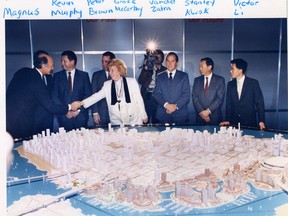
He was president of B.C. Place in the mid-1980s, served on the board of Expo 86, then was part of Concord Pacific’s successful bid to purchase and redevelop the Expo Lands.
“Li Ka-shing would not have won that bid without Stanley’s involvement,” said planner and developer Michael Geller. “And of course, the rest is history, because Li’s decision to buy that property not only resulted in the redevelopment of the north shore of False Creek, it really led to all of the significant Asian investment in Vancouver.”
Kwok passed away Dec. 7, a month shy of his 99th birthday.
“He was almost 100 years old,” marvels architect James Cheng. “Amazing. (He still had) all his faculties. His body gave up on him, but not his brain.”
Metro Vancouver’s focus post-Expo on high-rise condos was often controversial. But Kwok was unapologetic for the way much of the city changed from single-family houses to towers.
“Why stick to the past?” he said to Doug Todd of The Vancouver Sun in 2023.
Stanley Tun-Li Kwok was born on Jan. 2, 1927, in Shanghai, China.
“He was born in the most interesting, turbulent time in China,” said Cheng. “That was right after the revolution (in 1911). The warlords were fighting each other, and Chiang Kai-shek and Mao Zedong were killing each other.
“Yet he was able to go to St. John’s College, which was the first and only English-speaking University in China at the time, in Shanghai. And then he graduated with an architectural degree. He’s one of the first people in China (to have an architectural degree).”
In 1949, Mao’s Communists took over China, and Kwok fled to Hong Kong, where he became a successful architect, designing over 200 buildings and becoming president of the Hong Kong Society of Architects.
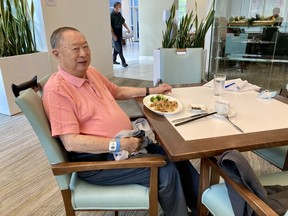
But he was worried about the future for his family, and moved to Vancouver in 1968. In Canada, he focused on development rather than architecture, where he could use his knack for seeing the big picture.
“I think he could see the big picture all his life,” said Cheng. “He was not hung up with, ‘I have to be an architect,’ or ‘I have to do this, I have to do that.’ I think he had enough confidence in himself that he could see the bigger picture, that he can change with the times.”
He started off with Grosvenor International in Canada, and in 1984 was named president of B.C. Place by the provincial Social Credit government. The original concept was to sell off the north side of False Creek bit by bit, but in 1987 the Socreds decided to sell it as one project.
Kwok knew Hong Kong billionaire Li Ka-shing, and left the government to become part of the Concord Pacific bid and development.
“He was the perfect guy, because he had the Hong Kong contacts,” said Geller. “While many people regret what has happened, I think it is important to remember that back in the 1980s, we were all quite flattered and thrilled that someone of Li’s stature would want to invest in our city.”
Having been president of B.C. Place, Kwok knew about the soil contamination from the former industries on the Expo lands. So Geller said Kwok inserted a clause in the Expo deal that “the province would look after the site remediation,” which may have amounted to tens of millions of dollars.
“He was very creative and a very decent guy, but he was very sharp, very sharp, very shrewd,” said Geller.
The tall, slender towers on the Concord lands became the blueprint for much of the city. The waterfront seawall also became a city staple.
The redevelopment brought him international attention.
“If you go to Dubai, there’s a development called Marina City, which is a kind of a copy of the north shore of False Creek, right down to identical balcony rail details along the waterfront,” said Geller. “Stanley Kwok was instrumental in that project as well.”
Kwok is survived by his wife of 35 years, Eva Lee Kwok, and his children Jing Hun, Joanne, Marianne, and Colin. He was predeceased by two earlier wives.