
B.C. says it needs Ottawa’s help to pay for flood risk reduction plan
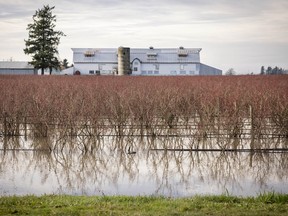
The Fraser Valley was devastated by flooding in 2021 and hit again this month by rains that flooded farmland and resulted in hundreds of evacuations.
Last updated 6 hours ago
You can save this article by registering for free here. Or sign-in if you have an account.
B.C. could have solutions ready next year to reduce flooding in the Fraser Valley, but Ottawa must step up to help fund them because of the scale of the problem, says Kelly Greene, the provincial minister of emergency management and climate readiness.

Subscribe now to read the latest news in your city and across Canada.
- Unlimited online access to articles from across Canada with one account.
- Get exclusive access to the Vancouver Sun ePaper, an electronic replica of the print edition that you can share, download and comment on.
- Enjoy insights and behind-the-scenes analysis from our award-winning journalists.
- Support local journalists and the next generation of journalists.
- Daily puzzles including the New York Times Crossword.
Subscribe now to read the latest news in your city and across Canada.
- Unlimited online access to articles from across Canada with one account.
- Get exclusive access to the Vancouver Sun ePaper, an electronic replica of the print edition that you can share, download and comment on.
- Enjoy insights and behind-the-scenes analysis from our award-winning journalists.
- Support local journalists and the next generation of journalists.
- Daily puzzles including the New York Times Crossword.
Create an account or sign in to continue with your reading experience.
- Access articles from across Canada with one account.
- Share your thoughts and join the conversation in the comments.
- Enjoy additional articles per month.
- Get email updates from your favourite authors.
Create an account or sign in to continue with your reading experience.
- Access articles from across Canada with one account
- Share your thoughts and join the conversation in the comments
- Enjoy additional articles per month
- Get email updates from your favourite authors
Sign In or Create an Account
The region was devastated by flooding in 2021 and was hit again this month by heavy rains that flooded farmland and resulted in hundreds of evacuation orders. Weary farmers and residents have said action is needed now, as they don’t want to continually live with the threat of flooding.

tap here to see other videos from our team.
B.C. says it needs Ottawa’s help to pay for flood risk reduction plan Back to video
tap here to see other videos from our team.
The flood area is also a critical transportation corridor for B.C. and Canada, for highways, rail and pipelines, and provides access to ports that are Canada’s gateway to Asia.
“(The federal government) had significant promises after 2021 and didn’t follow through,” Greene told Postmedia on Thursday.
Greene said that a federal program that helps communities build climate resilience has been retired, which is a problem because the only mitigation assistance now available is through a post-disaster program going forward from April 2025.
So, all the work that has to happen in Abbotsford, Merritt and Princeton has really been orphaned from mitigation dollars, she said.
Merritt and Princeton in B.C.’s Interior were also heavily hit in the 2021 floods.
While Greene pointed the finger at the federal government, spending by her government led by NDP Premier David Eby has fallen far short of what is needed to reduce risks with billions of dollars of needed projects, outlined in a 2022 Postmedia investigation.
And recently, Greene told Metro Vancouver representatives there is no new funding for B.C.’s flood strategy because of the province’s financial woes.
-
Advertisement 1Story continues belowThis advertisement has not loaded yet, but your article continues below.
B.C. has a projected deficit this year of $11 billion, a sharp turnaround under Eby, who was left with a $5.7-billion surplus in 2023 by departing NDP premier John Horgan.
In a written response to Postmedia questions, federal government officials did not say whether B.C. would be provided mitigation funding to reduce flood risks in the Fraser Valley. “(The federal government) does not publicly share details on individual funding applications,” Steve Cloutier, an official with Housing, Infrastructure, and Communities Canada, said in an email.
Cloutier said demand for the disaster mitigation and adaptation fund had surpassed the programs available funds since its launch in 2018.
According to a federal government website, the program, which was funded with $3.86 billion, is fully subscribed and no longer taking applications.
The floods in 2021 and this month were triggered by heavy rains from so-called atmospheric rivers, huge plumes of moisture carried from tropical storms across the Pacific Ocean. The flooding in the Sumas Prairie area in Abbotsford is exacerbated by flood waters that overtop the Nooksack River in Washington State and flow north to B.C.
Climate change is expected to increase the frequency and intensity of the atmospheric rivers.
The group in B.C. working on flood solutions in the Fraser Valley includes provincial officials and representatives of the cities of Abbotsford and Chilliwack, as well as the Sumas, Leq’á:mel and Matsqui First Nations.
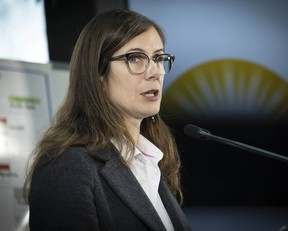
Greene said some elements that are being examined are fish passage and another pump station. Work is also underway on water-flow modelling and an ecological assessment to analyze risks and chart the effects of various solutions.
“We’re looking for a delivery date in the new year. I don’t have an exact timing, but it is a very high priority,” said Greene.
Still, any potential solutions ready next year, which would still need funding, will be delivered five years after the devastating floods of 2021 that caused billions in damages. Any solutions would also take time to implement.
And Greene was less direct on whether B.C. would fund any flood risk reduction solutions delivered in 2026 for the Fraser Valley. She reiterated the need for aid from Ottawa, noting B.C. would be a partner.
She also argued the province has contributed already, including $76 million to upgrade an existing pump station in Abbotsford, which drains low-lying land at risk of flooding into the Fraser River.
Asked whether B.C. will provide money to its flood strategy, the one for which the province told Metro Vancouver officials there was no funding, Greene did not directly answer, saying there is flood-risk mitigation dollars available to communities and the province has funded $400 million in projects since 2017.
However, those dollars are spread over hundreds of projects, and fall far short of community needs, municipal representatives have said.
For example, the money provided in Abbotsford is a fraction of the $1.6-billion pricetag of its flood-reduction plan.
And Delta, which faces flood threats from the Fraser River and the ocean, has an estimated $3 billion in needed flood upgrades.
In Washington State, officials have said that a cross-border plan that might lessen flood waters to B.C. from the Nooksack River could be complete in two years. If such as plan is found feasible, funding would need to be found, and it would take years to implement.
Greene said the cross-border group has been helpful for improving data sharing, with B.C. and Washington State now working off water-flow modelling that aligns on both sides of the border.
She said the federal government could also play an important roll in the cross-border group.
The cross-border group includes provincial, state, municipal and First Nation representatives, but none from the U.S. or Canadian governments.