
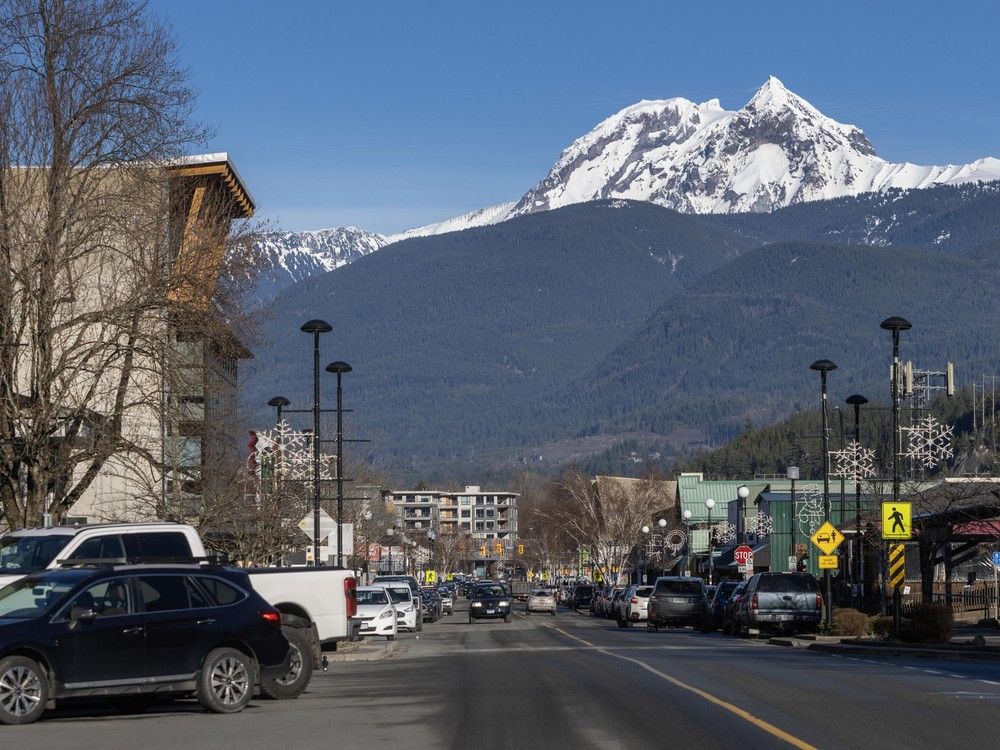
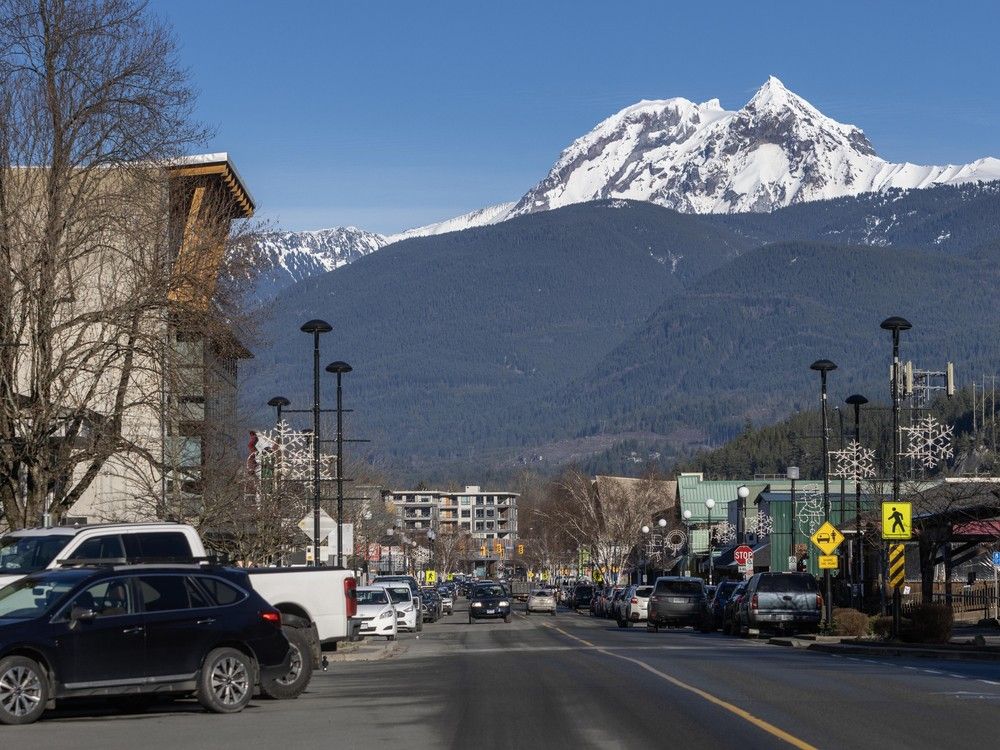
Five years ago, it was an anomaly if a home in Squamish sold for more than $2 million, says local Realtor Lisa Bjornson.
Not anymore.
Last year, the District of Squamish recorded 37 home sales over $2 million — plus four over $3 million, said Bjornson, managing broker of Black Tusk Realty, the longest-running locally owned and operated brokerage in Squamish.
A four-bedroom, 3,979 square foot home in Squamish is currently listed for sale at $6.85 million.
That’s an outlier, at the very high end of the market for the District of Squamish.
But, Bjornson says, “five years ago, nobody would have contemplated that type of build in Squamish. That’s a West Vancouver build, that’s a Whistler build … It just speaks to how people feel about the community now, they’re prepared to build nice houses and come here to live.
“It’s just speaking to what Squamish has become,” said Bjornson, who has lived in Squamish for 40 years and seen the former logging town go through mill closures, population downturns, and, more recently, the boom. “We’ve come into our own.”
While
B.C. Assessment’s residential property valuations for this year
show a general trend of declining values across almost all jurisdictions and housing types throughout B.C.’s Lower Mainland, a few smaller markets were outliers.
Squamish’s population has grown by almost 50 per cent over the last decade to around 28,000 people. It’s not necessarily a lower-cost option: B.C. Assessment’s median condo and townhouse value in Squamish is $848,000 for 2026, higher than the City of Vancouver or North Vancouver City.
“It’s about lifestyle,” Bjornson said. “People want to be here.”
Across B.C. Assessment’s Lower Mainland region — which stretches from Hope in the east, through Metro Vancouver and up to Pemberton in the north — almost every jurisdiction saw detached house values decline or stay flat, but the Village of Anmore (with a population of around 2,600) saw a four per cent increase year-over-year.
For the “attached” category, which includes duplexes and townhouses, there were declines in median values across almost all Lower Mainland municipalities, including year-over-year drops as low as 5.8 per cent in Richmond and 5.5 per cent in Surrey, but Bowen Island (population 4,700) saw a 2.3 per cent increase.
And Squamish was the only jurisdiction out of 32 in the Lower Mainland to see increases across all three housing categories: detached houses, attached units and condos.
Analysis of the new B.C. Assessment data by the Landcor Data Corp. shows a general trend of decline across different parts of the region and different housing types. In bigger markets like Vancouver, Surrey and Richmond, all housing types saw declines in median values, with similar rates of decline in each city for strata units with one, two or three-plus bedrooms.
The rise of remote-work could be a factor behind certain municipalities bucking the general downward trend, said Landcor CEO Jeff Tisdale. If people no longer need to commute five days a week to an office in an urban centre, they might be inclined to move to somewhere where they like the setting and lifestyle more.
“I love trail running and mountain biking, and I’m fortunate enough to be in a role where I can work remotely,” said Tisdale, who lives in Abbotsford. “So if I my druthers between dealing with downtown or living in Squamish, it’s a pretty easy call.”
Tisdale cautioned against reading too much into year-over-year property value trends in such small markets, where “a couple of unique sales are going to skew the numbers.”
Still, Tisdale said, the two other Lower Mainland municipalities that didn’t report declining median values, Anmore and Bowen Island, also offer appealing settings for people who can work from home in a pleasant setting surrounded by nature.
“If you’re into the outdoors and you’ve got the luxury to work from home, why would you want to deal with traffic and all that hubbub?” Tisdale asked.
B.C. Assessment’s 2026 property assessments for about 1.14 million properties across the Lower Mainland reflect market values as of July 1, 2025.
The declines in median values aren’t particularly surprising, said Brendon Ogmundson, chief economist for the B.C. Real Estate Association, considering how weak the home sales market was in 2025 — especially in the first half of the year, when uncertainty related to U.S. tariffs kept a lot of buyers on the sidelines.
“Given how weak sales were … it’s surprising how resilient prices were, in the face of a lot of headwinds,” Ogmundson said.
With files from Nathan Griffiths