Vancouver council’s eagerness to transform its industrial land is causing alarm and bewilderment among local city planners.
This week, Vancouver city council made the rare decision to go against the advice of city staff, approving a developer’s proposal to build a residential tower on a property zoned for industrial use.
For some local urban planning experts, it came as a disappointing validation of the
they’ve had since
, when council directed staff to explore allowing residential development in certain industrial areas.
Tuesday’s decision to approve the developer’s unusual proposal was unanimous, though some of them said they struggled with the decision. Councillors acknowledged city planning staff’s concerns about impacts on the local economy if they allow residential use to encroach on industrial-zoned lands, but they also said the changing nature of industry necessitates a modernized approach.
At the public hearing, Strand Development was proposing to build a 25-storey tower with a six-storey podium at 320 West 2nd Ave., in Mount Pleasant’s industrial area. The lower three levels would be reserved for industrial use, with 200 market rental homes in the upper floors.
City staff recommended against approval, noting that residential use is prohibited on the site and “the inclusion of housing is incompatible with the goal of preserving industrial and employment land in the city.”
About 90 per cent of Vancouver’s land base is zoned for residential use, the staff report says, and only six per cent is zoned for industrial.
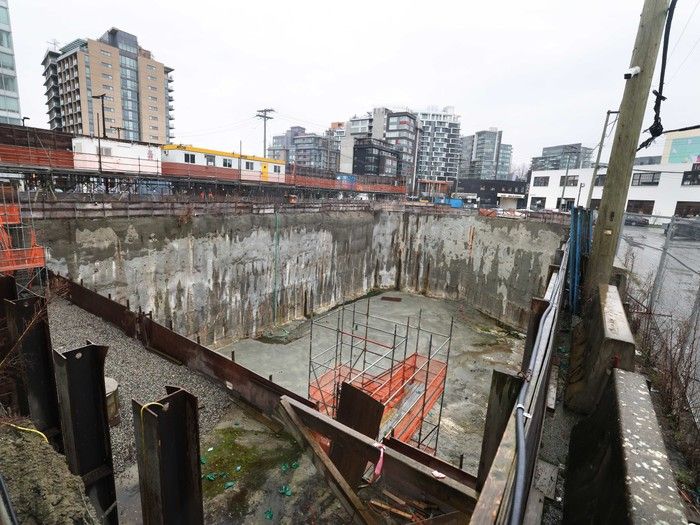
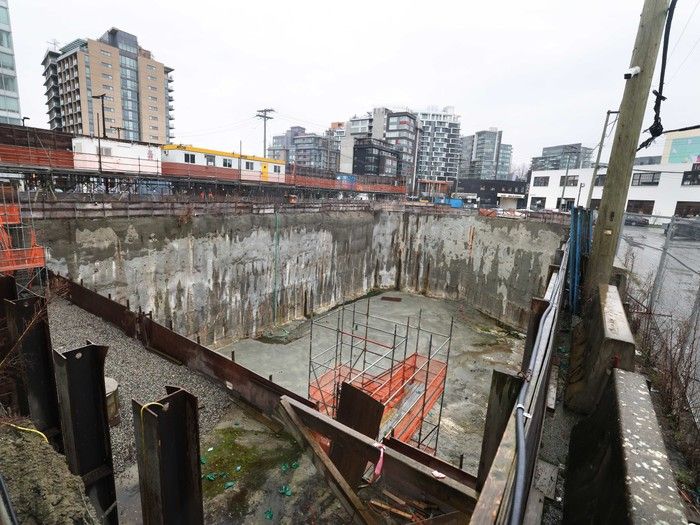
Strand previously obtained a building permit in 2021 for an industrial office building on the West 2nd site, and began excavating there in 2023.
But the struggling office market post-COVID-19 meant there was no interest in the project, Strand’s CEO Mike Mackay told Postmedia Wednesday.
“It was absolutely crickets,” Mackay said. “So we went back to the drawing board.”
The Strand property is a short walk from a rapid transit station, Mackay said, and across the street from existing residential towers on the north side of West 2nd.
Strand came back in 2024 with a new application for a mixed-use project and tried to work with city staff, but “it was very clear early last year that things were not really being moved along,” Mackay said. “So we really had to bring things to a head by saying to staff: ‘We need to get this before council, and let the cards fall where they may.’”
The path for this application was laid by a motion introduced last July by ABC Vancouver Mayor Ken Sim and supported unanimously, directing city staff to explore ways to “intensify” and potentially add residential development to five industrial zones around town, including the Mount Pleasant industrial area where Strand’s property is located.
With Strand’s application this week, city staff presented three options for council. Staff’s preferred recommendation was for council to refer Strand’s application back to staff for future consideration as part of the ongoing work on the future of those five industrial areas.
The second option was for council to reject the rezoning application.
The third option was for council to support the application, which would then mean seeking approval from Metro Vancouver’s board of directors to re-designate the land from industrial to general urban.
Council ended up creating a fourth option, which was proposed by ABC Coun. Sarah Kirby-Yung at the end of Tuesday’s meeting. Kirby-Yung proposed council could invoke something called the “municipal flexibility clause,” which enables council to change the use of industrial properties of a certain size without the approval of Metro’s board.
The municipal flexibility clause is not a well-known or commonly used mechanism. Speaking Wednesday, Kirby-Yung commented that she could not recall seeing a use of the clause during her two terms on council.
“Council exercised its discretion in a very unique and exceptional circumstance for this one specific project,” said Kirby-Yung.
Kirby-Yung’s amendment also included language, based on city staff’s guidance, meant to send a signal to the broader development community that Strand’s application was a unique situation, and these kinds of changes were not going to become frequent. This included directing staff “to not recommend further use of the municipal flexibility clause” for these kinds of rezonings until after staff report back about the future of the Mount Pleasant industrial area.
Kirby-Yung said she believes in the value of preserving industrial and employment space, but that the city’s approach to this zoning needs to modernize, which could, in some cases, include allowing residential or other uses.
Some local urban planning experts had publicly urged council to follow staff’s advice and not approve Strand’s application.
Christina DeMarco, a former planner with both the City of Vancouver and Metro Vancouver, called council’s decision “reckless and short-sighted.”
“Last night, the city changed direction on a policy that’s been in place for 30 years on protecting industrial land,” DeMarco said.
While Strand’s proposal includes industrial space on the lower levels of the building, DeMarco said that the amount of industrial uses possible there will be severely limited by having homes above.
Despite council’s statement attempt to signal this was a unique one-off, DeMarco believes the decision “will send out the signal that industrial land is up for grabs for residential developers.”
And when developers believe industrial properties could be made available for more profitable residential building, it can lead to speculative activity, driving up the cost of land and driving out the kinds of industrial uses that are needed for a well-functioning city, she said.
“It’s a risky experiment,” DeMarco said. “There could be a chain reaction of more rezonings to come.”