
‘Monstrosities’ or the evolution of housing? Multi-unit buildings on single-family lots gain traction in B.C. cities
The number of multi-unit developments on single-family lots is increasing in B.C. neighbourhoods dominated by single-detached houses. Opinions vary over what these changes will mean for communities.
By Dan Fumano
Last updated 2 days ago
You can save this article by registering for free here. Or sign-in if you have an account.
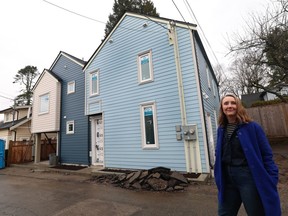
Byron Cook has lived in the same house in North Burnaby for more than four decades. He loves his neighbourhood and knows it like the back of his hand.

Subscribe now to read the latest news in your city and across Canada.
- Unlimited online access to articles from across Canada with one account.
- Get exclusive access to the Vancouver Sun ePaper, an electronic replica of the print edition that you can share, download and comment on.
- Enjoy insights and behind-the-scenes analysis from our award-winning journalists.
- Support local journalists and the next generation of journalists.
- Daily puzzles including the New York Times Crossword.
Subscribe now to read the latest news in your city and across Canada.
- Unlimited online access to articles from across Canada with one account.
- Get exclusive access to the Vancouver Sun ePaper, an electronic replica of the print edition that you can share, download and comment on.
- Enjoy insights and behind-the-scenes analysis from our award-winning journalists.
- Support local journalists and the next generation of journalists.
- Daily puzzles including the New York Times Crossword.
Create an account or sign in to continue with your reading experience.
- Access articles from across Canada with one account.
- Share your thoughts and join the conversation in the comments.
- Enjoy additional articles per month.
- Get email updates from your favourite authors.
Create an account or sign in to continue with your reading experience.
- Access articles from across Canada with one account
- Share your thoughts and join the conversation in the comments
- Enjoy additional articles per month
- Get email updates from your favourite authors
Sign In or Create an Account
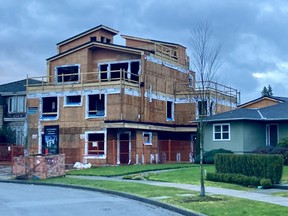
Lately, he’s dismayed at the new buildings going up. He calls them “monstrosities,” a wave of three- and four-storey buildings with three or four homes in each, mostly replacing old post-Second World War bungalows and looming over neighbouring houses.

tap here to see other videos from our team.
‘Monstrosities’ or the evolution of housing? Multi-unit buildings on single-family lots gain traction in B.C. cities Back to video
tap here to see other videos from our team.
“Pretty well every block’s got one or two of these things going up here all of a sudden. … They’ve just totally distorted the whole neighbourhood,” Cook says. He worries the new buildings will make parking and traffic worse, and will cast shade on neighbouring properties.
“It’s just a tragedy.”
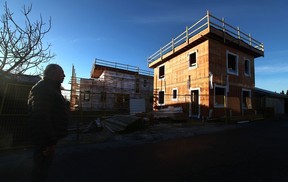
These kinds of projects have often been described as “missing-middle” housing. It’s in the middle in terms of density, between a single-family house and a highrise. And it’s missing, because this building type has been historically scarce in most North American cities.
For years, many urban planning experts have promoted the value of missing-middle housing and urged governments to encourage these kinds of buildings. These developments could provide more affordable options than detached houses, the argument goes, and they provide ground-oriented housing types favoured by many buyers and renters, while not transforming existing neighbourhoods as much as highrises.
That’s why the B.C. NDP released legislation, announced in 2023, forcing municipal governments to update their zoning by July 2024 to allow at least three or four homes per residential lot, and six units per lot in areas close to frequent transit. The province calls them small-scale, multi-unit housing developments and many municipalities are now calling them “multiplexes.”
-
Advertisement 1Story continues belowThis advertisement has not loaded yet, but your article continues below.
In effect, B.C. ended the ability of city halls to zone some of their residential neighbourhoods exclusively for single-detached houses, following similar reforms in other jurisdictions in Canada, the U.S., and overseas.
Now, 1½ years after provincial legislation allowed these kinds of projects, the buildings are taking shape and the reception has not always been warm.
Cook’s neighbour launched a petition urging Burnaby city hall to stop these “oversized, inappropriate multi-family homes.”
In October, Burnaby council responded to public pressure and approved bylaw amendments to reduce allowable building heights and sizes.
But many Burnaby residents are still upset, as are some other British Columbians.
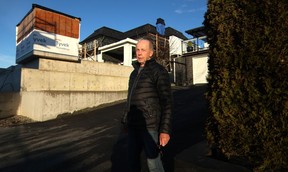
Some municipal leaders — including Burnaby Mayor Mike Hurley — have called for the B.C. NDP to change course. The B.C. Conservatives have pledged to repeal the missing middle legislation if they form government.
But many other British Columbians — including many who live in the multi-unit housing or would like to — are applauding the NDP for maintaining its commitment to them. Some polling suggests this type of densification is popular with many B.C. residents, and the opposition might be a vocal minority.
Christine Boyle, B.C.’s minister of housing, has rejected calls to repeal the upzoning law, known as Bill 44, as well as her party’s other recent housing reforms, saying: “We’re not going backward.”
But despite the province’s commitment to multi-unit housing, the Ministry of Housing confirmed it does not currently track how many of these buildings are being approved or completed in B.C. cities, or where.
Postmedia News requested housing permit data from five of B.C.’s most populous municipalities, including three — Kelowna, Victoria, and Vancouver — that legalized such housing on their own before Bill 44, and two — Surrey and Burnaby — whose mayors have criticized the provincial legislation.
Burnaby:
Since the new zoning came into effect in July 2024, Burnaby has issued 126 permits for multi-unit homes that would not have been allowed under the old rules. That represents about 40 per cent of all building permits issued in those residential areas during that time.
Burnaby’s recent move to shrink the allowable building sizes has not stopped developer interest. Since the amended bylaw came into effect on Dec. 10, the city has processed eight new building permit applications, with another 15 pending review.
Kelowna:
The central Okanagan city has been a leader on this kind of housing in B.C. Since 2018, Kelowna has issued 476 building permits issued for what the city calls “ground-oriented infill” projects. The term infill refers to increased density on single-family lots.
Kelowna had a 155 per cent increase in the number of infill applications in the year after new zoning was implemented in March 2024, as compared to the year before. Between January 2020 and June 2025, 433 of these buildings (totalling 1,713 units) were completed.
Vancouver:
Since November 2023, when the city started accepting applications for the multi-unit buildings, the city has received 549 applications for them, 218 of which have been approved, and 22 projects (totalling 78 homes) have been completed.
Victoria:
The City of Victoria was ahead of the curve on missing-middle housing, passing its own policies in January 2023 to enable it. But builder interest was scarce, with city hall receiving only three applications for medium-density projects in the first six months of the new policies.
Responding to developer comments, Victoria council overhauled its missing-middle policy in December 2023. Since then, the city has received 38 applications for missing-middle projects, and issued building permits for 10, most of which were in 2025.
Surrey:
Since July 2024, Surrey has received 604 new applications for small-scale, multi-unit projects, and issued 317 building permits, totalling 658 homes. Most of these projects are coach houses, garden suites, and duplexes with suites (under the pre-2024 zoning, duplexes were not allowed to have secondary suites). Only 17 of the new applications received are for what Surrey calls a “houseplex,” which has three or four units.
‘A long history’ of urban change
Akua Schatz, who has had experience with gentle urban densification on the personal, academic, and professional levels, sees the current backlash as an unfortunate, but temporary, transitional period.
“We’re in the most disruptive phase right now,” she said.
Construction is inevitably annoying for neighbours, she said, and it’s not uncommon for longtime residents to feel uneasy when a new type of home or building appears in an area that hasn’t seen much change in a while.
“There’s a long history of this,” Schatz said.
When Schatz and her partner moved from Ontario to Vancouver, they needed an affordable place to live while they were both getting started in their careers and she was completing grad school. They moved into the basement suite of his parents’ house in Dunbar on Vancouver’s west side. It was 2007, only three years after Vancouver council legalized basement suites citywide.
Two years later, in 2009, Vancouver approved a new housing form: the laneway house. So Schatz and her family built one of the first laneway houses in Vancouver on the Dunbar property, where they raised their first child.
Vancouver city hall’s 2004 decision to legalize basement suites in all homes was contentious, as was the 2009 decision to allow laneway houses. There was also backlash against the Vision Vancouver-majority council’s decision in 2018 to allow duplexes on single detached lots throughout most residential neighbourhoods.
All those new housing types were met with sometimes fierce opposition, which soon gave way to widespread acceptance, said Schatz, who wrote her masters thesis on the history of neighbourhood opposition to densification in Dunbar.
Since 2024, Schatz has been a partner at Smallworks, a Vancouver-based company that was an early specialist in designing and building laneway homes and now builds various kinds of infill developments, including small multi-unit buildings.
These, she says, are the latest chapter of this evolution.
“It will always be a bit of a painful process. These multiplexes are just getting built, they’re not even occupied yet, they don’t have the nice landscaping,” Schatz said. After the buildings are complete and people move in, she predicts that neighbours will view these new buildings differently.
“Six months after occupation, it’s a very different environment. You’re seeing the people who are able to live there, seeing their contributions to the community, you’re excited to see the reintegration of younger families and young professionals who can stay in the city. Suddenly, it starts to shift your understanding about the role of this housing. But we’re in the mess right now.”
Dan Winer, co-executive lead at Small Housing B.C., an advocacy group that promotes “gentle density,” acknowledges that some photos recently making the rounds online, showing tall, boxy buildings towering over neighbouring bungalows, can look jarring.
“But it’s a challenge to create something that is sustainable and affordable while maintaining the esthetics of yesterday,” Winer said. “So we’re in a balancing act, and all parties need to find compromise.
“While there is a section of the community worried about change in their neighbourhoods, based on our polling and research, they represent a vocal minority. At the end of the day, many people desire these homes.”
Small Housing B.C. commissioned a poll last year conducted by Leger, which found 83 per cent of respondents support or strongly support small-scale multi-unit housing in their neighbourhood, compared to 85 per cent support for single detached housing, 72 per cent for mid-rise apartments, and 48 per cent for highrise towers.
There are still obstacles facing these developments, such as the challenges for builders seeking construction financing for this type of development, Winer says, and all levels of government still need to resolve the long-standing issue of how to fairly and sustainably finance infrastructure for growing communities.
But, Winer says, Bill 44 represents a “transformational, generational opportunity to rethink how we build housing in the communities that we know and love.”
A different survey by Leger, conducted last month on a range of topics, found something similar among Vancouver and Surrey residents.
When Leger asked residents of B.C.’s two largest cities which approach they prefer to development, almost half of respondents chose four- to six-storey buildings — taller than most multi-unit projects currently being built through the new zoning — spread across neighbourhoods.
In both cities, more respondents preferred this medium-density approach than the next two choices combined: only about a quarter of respondents preferred concentrating new housing in highrises at transit hubs, and 14 per cent chose “maintain existing low-density character, even if that limits growth.”
Boyle, the housing minister, was not made available for an interview to discuss missing-middle housing. In an emailed statement, she said she was pleased to see builders show interest in this kind of housing and the actions of local governments to support it.
“The intent of small-scale multi-unit housing is to open the door to more types of homes being built across B.C. faster, providing more choices for families, workers and people of all ages to find homes that meet their needs,” Boyle said. “We will continue to work with everyone who wants to make housing more available so families can afford to live in the communities they grew up in.”
B.C. Conservative housing critic Linda Hepner said her party is committed to repealing Bill 44 if it forms a government.
“While we would be in favour of densification, particularly around transit areas, the actual job of designing neighbourhoods is local governments’,” said Hepner, a former Surrey mayor and councillor.
Hepner is not surprised that some residents and municipal politicians are up in arms about the province’s medium-density legislation.
“This policy is very indicative of when you do something by edict and not by conversation,” she said. “This is usurping all that local government is. The very nature of what they do is create community. … So then when you take a more senior level of government saying to you: ‘Thou shalt do this,’ you are bound to have these very issues.”
Hepner recalls while she was on city council and Surrey legalized secondary suites in homes in 2010.
That decision faced significant opposition, she recalls. But it was made by a local council, not the provincial government.
“You don’t get a provincial government deciding what a community looks like, you have local government — that’s why they’re elected, that’s why they exist,” Hepner said.
B.C. mayors and city councillors who oppose the B.C. legislation are likely trying to ensure local voters know that the province — not their city hall — is behind the changes, Hepner said.
“We’re heading into an election year for local government,” Hepner said. “I expect that’s why some (municipal politicians) are out of the gate early saying: ‘Hey, this isn’t working in our community, and we know it isn’t working in our community — don’t lay it our feet.”
‘People now have options’
Back in 2019, architect Xeniya Vins and her husband, a civil engineer, bought a house in the Victoria-area township of Esquimalt. The 6,000-square-foot lot was too small to develop townhouses, so they decided to build a second house on the property while retaining the exiting house. At the time, that required subdividing the lot, which meant appearing before Esquimalt council for a series of approvals that took nearly three years.
“It was an uphill battle,” Vins said.

When the new house was completed in late 2023, the couple and their children moved into its upper floor, and her parents into the lower floor, while the original house on the lot was rented.
Around that time, the discussion around missing middle development was picking up steam around B.C., Vins recalls, and “it was a very quickly shifting landscape.”
The City of Victoria had approved its own missing-middle housing program earlier that year, and the B.C. government announced Bill 44 in November 2023, pushing cities to update their zoning by the following summer.
Vins started hearing from people who had inherited a property from their grandparents and wanted to explore its potential. Others were longtime Victoria-area homeowners interested in adding units to their property for their adult children and grandchildren. Some were small-scale builders looking to buy and develop properties.
Now, between Vins’s architectural consulting work and the company she started with her husband, called Xquimalt Developments, she has more than a dozen projects underway in Esquimalt and Victoria, most of which have four to six units each, on former single-family lots.
Bill 44 opened up new possibilities for Vins’s property, and after Esquimalt updated its zoning in 2024, she submitted the municipality’s very first fourplex application. With no need to seek council’s approval this time, she had a development permit in hand within two months.
Xquimalt has completed other multi-unit projects in recent years, including an eight-unit, three-storey infill project completed last year two blocks away from Vins’s home. That project included small (930 sq. ft.) three-bedroom homes for $675,000, and larger three-bedroom homes (1,325 sq. ft.) for $890,000.
That’s not cheap compared to real estate in some Canadian cities.
But a single-detached house with the same number of bedrooms in the same part of Esquimalt could cost nearly twice as much, Vins said. While that detached house would likely have more square footage and more private outdoor space than homes in her multi-unit development, it is only affordable to a much smaller percentage of people, she said.
“Now we’re having smaller units that are more compact, that don’t need as much land, and they’re coming in at prices that young families can afford,” Vins said. “There’s huge value in that. People now have options. … The variety of units this can bring is going to be great.”
That’s why Vins believes that despite the pushback from some residents and certain mayors, “the province absolutely needed to push all these municipalities” with Bill 44.
Vins described Bill 44 as “aggressive,” but necessary.
B.C.’s most populous metropolitan areas are patchworks of municipalities, so if certain municipalities resist change, it puts undue pressure on others, she said, and does not help regions grow in a more sustainable way.
“The positives are very clear to me: more choice, cheaper overall housing, and small-scale enough that it doesn’t drastically change communities and streets,” she said.
A decade ago, Kelowna became B.C.’s first major city to make sweeping changes enabling medium-density housing, pre-zoning 800 residential lots in 2016 to allow four homes on each.
At first, the building industry did not know exactly what to do with this new housing type, recalls James Moore, Kelowna’s housing policy manager.
“The market had to figure out what it wanted to do,” he said. The city had only a handful of applications for multi-unit infill projects over the first couple of years, but after those were completed successfully around 2018, “everybody else jumped in and suddenly there were a lot more projects happening, and that has continued on since then.”
Last year, out of the building permits issued for 1,773 homes in Kelowna, about 10 per cent were for developments of between two and four units, compared with about 16 per cent of permits for single-family detached houses. The majority of residential units permitted last year in Kelowna were apartments and condos, most of which are in buildings of six storeys or higher.
Despite being a trailblazer in this area among B.C. cities, the changes seem to have been relatively uncontroversial in Kelowna, Moore said.
Some of that could be attributed to Kelowna’s “iterative approach,” he said, testing new things, and adjusting to respond to the needs of both industry and community.
Back in the 1990s, Kelowna became one of B.C.’s first cities to allow secondary suites in carriage houses, long before Vancouver’s first laneway houses started going up in 2009.
“In-fill has happened gradually over time in Kelowna. … People know what it feels like, and that it doesn’t happen all at once, so it’s less scary,” Moore said. Some other areas, like suburban Metro Vancouver neighbourhoods that have had nothing but single-detached bungalows since they were built in the last century, feel like they’re “going from zero to 100, overnight.”
Some multi-unit developments, depending on their size and location, still draw local opposition in Kelowna, as they do in any city, Moore said. “But for the most part, where fourplexes and sixplexes go in, it is routine. Ordinary. Expected.”
Get the latest from Dan Fumano straight to your inbox