
North Vancouver District faces big bill for girl injured in crosswalk obscured by greenery
B.C. Supreme Court judge ruled district was 70 per cent responsible because it was negligent for not properly clearing branch growth around crosswalk, and driver 30 per cent liable for hitting girl.
Last updated 1 day ago
You can save this article by registering for free here. Or sign-in if you have an account.
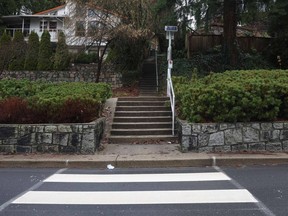
The District of North Vancouver must pay more than two-thirds of a $3.6 million damage award for a girl who suffered permanent brain damage when she was hit by a vehicle in a crosswalk where the municipality had failed to properly trim greenery that obstructed visibility.

Subscribe now to read the latest news in your city and across Canada.
- Unlimited online access to articles from across Canada with one account.
- Get exclusive access to the Vancouver Sun ePaper, an electronic replica of the print edition that you can share, download and comment on.
- Enjoy insights and behind-the-scenes analysis from our award-winning journalists.
- Support local journalists and the next generation of journalists.
- Daily puzzles including the New York Times Crossword.
Subscribe now to read the latest news in your city and across Canada.
- Unlimited online access to articles from across Canada with one account.
- Get exclusive access to the Vancouver Sun ePaper, an electronic replica of the print edition that you can share, download and comment on.
- Enjoy insights and behind-the-scenes analysis from our award-winning journalists.
- Support local journalists and the next generation of journalists.
- Daily puzzles including the New York Times Crossword.
Create an account or sign in to continue with your reading experience.
- Access articles from across Canada with one account.
- Share your thoughts and join the conversation in the comments.
- Enjoy additional articles per month.
- Get email updates from your favourite authors.
Create an account or sign in to continue with your reading experience.
- Access articles from across Canada with one account
- Share your thoughts and join the conversation in the comments
- Enjoy additional articles per month
- Get email updates from your favourite authors
Sign In or Create an Account
The girl, named only as H.D. in the B.C. Supreme Court judgment, was seven and sustained a “very significant traumatic brain injury.”
H.D., now 17, was awarded $2 million for future care, $1.25 million for loss of future income, and $350,000 for pain and suffering, according to the judgment released Jan. 30.
Justice Elin Sigurdson found the municipality was 70 per cent responsible, the driver 30 per cent responsible, and that H.D. bore no legal responsibility for her injury. It means the district is on the hook for just over $2.5 million.
H.D. was walking to Carisbrooke Elementary school on June 12, 2015, excited for a sports day, when she was hit by a van in a crosswalk on East Braemer Road, midblock between St. Andrews and St. Georges avenues, wrote Sigurdson.
“At the time of the accident, the pedestrian walkway and stairs (leading to the crosswalk) were lined with greenery,” Sigurdson wrote. “The street is lushly treed and the side of the road on which the footpath sits is forested and verdant. In June 2015, that greenery was abundant.”
She concluded the growth of ivy, branches and leaves around the stairway leading to the crosswalk “impeded visibility of important views” for pedestrians and drivers. And she found the maintenance of the area didn’t meet the district’s duty of care, particularly since the crosswalk was used by schoolchildren.
John Morrall, a traffic engineering expert, testified the location of the crosswalk wasn’t ideal because there were limited visual clues to alert drivers to it, such as flashing lights.
-
Advertisement 1Story continues belowThis advertisement has not loaded yet, but your article continues below.
And he told court the speed limit should have been 40 km/h, the lack of lights meant speeding wasn’t discouraged, and the stopping distance after the crosswalk became visible was inadequate at 70 metres. Plus, he said the vegetation was overgrown, obstructing visibility of the path leading to the crosswalk.
The attending RCMP officer also testified the vegetation posed a safety concern.
About a week before the girl was hit, a district employee trimmed back some of the vegetation, especially around the pedestrian-crossing sign. But his supervisor said that work had been inadequate and he “should have called the transportation department to alert them of sightline issues, as they were relying on him to do,” wrote Sigurdson.
The plaintiff alleged the district was negligent and liable for damages because it failed to clear vegetation, to design and build the crosswalk to ensure it didn’t create a hazard, to take steps to prevent injury to users or to put up proper signage, according to the judgment.
Sigurdson also found the driver, William Neill, was 30 per cent responsible for the crash. He testified he knew of the crosswalk but not of the path leading to it.
But the judge ruled he should have been “alive to the fact” there was a path to the crosswalk or that users of the crosswalk might be approaching it, concluding he made an “incorrect and negligent assumption that there was nothing there but vegetation.”
Neill testified he was driving 55 km/h in the 50 km/h zone, but an expert witness for H.D. concluded Neill was travelling at 70 km/h.
And even though he hit the brakes 34 metres before the crosswalk, he was moving at 54 km/h at impact, sending H.D. flying 25 metres, Sigurdson wrote.
Legally, H.D. could have been found negligent and the district argued she should assume some responsibility for the crash.
But Sigurdson said the district hadn’t proved on a balance of probabilities that she was negligent and that she had failed to exercise the care expected of a child of her age, intelligence and experience.
The district is reviewing the decision and has no comment on it, spokesman Ryan Schaap said in an email.
“Any accident involving a person, particularly a child — no matter the circumstances — is upsetting,” he said. “We do our best every day to ensure our community’s safety and well-being.”