
B.C. environmental groups sue federal government over alleged failure to protect southern mountain caribou
Southern mountain caribou have been classified as threatened under Canada’s Species at Risk Act for more than two decades. Eight herds have already gone extinct.
Last updated 7 hours ago
You can save this article by registering for free here. Or sign-in if you have an account.
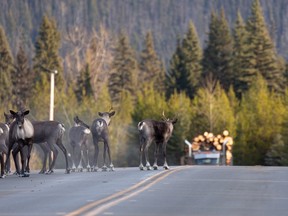
Several B.C. environmental groups are suing the federal government over delays in protecting southern mountain caribou, which have been listed as a threatened species for more than two decades.

Subscribe now to read the latest news in your city and across Canada.
- Unlimited online access to articles from across Canada with one account.
- Get exclusive access to the Vancouver Sun ePaper, an electronic replica of the print edition that you can share, download and comment on.
- Enjoy insights and behind-the-scenes analysis from our award-winning journalists.
- Support local journalists and the next generation of journalists.
- Daily puzzles including the New York Times Crossword.
Subscribe now to read the latest news in your city and across Canada.
- Unlimited online access to articles from across Canada with one account.
- Get exclusive access to the Vancouver Sun ePaper, an electronic replica of the print edition that you can share, download and comment on.
- Enjoy insights and behind-the-scenes analysis from our award-winning journalists.
- Support local journalists and the next generation of journalists.
- Daily puzzles including the New York Times Crossword.
Create an account or sign in to continue with your reading experience.
- Access articles from across Canada with one account.
- Share your thoughts and join the conversation in the comments.
- Enjoy additional articles per month.
- Get email updates from your favourite authors.
Create an account or sign in to continue with your reading experience.
- Access articles from across Canada with one account
- Share your thoughts and join the conversation in the comments
- Enjoy additional articles per month
- Get email updates from your favourite authors
Sign In or Create an Account
Ecojustice — representing Stand.earth, Wildsight and the Wilderness Committee — filed a lawsuit in Federal Court on Monday against Canada’s Environment Department, alleging it has delayed mapping the animal’s critical habitat for more than 11 years.
The groups say habitat mapping is a necessary first step under the Species at Risk Act to protect and recover caribou and other threatened and endangered species.
The department released a recovery strategy in 2014 for the animals that included partial habitat mapping by the end of that year.
But more than a decade later, the groups say nothing has been done.
More than 11 years have passed since the Dec. 31, 2014, deadline and the minister has not yet published an amended recovery strategy or one or more plans “that fully map and otherwise fully identify critical habitat” for southern mountain caribou, the lawsuit states.
Caribou are now disappearing because of habitat loss from logging and other industrial development in southern and central B.C. Eight of 18 herds are already extinct.
Lawyers for the environmental group are seeking an order declaring that the delay in mapping the habitat is unlawful.
Ecojustice lawyer Sean Nixon contends the government’s continuing failure to finish habitat mapping for these caribou is causing “serious harm to an iconic Canadian species.”
The federal department said in an emailed statement that the southern mountain caribou are the subject of three conservation agreements with the province and First Nations.
-
Advertisement 1Story continues belowThis advertisement has not loaded yet, but your article continues below.
The department said under these agreements, the amount of habitat protected has increased, and “some caribou populations are increasing in size thanks in part to maternity pens, supplemental feeding and predator management.”
“Mapping to refine the identification of critical habitat for southern mountain caribou is underway,” the department said. It did not provide a timeline for when that work was expected to be complete.
During the delay, logging and industrial development have continued across caribou habitat. Old-growth forests have been clearcut, and remaining herds pushed closer to extinction, the groups say.
“We cannot allow more localized extinctions to happen; the federal government must step up and fulfil its responsibility to protect this iconic and threatened species,” said Eddie Petryshen, a conservation specialist at Wildsight.
Tegan Hansen, a senior forest campaigner at Stand.earth, said 11 years is far too long to wait for the government to fulfil its pledge to map the habitat.
Hansen said while the department drags its feet, some southern mountain caribou herds have vanished.
“It shouldn’t take a lawsuit for the government to meet its obligations, but we don’t have another decade to waste if we want this species to survive. That’s why we’re headed to court.”
A report last year from the same environmental groups showed that B.C. plans to log old-growth forest in endangered southern mountain caribou habitat, despite commitments to conserve these forests.
The report used provincial satellite data to show that 57 square kilometres of old-growth forests were either approved or pending approval for logging in the ranges of three endangered caribou herds: the Columbia North, Groundhog and Wells Gray South herds.