B.C. public sector contracts could increase by roughly $16 billion over next four years
The province, already facing a record $13.3 billion deficit, is hoping to partially offset costs by eliminating 15,000 positions
By Alec Lazenby
Last updated 8 hours ago
You can save this article by registering for free here. Or sign-in if you have an account.
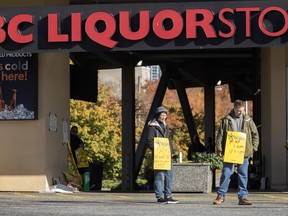
The amount of money the B.C. government is spending on salaries for public-sector employees could increase by roughly $16 billion over the next four years, putting additional pressure on a projected $13.3 billion deficit.

Subscribe now to read the latest news in your city and across Canada.
- Unlimited online access to articles from across Canada with one account.
- Get exclusive access to the Vancouver Sun ePaper, an electronic replica of the print edition that you can share, download and comment on.
- Enjoy insights and behind-the-scenes analysis from our award-winning journalists.
- Support local journalists and the next generation of journalists.
- Daily puzzles including the New York Times Crossword.
Subscribe now to read the latest news in your city and across Canada.
- Unlimited online access to articles from across Canada with one account.
- Get exclusive access to the Vancouver Sun ePaper, an electronic replica of the print edition that you can share, download and comment on.
- Enjoy insights and behind-the-scenes analysis from our award-winning journalists.
- Support local journalists and the next generation of journalists.
- Daily puzzles including the New York Times Crossword.
Create an account or sign in to continue with your reading experience.
- Access articles from across Canada with one account.
- Share your thoughts and join the conversation in the comments.
- Enjoy additional articles per month.
- Get email updates from your favourite authors.
Create an account or sign in to continue with your reading experience.
- Access articles from across Canada with one account
- Share your thoughts and join the conversation in the comments
- Enjoy additional articles per month
- Get email updates from your favourite authors
Sign In or Create an Account
Experts say that while economic impacts caused by tariffs and supply chains are out of the province’s control, how much the government decides to spend on wage increases is squarely within their decision-making ability.

tap here to see other videos from our team.
B.C. public sector contracts could increase by roughly $16 billion over next four years Back to video
tap here to see other videos from our team.
“Expenditures are growing more quickly than revenue, and that’s a choice that they made,” said Kevin Milligan, an economics professor at UBC.
“Some things that hit us, like tariffs from the U.S. and oil price increases from wars in the Middle East, these are things that are outside of our control, right? And so if that was what was moving the budget around, maybe we’d have more sympathy for it. But in this case, this is a decision made by the government to fund these wage increases.”
So far, only three of the 128 agreements the province is negotiating under the current round of bargaining have been ratified, but those deals — with the B.C. Teachers’ Federation, the B.C. General Employees’ Union, and the Hospital Employees’ Union — collectively account for about half of the public-sector’s unionized workforce.
Each union will get a raise of three per cent a year for four years.
The Ambulance Paramedics Of B.C. announced it had reached a tentative agreement in late February after threatening to go on strike. Others, such as the B.C. Nurses’ Union and the Doctors Of B.C., have yet to reach a tentative agreement.
Teachers’ Federation president Carole Gordon said she is pleased with some of the improvements her union was able to get for teachers in the budget, including more preparation time for elementary school teachers and additional mental-health counsellors for classrooms.
-
Advertisement 1Story continues belowThis advertisement has not loaded yet, but your article continues below.
She said there was little movement on uniform class-size limits in the recent negotiations, something that the federation has long pushed for.
“We always wanted to address class size and class composition, and we didn’t see any improvements to class size. We know smaller classes make a difference to learning,” said Gordon. “But in that same section of the collective agreement, the ratios improving the special teachers was a good thing. So we couldn’t address all of it. We got prep time for elementary school teachers, a very small amount, but we didn’t get anything for secondary school teachers.”
The public sector accounts for roughly 60 per cent of all government expenditures, with the Public Sector Employers’ Council Secretariat putting the total cost at $53.2 billion before the latest round of collective bargaining.
A one-per-cent increase across the whole public sector is costed at $532 million, while the same increase for just those who are unionized under collective agreements comes to $419 million.
Under the shared mandate, all public-sector unions will get the same three-per-cent raise a year for four years that the BCGEU negotiated in the fall after an eight-week strike. Non-unionized workers who make up the rest of the public sector traditionally get the same increase.
That means the cost over the first year of the collective agreements will be just over $1.5 billion, and will compound to just under $16 billion over the next four years.
The additional money will come from the $5 billion in contingency funds that the province has set aside for each of the next three years.
Provincial officials say the cost will be partially offset by a 15,000 employee cut to the number of positions in the public sector, but University of Victoria economist Justin Wiltshire said the reductions are a drop in the bucket and won’t help the province weather the added wage expenses.
Even though the size of the public service has doubled during the past decade, there has been little notable improvement in services, he argued.
“We really don’t seem to be getting anything close to improvement in services the way that you would expect with that kind of growth,” said Wiltshire.
“The big hit comes from the fact that the public sector has grown so much in the past eight, nine years. So when you do have a three-per-cent increase instead of a two-per-cent increase, it’s for that many more people.”
The provincial Ministry of Finance said it is still calculating the amount the new agreements are going to cost the government and hopes to include some initial figures in its next quarterly update, set to be released in the summer.
The ministry said the amounts in the 2026 budget do not account for those added costs, particularly in the health sector.