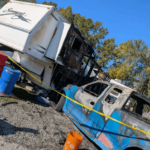
B.C. auditor general finds province expected village of Lytton to be responsible for recovery following devastating fire
The community has struggled to rebuild after a devastating fire levelled nearly all of its homes in 2021 and killed two residents.
By Alec Lazenby
Last updated 5 hours ago
You can save this article by registering for free here. Or sign-in if you have an account.

The B.C. government largely expected the village of Lytton to rebuild on its own after a devastating wildfire five years ago, and not all the money it promised has been distributed, says the province’s new auditor general.

Subscribe now to read the latest news in your city and across Canada.
- Unlimited online access to articles from across Canada with one account.
- Get exclusive access to the Vancouver Sun ePaper, an electronic replica of the print edition that you can share, download and comment on.
- Enjoy insights and behind-the-scenes analysis from our award-winning journalists.
- Support local journalists and the next generation of journalists.
- Daily puzzles including the New York Times Crossword.
Subscribe now to read the latest news in your city and across Canada.
- Unlimited online access to articles from across Canada with one account.
- Get exclusive access to the Vancouver Sun ePaper, an electronic replica of the print edition that you can share, download and comment on.
- Enjoy insights and behind-the-scenes analysis from our award-winning journalists.
- Support local journalists and the next generation of journalists.
- Daily puzzles including the New York Times Crossword.
Create an account or sign in to continue with your reading experience.
- Access articles from across Canada with one account.
- Share your thoughts and join the conversation in the comments.
- Enjoy additional articles per month.
- Get email updates from your favourite authors.
Create an account or sign in to continue with your reading experience.
- Access articles from across Canada with one account
- Share your thoughts and join the conversation in the comments
- Enjoy additional articles per month
- Get email updates from your favourite authors
Sign In or Create an Account
In a report released Tuesday, Bridget Parrish found the NDP government “did not have a comprehensive legal framework to guide disaster recovery” at the time of the June 2021 wildfire that wiped out almost the entire village, killed two residents and caused damage to the local First Nation.

tap here to see other videos from our team.
B.C. auditor general finds province expected village of Lytton to be responsible for recovery following devastating fire Back to video
tap here to see other videos from our team.
“The situation in the village of Lytton was complex and unprecedented, nearly the entire community was destroyed,” said Parrish. “The province’s legislation and policy was not sufficient to support recovery on that scale.”
Parrish found that the village lacked the staff and the resources to rebuild on its own, and that 60 per cent of residents didn’t have insurance to cover losses.
The community was also not able to properly leverage funding programs, including the disaster financial assistance program, said Parrish. In the end, the village only ended up receiving $48,000 from the fund for a right-of-way survey and the removal of garbage cans and other debris.
As of March 2025, only 33 building permits had been issued by the Village of Lytton for people to rebuild. The first permit wasn’t issued until October 2023, more than two years after the fire.

Parrish recommended the province develop a framework to guide decisions on recovery funding, create clear guidance for local authorities for the use of provincial funds and provide better training for local authorities for co-ordination with local First Nations.
One problem identified in the report was the failure of provincial officials to develop collaboration between Lytton officials and the Nlaka’pamux Nation, within whose traditional territory Lytton lies.
-
Advertisement 1Story continues belowThis advertisement has not loaded yet, but your article continues below.
Numerous residents have complained in the years since the fire about the astronomical costs of the archeological work mandated by the Heritage Conservation Act to ensure homes weren’t being rebuilt on top of Indigenous remains or artifacts.
Mayor Denise O’Connor has said that the costs for residents for this archeological work ranged between $26,000 and $46,000 a home, with at least one resident given a quote as high as $82,000.
Provincial funding has allowed the village to offer residents up to $20,000 a person to cover these costs but homeowners and business owners are still on the hook for the rest, O’Connor said.
She said there were few surprises in the report and hopes the community is turning around. There were 30 homes that didn’t burn above the highway, she said. In the village core, 17 new homes are now occupied and the local Legion should be opening in May.
“I would hope that no other community ever has to go through what we went through, and that those recommendations are put in place … so that it’s never repeated.”
Of the $60 million allocated by the province to help with recovery, $51 million of that had been distributed as of March 2025, according to Parrish’s report.
Parrish said her office wasn’t able to examine how the money was spent because Lytton’s lack of capacity meant it wasn’t able to file a number of the required reports about where funding was going.
Tricia Thorpe, electoral area director for the part of the Thompson-Nicola Regional District surrounding Lytton, said the report also doesn’t touch on the 30 or so properties immediately surrounding the village that didn’t receive any provincial support because they were outside the village boundary.
She said she and her husband Don have only been able to rebuild their home and hobby farm through the generosity of neighbours and the support of aid organizations like Samaritan’s Purse.
“I don’t know what we would have done without them, because you look at it as an individual and it was overwhelming. The entire farm was destroyed. We lost most of the animals in that fire too,” said Thorpe.
“There was funding for the village properties that were underinsured or had no insurance in terms of full debris cleanup and soil remediation. We were on our own.”
Thorpe said she wants to see all people who lose their homes treated equally, instead of creating a disparity between rural residents and those living in town.
B.C. Premier David Eby told reporters before the report’s release that he looked forward to reviewing the report and that the government would take its analysis seriously.
“The situation in British Columbia has changed since the fire in Lytton, we’ve passed a new law that requires the conversations between communities and First Nations to happen in advance of an emergency, rather than in the middle of an emergency or immediately following an emergency,” said Eby.
“This hopefully will be just one of the many improvements that have come about, hard lessons learned through the events and the terrible loss of property that took place in Lytton following that devastating fire.”
In a followup statement, Kelly Greene, minister of emergency management and climate readiness, touted the province’s introduction of the new Emergency and Disaster Management Act in 2023. The Act puts the onus on municipalities and First Nations to be better prepared for natural disasters, such as fires and floods, and work together on emergency plans.
Tony Luck, Conservative MLA for Fraser-Nicola, said the problem is that many communities don’t have the capacity to prepare for emergencies and the province needs to be more involved.
“You can’t just expect these communities to pick up the shovel and pick up and go with it,” he said.
“We’re going to have to look at something much more robust coming out of Victoria, that they’re ready to assemble and get going and helping these small communities, because this delay is absolutely outrageous.”