
Polls show Americans dislike Canada more than ever, and that’s bad news for the trade war
Carney is constrained because ‘there’s a point at which Canadians aren’t going to accept big concessions … until they get an apology’ from America, a foreign affairs observer in Washington says
By Tracy Moran
Last updated 3 hours ago
You can save this article by registering for free here. Or sign-in if you have an account.
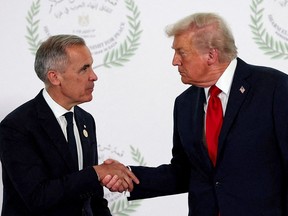
WASHINGTON, D.C. — Canadians’ affection for the United States tends to rise and fall with whoever’s in the White House. It dropped for president George W. Bush, rose for Barack Obama, and then plunged during Donald Trump’s first term, only to rise again with Joe Biden. In the first year of Trump’s second presidency, however, Canada’s fondness for its southern neighbour has plumbed new lows.

Subscribe now to read the latest news in your city and across Canada.
- Unlimited online access to articles from across Canada with one account.
- Get exclusive access to the Vancouver Sun ePaper, an electronic replica of the print edition that you can share, download and comment on.
- Enjoy insights and behind-the-scenes analysis from our award-winning journalists.
- Support local journalists and the next generation of journalists.
- Daily puzzles including the New York Times Crossword.
Subscribe now to read the latest news in your city and across Canada.
- Unlimited online access to articles from across Canada with one account.
- Get exclusive access to the Vancouver Sun ePaper, an electronic replica of the print edition that you can share, download and comment on.
- Enjoy insights and behind-the-scenes analysis from our award-winning journalists.
- Support local journalists and the next generation of journalists.
- Daily puzzles including the New York Times Crossword.
Create an account or sign in to continue with your reading experience.
- Access articles from across Canada with one account.
- Share your thoughts and join the conversation in the comments.
- Enjoy additional articles per month.
- Get email updates from your favourite authors.
Create an account or sign in to continue with your reading experience.
- Access articles from across Canada with one account
- Share your thoughts and join the conversation in the comments
- Enjoy additional articles per month
- Get email updates from your favourite authors
Sign In or Create an Account
Also new is that Americans’ views of Canadians have also made a historic shift — for the worse. According to a Gallup poll out this month, while most Americans see Canada favourably, that has dropped from 91 per cent to 80 per cent, the lowest level Gallup has seen since the 1980s.

tap here to see other videos from our team.
Polls show Americans dislike Canada more than ever, and that’s bad news for the trade war Back to video
tap here to see other videos from our team.
“During the first Trump administration, (Canadians’) views of the United States definitely plunged,” said Shachi Kurl, president of the Angus Reid Institute polling firm.
“But this, today, is a whole new dynamic.”
Only one in five Canadians now view the U.S. positively, reports an Angus Reid survey released last month, while 74 per cent see it unfavourably or very unfavourably. Nearly four in 10 see it as an enemy or threat, which is unprecedented.
Angus Reid has found that 51 per cent of Americans say Canadian products should not be tariffed. But among Trump supporters, it’s just 21 per cent.
There is a stark partisan division. Positive views of Canada have held steadily high among Democrats at 95 per cent, according to Gallup. But Republicans’ positive views dropped from 85 to just 62 per cent over the past year — and among Independents, the number has dropped nine points from 2024 to 80 per cent.
Trump’s trade war and “51st state” rhetoric are almost certainly a major factor. But political scientists point out that most voters pay very little attention to, or understand much about foreign policy.
-
Advertisement 1Story continues belowThis advertisement has not loaded yet, but your article continues below.
“I don’t think many Americans really have very negative views about Canada or Canadians,” said Erik Voeten, professor of geopolitics at Georgetown University.
“I really think this is just a follow-the-leader kind of thing.”
Trump’s rhetoric, he added, “shapes these views, but I don’t think that reflects really deep-seated sort of feelings that people have towards Canada per se.”
Daniel Béland, a Canadian political sociologist and director of McGill’s Institute for the Study of Canada, agreed, comparing the feelings to affinity with a local sports team.
“You identify with your team, especially in a hyper-partisan context,” he said, adding that it’s especially true among less-educated voters, who are more likely to take their cues from a political leader’s policy.
“People rally around the flag when they feel that they are under threat … it’s just basic social psychology. It tends to reinforce inner-group solidarity,” Béland added.
Christopher Sands, director of the Center for Canadian Studies at the Johns Hopkins School of Advanced International Studies in Washington, D.C., said the Canadian numbers reflect a sense of betrayal by longtime American friends.
For Canadians, he said, it’s “more about trust and friendship. I think those are the things that are the biggest stake.”
The effect is also self-reinforcing.
“If you say negative things about the country, in the case of Trump about Canada,” said Béland, “then your voters will expect you to be tougher in a way.”
So deepening divisions may soon shape policy, constraining both Trump and Prime Minister Mark Carney in their ongoing trade talks.
“If Canadians are down on the U.S., that might constrain the options available to the government,” said Jeffrey Jones, senior editor at Gallup.
“Policies that maybe they (Canadians) see are beneficial to the U.S. and not as beneficial to Canada, maybe that wouldn’t fly.”
Many global leaders are faced with the same conundrum, where the actions by the U.S. president are unpopular with their domestic populace. But Georgetown University’s Voeten noted that on the other side is the awareness among businesses and politicians that the U.S.-Canada relationship is economically crucial.
“So at some point, you need to make some concessions. That’s a balancing act that I’m sure Carney will have to manage.”
Nonetheless, Canada faces limits in how far it can go with Washington, according to Sands, who said Carney is a “very smart guy, but not a career politician,” so he may lack the political charisma needed to bring Canadians along with him if big concessions need to be made.
The hardening views, he said, “operate like cement shoes for Carney,” noting that he’s constrained because “there’s a point at which Canadians aren’t going to accept big concessions … until they get an apology” from America.
People rally around the flag when they feel that they are under threat … it’s just basic social psychology
But while the growing hostility might make it harder for Ottawa to make concessions, Kurl said that “what it really does is it emboldens and bolsters Canada if they want to take a hard line” in trade talks.
High approval ratings, mixed with the potential for achieving a majority in Parliament after April’s byelections, give Carney more cover to play hardball or make concessions, said Béland. Polls measure Carney’s approval ratings as over 60 per cent, while Trump’s hover around the high 30 per cents.
Carney’s numbers have only risen despite having so far failed to show any progress on his election promise a year ago to “win” the trade war with the United States.
And Béland thinks Canadians will continue to give Carney lots of latitude.
“For the time being, many Canadians trust Carney to basically adapt to the situation and be pragmatic,” he said.
As in the past, when Canadians have cooled on their neighbours, warmer feelings for America are likely to return once Trump leaves office, but most expect it will take longer than usual — and depend on who the next president is.
Sands noted that a lot of damage has been done to Canadian trust.
“Trust is the ultimate thing that has been destroyed,” he said, “And there’s no way to get that back except incrementally — not by pledges, but by performance.”
National Post
tmoran@postmedia.com
Our website is the place for the latest breaking news, exclusive scoops, longreads and provocative commentary. Please bookmark nationalpost.com and sign up for our newsletters here.