
Ottawa pulls funding to program matching Lower Mainland wheelchair-users with accessible homes
For full-time wheelchair-users in the Lower Mainland, the ability to live independently has often hinged on one thing: finding accessible housing.
Last updated 26 minutes ago
You can save this article by registering for free here. Or sign-in if you have an account.
For Vancouver’s Mark Cody, 44, life was once confined to the parts of his apartment that he could physically reach.

Subscribe now to read the latest news in your city and across Canada.
- Unlimited online access to articles from across Canada with one account.
- Get exclusive access to the Vancouver Sun ePaper, an electronic replica of the print edition that you can share, download and comment on.
- Enjoy insights and behind-the-scenes analysis from our award-winning journalists.
- Support local journalists and the next generation of journalists.
- Daily puzzles including the New York Times Crossword.
Subscribe now to read the latest news in your city and across Canada.
- Unlimited online access to articles from across Canada with one account.
- Get exclusive access to the Vancouver Sun ePaper, an electronic replica of the print edition that you can share, download and comment on.
- Enjoy insights and behind-the-scenes analysis from our award-winning journalists.
- Support local journalists and the next generation of journalists.
- Daily puzzles including the New York Times Crossword.
Create an account or sign in to continue with your reading experience.
- Access articles from across Canada with one account.
- Share your thoughts and join the conversation in the comments.
- Enjoy additional articles per month.
- Get email updates from your favourite authors.
Create an account or sign in to continue with your reading experience.
- Access articles from across Canada with one account
- Share your thoughts and join the conversation in the comments
- Enjoy additional articles per month
- Get email updates from your favourite authors
Sign In or Create an Account
Cody lost the use of his legs after a missile strike while in Baghdad, Iraq. He spent years unable to bathe himself or leave his house until a program connected him and his wife, Zoey, with an accessible two-bedroom apartment in 2023 — making it possible for them to start a family.

tap here to see other videos from our team.
Ottawa pulls funding to program matching Lower Mainland wheelchair-users with accessible homes Back to video
tap here to see other videos from our team.
“I had to do it all for him,” recalled Zoey. “He couldn’t reach the fridge or cook by himself. We were too scared to have children.”
On Wednesday, the pair beamed as they spoke about their two kids, Chloe and Jack: “We were not happy before this,” said Zoey, who is pregnant with their third child.
For full-time wheelchair-users in the Lower Mainland, the ability to live independently has often hinged on one thing: finding accessible housing. Now, with a federal funding cut forcing the closure of a program that helped make those matches possible, residents and politicians warn that hundreds of people could be pushed to the brink of homelessness.
Speaking Wednesday inside the Harmony Building in Vancouver’s Grandview-Woodland neighbourhood, clients of Disability Alliance B.C.’s right fit program stood alongside Vancouver East NDP MP Jenny Kwan to draw attention to the program’s closure after a recent $500,000 cut in federal funding through Reaching home: Canada’s homelessness strategy.
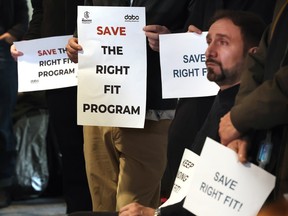
About a dozen wheelchair-users attended the news conference. Many held signs reading: “Save the right fit program.” Some were visibly teary-eyed.
-
Advertisement 1Story continues belowThis advertisement has not loaded yet, but your article continues below.
Launched in Vancouver in 2017, the right fit program successfully matched 371 wheelchair-users with accessible rental units across the Lower Mainland. In partnership with the Individualized Funding Resource Centre Society, Disability Alliance B.C. worked with housing providers while staff supported clients directly.
The non-profit program had been expanding into Vancouver Island’s Capital Regional District, Helaine Boyd, executive director of Disability Alliance B.C., said, drawing interest from other parts of the province, including Kelowna and Prince George, before the funding halted operations after six years.
“They decided for some reason that the activities under our program were more aligned with systemic advocacy work,” Boyd said.
The non-profit was given less than two weeks’ notice of the funding cut.

“It doesn’t make sense to us because our work does provide direct services in placing people into accessible housing,” Boyd said.
Postmedia News reached out to the federal government for comment but it did not respond by the afternoon of April 2.
About 226 people are on the program’s wait list, Boyd said, a 73 per cent increase over the past two years. She added that many accessible units in newer buildings are often occupied by people without disabilities rather than those who need them most.
Shantal Bateham, 29, who attended the news conference, described living in unsafe conditions before being connected with the program.
“For every person you see behind me, there are 10 more who cannot leave their homes, who go completely invisible, ignored and lost to our society,” Bateham said Wednesday.
Following a spinal cord injury at age 15 during cancer surgery, Bateham relied on B.C. Housing to find a wheelchair-accessible home after her rehab at GF Strong Rehabilitation Centre. After living in an emergency shelter for months while waiting on the provincial wait-list, she was placed in supportive housing.
“I watched my neighbours die, I listened to fights and screaming on either side of me,” she recalled, noting she lived in supportive housing for five years.
Program workers later matched her with a co-op unit, where she now lives.
“I have a patio where I can grow flowers and vegetables, I’m able to go and participate in my community … I can take my dog to the park. The right fit didn’t just stop at that. Every year they come back, they say, ‘Hey, how are you doing? What more do you need?’”
Boyd and Kwan are calling on the federal government to immediately reverse its funding cut, noting that residents living with disabilities are among those hit hardest by the country’s housing crisis.
“The right fit program is the only program of its kind in Canada. It has been life-changing — and in many cases, life-saving — for people with disabilities who are trying to find accessible housing,” Kwan said. “Cutting this program is not just short-sighted — it puts people at real risk of homelessness.”