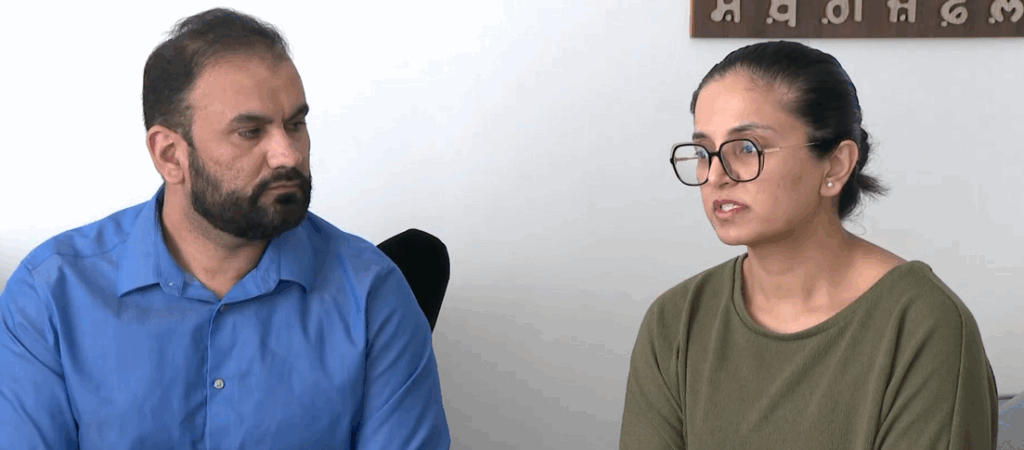
Two Surrey parents are seeking help from academics and the community to save their son, who has an extremely rare disease.
Three-year-old Gurmoh loves listening to Wheels on the Bus and dancing to Baby Shark, like any other child. He loves to drive his toy fire truck, dreaming of becoming a firefighter when he grows up.
But his parents, Navpreet and Stalin Gill, say they discovered about a month ago that Gurmoh has a rare disease called spastic paraplegia.
According to the U.S. National Institute of Health (U.S. NIH), hereditary spastic paraplegia is a group of rare and progressive disorders that cause weakness and stiffness of the legs.
However, Gurmoh’s particular case is caused by a de novo mutation that does not have an approved therapy.
In fact, he is the only child with this variation of a rare disease, SPAST c.1496 G>A (p.Arg499His), in Canada, and as such, government funding for his gene therapy is largely unavailable.
The parents say that every second, the disease is causing irreversible damage to their son’s nerves.
On April 8, with hopes of receiving help from the community, the Gills launched a GoFundMe campaign to fund the gene therapy that can save their son. About a week later, they received nearly $500,000 of the $2.7 million required to initiate the development of the therapy.
“People can feel our pain,” Navpreet said. “They’re parents, they have kids. So they feel what you’re going through.”
“That is what’s keeping us going.”
The Gills say researchers at McGill University are thankfully working to develop a personalized gene therapy, led by Dr. Ziv Gan-Or, director of clinical research at The Neuro.

On the funding website, Gurmoh’s parents said saving him from the disease that destroys his nerves will be impossible without getting funding in time. The therapy, they say, requires $6-8 million to cover research, pre-clinical, and clinical phases.
Early stages of the gene therapy depend heavily on patient and philanthropic funding, while later stages may receive support from the government, the campaign website reads.
On April 15, Navpreet and Stalin travelled to Montreal to discuss matters with the researchers at McGill and others from the U.S. to share their struggles and challenges.
“Due to the rarity of his condition—he is the only known case in Canada—treatment must be developed for his specific mutation within the SPG4 category,” said the Gills on their website.
Gurmoh’s parents say he started to show symptoms, such as being unable to stand independently without holding on to anything, around the age of one.
He was diagnosed about a month ago.
The symptoms of the genetic disorder, according to the U.S. NIH, include mobility issues and stiffness in the legs, which can worsen to the point of reliance on a cane, walker, or wheelchair.
Following the discovery of her son’s illness, Navpreet felt the worst feeling ever as a parent.
“Getting to know a condition is one thing, and getting to know it’s something that has no cure [is another]. And it’s going to keep on getting worse,” she said.
On top of the community’s contribution via the GoFundMe campaign, Navpreet and Stalin reached out to the provincial and federal governments, only to receive a disappointing response.
Navpreet says the federal government advised them to reach out to a list of other departments. RareKids-CAN, a federal department that helps children with rare diseases, offered to help with the documentation needed to get federal funding for the last two stages of the therapy.
A letter from the B.C. government’s health ministry to Navpreet and Stalin said it was unable to provide research funding through the National Strategy for Drugs for Rare Diseases (NSDRD) or through other avenues at the moment.
The funding for the gene therapy, Stalin says, will be a benchmark for Canada since it will help thousands of families.
1130 NewsRadio reached out to the provincial and federal governments for further comment. Health Canada redirected 1130 NewsRadio’s request to the B.C. Ministry of Health.
“The Ministry has active initiatives intended to simplify the process of initiating clinical research in the province with the aim of attracting more cutting-edge research into B.C. so that patients can benefit from participation in clinical trials closer to home,” said a statement from the province.
Now, Stalin and Navpreet are counting on the academics and their community members to get the funding needed.
The diagnosis of the disease, Stalin says, was around the time of the tragic Tumbler Ridge shooting in B.C., which took the lives of 9 people.
Stalin says his heart went out to the parents who could not save their children during the shooting.
“If the parents were with their son or their daughter, they would hide [their children] from bullets and take the bullets on their chest,” he said.
“I have all the opportunity to help save my son. I’m going to leave no stone unturned. I’m going to make sure I knock on all the doors possible.”
Stalin and Navpreet say they will be Gurmoh’s greatest advocates and will do whatever it takes to save him.
Their heartfelt message to their son?
“He doesn’t need to worry, and we will figure it out. He’ll be fine. It’s our responsibility as parents. We brought him into the world.”
With files from Parmeet Kamra, OMNI News