
B.C. climate news: Scientists link grey whale deaths in B.C., U.S to warming ocean | Increased water storage, added filtration among Metro Vancouver plans to combat climate risks | Cheap batteries take over world’s power grids
Here’s all the latest local and international news concerning climate change for the week of April 20 to April 26, 2026.
You can save this article by registering for free here. Or sign-in if you have an account.
Here’s the latest news concerning climate change and biodiversity loss in B.C. and around the world, from the steps leaders are taking to address the problems, to all the up-to-date science.

Subscribe now to read the latest news in your city and across Canada.
- Unlimited online access to articles from across Canada with one account.
- Get exclusive access to the Vancouver Sun ePaper, an electronic replica of the print edition that you can share, download and comment on.
- Enjoy insights and behind-the-scenes analysis from our award-winning journalists.
- Support local journalists and the next generation of journalists.
- Daily puzzles including the New York Times Crossword.
Subscribe now to read the latest news in your city and across Canada.
- Unlimited online access to articles from across Canada with one account.
- Get exclusive access to the Vancouver Sun ePaper, an electronic replica of the print edition that you can share, download and comment on.
- Enjoy insights and behind-the-scenes analysis from our award-winning journalists.
- Support local journalists and the next generation of journalists.
- Daily puzzles including the New York Times Crossword.
Create an account or sign in to continue with your reading experience.
- Access articles from across Canada with one account.
- Share your thoughts and join the conversation in the comments.
- Enjoy additional articles per month.
- Get email updates from your favourite authors.
Create an account or sign in to continue with your reading experience.
- Access articles from across Canada with one account
- Share your thoughts and join the conversation in the comments
- Enjoy additional articles per month
- Get email updates from your favourite authors
Sign In or Create an Account
Check back every Saturday for more climate and environmental news or sign up for our Sunrise newsletter HERE.

tap here to see other videos from our team.
B.C. climate news: Scientists link grey whale deaths in B.C., U.S to warming ocean | Increased water storage, added filtration among Metro Vancouver plans to combat climate risks | Cheap batteries take over world’s power grids Back to video
tap here to see other videos from our team.
In climate news this week:
• Scientists link grey whale deaths in B.C., U.S to climate change
• Increased water storage, added filtration among Metro Vancouver plans to combat climate risks
• Cheap batteries are taking over the world’s power grids
Human activities like burning fossil fuels and farming livestock are the main drivers of climate change, according to the UN’s intergovernmental panel on climate change. This causes heat-trapping greenhouse gas levels in Earth’s atmosphere, increasing the planet’s surface and ocean temperature.
The panel, which is made up of scientists from around the world, including researchers from B.C., has warned for decades that wildfires and severe weather, such as the province’s deadly heat dome and catastrophic flooding in 2021, would become more frequent and intense because of the climate emergency. It has issued a code red for humanity and warns the window to limit warming to 1.5 C above pre-industrial times is closing.
According to NASA climate scientists, human activities have raised the atmosphere’s carbon dioxide content by 50 per cent in less than 200 years, and “there is unequivocal evidence that Earth is warming at an unprecedented rate.”
As of March 5, carbon dioxide in the atmosphere was 429.35 parts per million, up from 428.62 ppm the previous month, according to the latest available data from the NOAA measured at the Mauna Loa Observatory, a global atmosphere monitoring lab in Hawaii. The NOAA notes there has been a steady rise in CO2 from under 320 ppm in 1960.

Quick facts:
• The global average temperature in 2023 reached 1.48 C higher than the pre-industrial average, according to the EU’s Copernicus Climate Change Service. In 2024, it breached the 1.5 C threshold at 1.55 C.
• 2025 was the third warmest on record after 2024 and 2023, capping the 11th consecutive warmest years.
• Human activities have raised atmospheric concentrations of CO2 by nearly 49 per cent above pre-industrial levels starting in 1850.
• The world is not on track to meet the Paris Agreement target to keep global temperature from exceeding 1.5 C above pre-industrial levels, the upper limit to avoid the worst fallout from climate change including sea level rise, and more intense drought, heat waves and wildfires.
• UNEP’s 2025 Emissions Gap Report, released in early December, shows that even if countries meet emissions targets, global temperatures could still rise by 2.3 C to 2.5 C this century.
• In June 2025, global concentrations of carbon dioxide exceeded 430 parts per million, a record high.
• There is global scientific consensus that the climate is warming and that humans are the cause.

Latest News

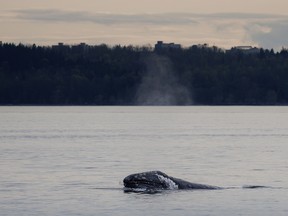
Five grey whales, some skinny as “a bag of bones,” have been found dead off B.C.’s coast this year, according to an official with Fisheries and Oceans Canada.
Paul Cottrell, the marine mammal coordinator with the DFO’s Pacific region, said at a news conference this week that there are signs of more deaths to come, given the emaciated state of some of the whales.
“This die-off — with four of them just in the last 10 days — is consistent with what we are seeing in Washington State. They are up to 15 in last couple of weeks … and similarly in California and Oregon,” he said.
“We’re hoping it’s just a blip, but the indications are that we’re likely going to see more mortalities,” said Cottrell, adding that the underlying consistent thing experts are seeing is “very skinny animals with certain animals that are just really a bag of bones.”
Wendy Szaniszlo, a scientist with the cetacean research program at the DFO, said they have been studying foraging and habitat use.
She said climate change is contributing to changing ice conditions and warmer ocean temperatures. This is causing a decline in the whales’ prey and contributing to challenges finding food.
—Tiffany Crawford
Water conservation is not enough to meet Metro Vancouver’s future demand as climate change presents significant risks to the region’s water quality and supply, regional officials say.
Plans are already underway to address supply issues, as Metro Vancouver plans to double the capacity to withdraw water from Coquitlam Reservoir, the largest of the three drinking water sources. With a deeper intake, Coquitlam Lake’s total storage capacity could increase from about 150 billion litres to almost 250 billion litres.
However, a warmer climate can lead to water quality issues because of higher turbidity, so a filtration system at the Coquitlam Reservoir will also be required, according to a recent report to the regional district’s water committee.
The report notes that climate change-related drought can also increase the risk of wildfires, which could further contaminate the water supply.
Metro Vancouver is looking at a filtration system similar to the one that was completed in 2010 for the Seymour and Capilano watersheds for the Coquitlam source, said Heidi Walsh, director of watersheds and environment at Metro Vancouver.
In a statement, Metro Vancouver said construction of the Coquitlam Lake Water Supply Project — including a new water intake, water supply tunnel, and new filtration treatment plant — is expected to begin in the early 2030s and be complete in the late 2030s. A budget of $254 million has been approved to determine the scope, timeline, and costs.
—Tiffany Crawford
Peter Heppner, the boss at Preston GM in Langley, said his car dealership didn’t really see a dip in zero-emission vehicle sales after governments hit pause on rebates. But with gas still in the range of $2 a litre, he is seeing a surge now.
Last month, for the first time in Heppner’s career, his dealership sold more EVs than non-EVs, he said.
Heppner said disclosing the number would tip competitive information, but noted that Preston is one of the region’s larger dealerships and EVs have become “a very material portion of our business nowadays.”
“Nobody wants to pay for gas,” Heppner said. “It’s interesting. It doesn’t matter how expensive the vehicle is that we sell, and we have some that are way up there nowadays, but nobody wants to pay for gas.”
The rebound in zero-emission vehicle sales, both EVs and plug-in hybrids, is being experienced by B.C. dealerships across the province as consumers struggle with high gas prices and react to the reinstatement of federal rebates, according to the New Car Dealers Association.
—Derrick Penner

More than half of B.C. residents not prepared for wildfires: Survey
More than half of B.C. residents don’t have an emergency plan in case of wildfire, according to a new survey.
The survey, conducted by Angus Reid for B.C. Hydro, found 61 per cent of B.C. adults polled admitted they haven’t created an emergency plan for their household, and 56 per cent don’t have an emergency kit.
In a statement Friday, B.C. Hydro said a lack of planning is likely why nearly one‑third say they don’t feel prepared to be without power during a wildfire lasting a full day or more.
The survey also suggests a lack of awareness when it comes to wildfire risk, with 42 per cent of respondents saying they don’t know, or are unsure, whether their area faces elevated wildfire risk.
This rises to 48 per cent in the Lower Mainland, the survey suggests. With an El Niño expected to bring hotter and drier conditions this year, B.C. Hydro is encouraging customers to take steps now to prepare for a potentially longer and more challenging wildfire season.
—Tiffany Crawford
Around the world, a wave of mega installations of batteries are lining up to be connected to the grid this year — from solar hubs in Texas to grasslands in Inner Mongolia and the site of a former coal plant north of Sydney.
Falling costs and soaring energy demand from data centres had already set the stage for rapid growth. The war in the Middle East has helped accelerate the trend by lifting demand for alternatives to expensive fossil fuels, setting 2026 up to be the year batteries become influential in the global energy system. BloombergNEF analysts had already expected installations to jump by about a third this year, led by expansion in Europe, the Middle East, Africa and Latin America. That momentum could build further if fuel disruptions persist.
Signs of the ramp up are already emerging. A Chinese battery manufacturer has forecast a sharp rise in first quarter profit as global demand picks up. In Vietnam, a developer is seeking approval to replace a planned LNG-to-power project with renewables paired with storage, citing the surge in fuel costs linked to the war.
In markets flooded with solar and wind — technologies that have been built out significantly since the last energy crisis in 2022 — battery operators can buy electricity when it’s cheap and sell it when demand peaks. Where grids once relied on coal and gas when renewable output dipped, storage technology is now becoming cheap and fast enough to make a difference in how the grid functions. Average costs have dropped by around 75 per cent from 2018 to 2025, according to BNEF, and are expected to tumble another 25 per ent through 2035.
—Bloomberg News
China’s new solar installations slowed sharply to hit a four-year low for the month of March, underscoring mounting pressure across the struggling sector.
A total of 8.91 gigawatts of solar capacity was added in March, according to data released by the National Energy Administration. The figure was slightly above the three-year low of 7.36 gigawatts recorded last August.
The slowdown has been evident since the start of this year. After several years of rapid renewable build-out, curtailment rates have risen close to a government-set cap and manufacturers across the supply chain are grappling with severe overcapacity and deep losses.
Although the figures were broadly expected, the March data stood in sharp contrast to last spring, when a policy shift in renewable power pricing triggered a 124 per cent surge in installations in the same month
—Bloomberg News
France wound up a meeting of G7 environment ministers on Friday defending its “pragmatic” decision to keep climate change off the agenda to avoid a clash with the U.S., according to a Reuters report.
U.S. President Donald Trump has dismissed climate change as a hoax despite scientific evidence, and has withdrawn his country from several international climate bodies, the report said.
Keeping it off the formal agenda of the Paris-hosted meeting was “a more pragmatic approach” that avoided “the risk of certain partners walking from the negotiating table,” French Environment Minister Monique Barbut told reporters.
—Reuters
I’m a breaking news reporter but I’m also interested in writing stories about health, the environment, climate change and sustainable living, including zero-waste goals. If you have a story idea related to any of these topics please send an email to ticrawford@postmedia.com