Fishing net defies time, resurfaces after 2,000 years in Tsawwassen
The net was discovered in May 2024, found at a wet site on the north end of the Beach Grove Golf Course during monitored municipal excavation work.
Author of the article:

You can save this article by registering for free here. Or sign-in if you have an account.
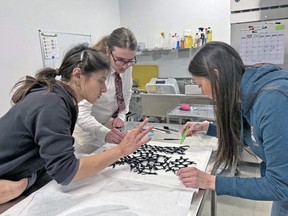
A rare 2,000-year-old fishing net unearthed in Tsawwassen is undergoing conservation at the First Nation’s repository, providing a window into the coastal life that flourished in the region millennia ago.

Subscribe now to read the latest news in your city and across Canada.
- Unlimited online access to articles from across Canada with one account.
- Get exclusive access to the Vancouver Sun ePaper, an electronic replica of the print edition that you can share, download and comment on.
- Enjoy insights and behind-the-scenes analysis from our award-winning journalists.
- Support local journalists and the next generation of journalists.
- Daily puzzles including the New York Times Crossword.
Subscribe now to read the latest news in your city and across Canada.
- Unlimited online access to articles from across Canada with one account.
- Get exclusive access to the Vancouver Sun ePaper, an electronic replica of the print edition that you can share, download and comment on.
- Enjoy insights and behind-the-scenes analysis from our award-winning journalists.
- Support local journalists and the next generation of journalists.
- Daily puzzles including the New York Times Crossword.
Create an account or sign in to continue with your reading experience.
- Access articles from across Canada with one account.
- Share your thoughts and join the conversation in the comments.
- Enjoy additional articles per month.
- Get email updates from your favourite authors.
Create an account or sign in to continue with your reading experience.
- Access articles from across Canada with one account
- Share your thoughts and join the conversation in the comments
- Enjoy additional articles per month
- Get email updates from your favourite authors
Sign In or Create an Account
“It really highlights the deep cultural importance of fishing for our people. It’s a privilege to be able to care for and hold a piece of our ancestors’ history and perpetuity,” said Tia Williams, archeology coordinator at the Tsawwassen First Nation.
Radiocarbon dating was used to determine the age of the net. It’s undergoing cellulose analysis after researchers confirmed that it’s made from bark fibres, but not cedar. Some professionals, weavers and elders suggest the material could be stinging nettle or big leaf maple.
“In archeology, we almost never recover a complete fish net. Most of the time, we’re lucky if we find small fragments, maybe a knot, a leaf. Usually, we only see traces,” said Williams.
According to Williams, they have a larger and much rarer piece, preserved only because it remained in a wet site.
Williams said most archeological sites are dry, which means organic materials typically break down over time. As a result, archeologists often find stone and bone tools, or small remnants, while materials such as fibres, wood or textiles rarely survive.
Wet sites are different. In water-saturated environments, such as clay, mud, or peat, oxygen can’t easily reach buried objects. This creates an anaerobic environment that significantly slows, or even stops, the decay of organic materials.
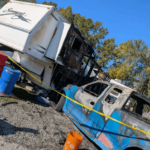
The net was discovered in May 2024, found at a wet site on the north end of the Beach Grove Golf Course during monitored municipal excavation work. Workers saw it hanging from the equipment, an incident that highlights how fragile and easily lost such artifacts can be. Once out of its natural environment, it can very quickly fall apart and disintegrate.
“We work on the traditional territory of Tsawwassen people, and whenever we find belongings of our ancestors, oftentimes when we’re in the field, we’re the first ones to touch and hold those belongings since our ancestors were the last ones to touch them,” said Williams. “It’s very impactful to all of us who do this work, and it’s incredible.”
-
Advertisement 1Story continues belowThis advertisement has not loaded yet, but your article continues below.
Each piece is carefully cleaned, monitored and kept cold before undergoing years of conservation, including polyethylene glycol treatment and freeze-drying, to prepare it for display.
The TFN repository opened in 2025, and Williams hopes for it to lead to a museum and cultural centre.
“I don’t know if it really sets a precedent, but it’s monumental to have a First Nations repository handling their own belongings and ancestors over a colonial institution, and we’ve been very fortunate to have wonderful relationships with all the local museums and universities,” said Williams.
The space already houses many other ancestral belongings, such as basketry, historic fishnets, and stone and bone artifacts.
Williams says there is abundant evidence of hunting and fishing throughout Tsawwassen, with numerous fish camps once located around Beach Grove, Boundary Bay, and the Tsawwassen beach area.
“I think discoveries like this remind us that Indigenous history isn’t abstract, it’s tangible. It’s sophisticated and deeply connected to the place, so we are fortunate to be able to protect and learn from it.”
Radha Agarwal is a Local Journalism Initiative reporter with the Delta Optimist. The Local Journalism Initiative is funded by the government of Canada.