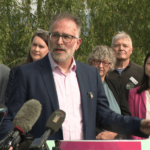
B.C. Premier David Eby is not holding back after hearing the Canadian government has signed a significant Memorandum of Understanding (MOU) with Alberta.
The announcement was made Friday, with both parties saying they are looking at a start date of Fall 2027 for the construction of a new bitumen pipeline to the West Coast.
CLICK HERE TO LISTEN TO 1130 NEWSRADIO VANCOUVER LIVE!
Eby said there are 35 projects in B.C. that need coordination with and support from the federal government, saying these should take precedence over this pipeline.
“As a country, it’s time to stop rewarding bad behaviour,” the premier said.
“It cannot be the case that the projects that get prioritized in Canada are those where a premier threatens to leave the country.”
He goes on to say that B.C. has the critical minerals, natural resources, and port access that the “rest of the world is looking for,” and the province is just waiting on the feds to move forward with several proposals.
“We have shovel-ready projects with real proponents, and investments that will provide good-paying jobs and funding for public services,” Eby said.
“Some of our $88 billion in prioritized projects have already reached final investment decisions, creating thousands of new, high-paying jobs.”
As well, he says, B.C.’s opposition to a repeal of the North Coast tanker ban has not changed.
On this point, Marilyn Slett, president of the Coastal First Nations-Great Bear Initiative and elected Chief of the Heiltsuk Nation, is in strong agreement.
“Today’s announcement does nothing to increase the chances of a pipeline and oil tankers route to the North Coast ever becoming a reality,” she said.
“We have heard directly from the Prime Minister and the Minister of Energy and Natural Resources, Tim Hodgson, that no project, and no route, will proceed without the support of affected First Nations and the province in which it is proposed.”
UBC political science lecturer Stewart Prest says this MOU “once again leaves B.C. outside the room where it happens.”
“We continue to see the federal government pursuing a bilateral relationship with the province of Alberta about a pipeline that mostly will be going through British Columbia. And I think that has to be frustrating for the province and the premier and for anyone in the province…seeing themselves having a stake in the outcome.”
Prest says this MOU is a clear-cut case of the squeaky wheel getting the grease.
“The province of Alberta has made a real fuss about not wanting to go along with the energy and environmental plans of previous governments,” he said.
“So even apart from the separatist talk that Premier Smith seems to be encouraging, or at least allowing to perpetuate in Alberta and to find ways to make that process go onward, even on the energy file in particular, I think the federal government here is really bending to Alberta’s wishes.”
He says that, unfortunately, Eby is limited in what he can actually do about this deal.
“The provincial government as an actor cannot unilaterally stop a pipeline that falls under federal jurisdiction from going ahead,” said Prest.
“He can make the case that the federal government is burning bridges here in the province, creating political enemies that it doesn’t really have to in taking this approach, but there’s not a lot that the province itself can do.”
However, he says, other parties in the province do have a voice, in particular those Indigenous communities whose lands may be affected by a possible pipeline route.
“Anyone who would be affected by that constitutionally must be consulted with, and that has to happen in a good-faith way, where there’s a real grappling with any issues that are brought up,” he said.
“So the way in which the federal government is broadly telegraphing that the pipeline will go ahead could still be a problem in terms of getting that constitutional requirement checked off.”
Slett echoes this point.
“As the legally recognized rights and title holders under Canadian and international law, we do not support a proposed oil pipeline and tankers route to the North Coast of B.C., and we, along with the Lax Kw’alaams Band and the Province of B.C., have called on the federal government to uphold the North Coast Oil Tanker Moratorium Act in its entirety, with no exceptions or carve outs,” she said.
Eby says he is meeting with Prime Minister Mark Carney next week to advocate for B.C.-based projects that will benefit the whole country.
“I know the Prime Minister believes we can work better in partnership as well.”
Eby also took a veiled jab at the separatist movement in Alberta.
“We will find a path forward, together — as Canadians,” he said. “Canada is our strength. We love this country.”