
Millions of B.C. amphibians, reptiles relocated for developments, but survival isn’t tracked: Study
UBC researchers say some of the most threatened species of amphibians were moved in B.C. for construction without anyone checking whether they survived relocation.
Last updated 2 hours ago
You can save this article by registering for free here. Or sign-in if you have an account.
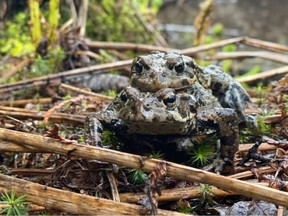
Researchers at the University of B.C. say millions of amphibians and reptiles, including threatened species, are being moved to make way for development in the province but with no monitoring requirement to ensure they survive.

Subscribe now to read the latest news in your city and across Canada.
- Unlimited online access to articles from across Canada with one account.
- Get exclusive access to the Vancouver Sun ePaper, an electronic replica of the print edition that you can share, download and comment on.
- Enjoy insights and behind-the-scenes analysis from our award-winning journalists.
- Support local journalists and the next generation of journalists.
- Daily puzzles including the New York Times Crossword.
Subscribe now to read the latest news in your city and across Canada.
- Unlimited online access to articles from across Canada with one account.
- Get exclusive access to the Vancouver Sun ePaper, an electronic replica of the print edition that you can share, download and comment on.
- Enjoy insights and behind-the-scenes analysis from our award-winning journalists.
- Support local journalists and the next generation of journalists.
- Daily puzzles including the New York Times Crossword.
Create an account or sign in to continue with your reading experience.
- Access articles from across Canada with one account.
- Share your thoughts and join the conversation in the comments.
- Enjoy additional articles per month.
- Get email updates from your favourite authors.
Create an account or sign in to continue with your reading experience.
- Access articles from across Canada with one account
- Share your thoughts and join the conversation in the comments
- Enjoy additional articles per month
- Get email updates from your favourite authors
Sign In or Create an Account
The UBC study, published in the Journal of Wildlife Management, found more than five million frogs and salamanders from 28 species were moved in B.C. due to construction from 2019 to 2022. Of the 28 reptiles and amphibians, 15 were at-risk species.
The study is the first of its kind to track the large-scale movement of amphibians and reptiles for infrastructure projects like pipelines, culverts and other development, said Megan Winand, lead author and recent UBC master of science graduate.
“A lot of people don’t know this is happening,” she said Thursday. “It’s the reason I did this study, to bring attention to this whole topic.”
The researchers say the practice, known as mitigation translocation, has become routine in B.C., but there are no regulations when it comes to checking on whether some of the most threatened species survived the move.

The Western Toad, for example, which the researchers found was the top B.C. amphibian to be moved because of construction, is considered a threatened species across North America. In B.C., it’s considered a blue-listed species, meaning it’s of conservation concern, while in the Northwest Territories it’s listed as threatened.
Winand also said often snakes are removed from dens or hibernacula (underground chambers,) without replicating that habitat for them when they’re moved.
The study says that despite growing global concerns about their effectiveness in offsetting development impacts, mitigation translocations have gained popularity.
-
Advertisement 1Story continues belowThis advertisement has not loaded yet, but your article continues below.
Before breaking ground, developers in B.C. must obtain a provincial permit and move amphibians and reptiles off-site, but that’s it. There are no followup requirements to ensure that they’re adapting to their new habitat.
B.C. has what is called a “best management practices of salvaging for amphibians and reptiles,” with guidelines suggesting consultants be brought in to choose where the animals are relocated. But there is no rule on who decides where they’re moved.
“You’re supposed to move them a short distance away. You’re supposed to move them into suitable habitat. But what we consider to be suitable habitat is at the discretion of those doing the translocation,” she said, adding the consultants may not be experts on the species they’re moving. “We don’t have a lot of people on the land truly understanding their habitat and their habitat needs. It’s an issue.”
The study says translocation efforts often fail because of poor release-site quality, inadequate habitat connectivity or habitat to support all life stages, overcrowding and increased competition because of the release of animals into an existing population.
The physiological stress of capture and relocation can also contribute to illness or mortality, the study says.
Winand said translocation should only be used as a last resort.
“If we do have to translocate, say there’s no other option, and we have to destroy or alter this habitat, we need to have research and monitoring and appropriate reporting in place to have proper guidelines and ways of actually carrying out that translocation with the higher level of success, if success at all,” said Winand.
She said over the last couple of decades translocation just became the standard way of dealing with amphibians and reptiles when planning for construction.
According to the study, amphibians and reptiles are important contributors to ecosystems because they control insect populations and serve as prey for birds, mammals and fish.
“Because now we’ve shone light on the scale of it, and the fact that it’s happening and the fact that we really don’t know what happens after we move them, now we can start having conversations about what we can do instead and can we find alternatives to translocation,” said Winand.
Postmedia News has asked the B.C. government for more information on why developers aren’t required to track whether these threatened species survive relocation.