
B.C. climate news: NOAA says El Niño expected to grow to ‘historic strength’ | Climate scientists say 2025 reached 1.37 C above pre-industrial levels
Here’s all the latest local and international news concerning climate change for the week of June 8 to June 14, 2026.
You can save this article by registering for free here. Or sign-in if you have an account.

Here’s the latest news concerning climate change and biodiversity loss in B.C. and around the world, from the steps leaders are taking to address the problems, to all the up-to-date science.

Subscribe now to read the latest news in your city and across Canada.
- Unlimited online access to articles from across Canada with one account.
- Get exclusive access to the Vancouver Sun ePaper, an electronic replica of the print edition that you can share, download and comment on.
- Enjoy insights and behind-the-scenes analysis from our award-winning journalists.
- Support local journalists and the next generation of journalists.
- Daily puzzles including the New York Times Crossword.
Subscribe now to read the latest news in your city and across Canada.
- Unlimited online access to articles from across Canada with one account.
- Get exclusive access to the Vancouver Sun ePaper, an electronic replica of the print edition that you can share, download and comment on.
- Enjoy insights and behind-the-scenes analysis from our award-winning journalists.
- Support local journalists and the next generation of journalists.
- Daily puzzles including the New York Times Crossword.
Create an account or sign in to continue with your reading experience.
- Access articles from across Canada with one account.
- Share your thoughts and join the conversation in the comments.
- Enjoy additional articles per month.
- Get email updates from your favourite authors.
Create an account or sign in to continue with your reading experience.
- Access articles from across Canada with one account
- Share your thoughts and join the conversation in the comments
- Enjoy additional articles per month
- Get email updates from your favourite authors
Sign In or Create an Account
Check back every Saturday for more climate and environmental news or sign up for our Sunrise newsletter HERE.

tap here to see other videos from our team.
B.C. climate news: NOAA says El Niño expected to grow to ‘historic strength’ | Climate scientists say 2025 reached 1.37 C above pre-industrial levels Back to video
tap here to see other videos from our team.
In climate news this week:
• The NOAA says El Niño expected to grow to ‘historic strength’
• Climate scientists say 2025 reached 1.37 C above pre-industrial levels
• New bill would protect Ontario renters from extreme heat
Human activities like burning fossil fuels and farming livestock are the main drivers of climate change, according to the UN’s intergovernmental panel on climate change. This causes heat-trapping greenhouse gas levels in Earth’s atmosphere, increasing the planet’s surface and ocean temperature.
The panel, which is made up of scientists from around the world, including researchers from B.C., has warned for decades that wildfires and severe weather, such as the province’s deadly heat dome and catastrophic flooding in 2021, would become more frequent and intense because of the climate emergency. It has issued a code red for humanity and warns the window to limit warming to 1.5 C above pre-industrial times is closing.
According to NASA climate scientists, human activities have raised the atmosphere’s carbon dioxide content by 50 per cent in less than 200 years, and “there is unequivocal evidence that Earth is warming at an unprecedented rate.”
As of June 5, 2026, carbon dioxide in the atmosphere was 432.34 parts per million, up slightly from 431.12 ppm the previous month, according to the latest available data from the NOAA measured at the Mauna Loa Observatory, a global atmosphere monitoring lab in Hawaii. The NOAA notes there has been a steady rise in CO2 from under 320 ppm in 1960.
Quick facts:
• The global average temperature in 2023 reached 1.48 C higher than the pre-industrial average, according to the EU’s Copernicus Climate Change Service. In 2024, it breached the 1.5 C threshold at 1.55 C.
• 2025 was the third warmest on record after 2024 and 2023, capping the 11th consecutive warmest years.
• Human activities have raised atmospheric concentrations of CO2 by nearly 49 per cent above pre-industrial levels starting in 1850.
• The world is not on track to meet the Paris Agreement target to keep global temperature from exceeding 1.5 C above pre-industrial levels, the upper limit to avoid the worst fallout from climate change including sea level rise, and more intense drought, heat waves and wildfires.
• UNEP’s 2025 Emissions Gap Report, released in early December, shows that even if countries meet emissions targets, global temperatures could still rise by 2.3 C to 2.5 C this century.
• In June 2025, global concentrations of carbon dioxide exceeded 430 parts per million, a record high.
• There is global scientific consensus that the climate is warming and that humans are the cause.

Latest News

The NOAA says El Niño expected to grow to ‘historic strength’
El Niño — a climate cycle that causes unusually warm ocean surface temperatures in the equatorial Pacific, altering global weather patterns — has begun and is expected to grow to historical strength, the U.S. National Oceanic and Atmospheric Administration said this week.
The NOAA also issued an El Niño advisory, saying there’s a 63 per cent chance of sea surface temperatures exceeding 2 C in the Pacific. If this threshold is surpassed, the NOAA considers the event a “very strong” El Niño.
El Niño tends to be strongest during the winter months, and its global impacts are typically most significant in the Northern Hemisphere winter, the agency said.
During an El Niño winter, the jet stream over the north Pacific Ocean tends to shift southward and cause a warmer than usual winter in the Pacific Northwest.
On the West Coast, there’s a higher risk of coastal flooding and the formation of harmful algae blooms, the NOAA said.
Meteorologists told the Associated Press that it will likely rival a record El Niño that began in 1997, leading to billions of dollars in damage from heat waves, floods and drought.
—Tiffany Crawford

Calgary first Canadian city to rescind climate emergency declaration
Calgary is no longer in a climate emergency, according to city council.
Council voted 10-5 a couple of weeks ago to repeal the climate emergency declaration the previous council led by then mayor Jyotia Gondek passed in November 2021 as one of its first orders of business.
Wednesday’s vote was in response to two notices of motion, from councillors Landon Johnston and Andre Chabot, who argued the declaration was purely symbolic and has not helped the city leverage additional funding to support climate initiatives.
Calgary is the first major Canadian city to rescind its climate emergency declaration. According to a city official, more than 600 municipalities across the country have passed similar declarations.
—Calgary Herald
A standing ovation for former federal environment minister Steven Guilbeault. A call for a national windfall tax on oil companies. In Alberta.
These were all part of Thursday’s keynote address at the Elbows Up for Climate conference at Edmonton’s Art Gallery of Alberta.
Elbows Up for Climate is a collection of more than 300 mayors and municipal councillors from across Canada, pushing for action on the environment.
John Vaillant, author of the bestselling Fire Weather, noted the irony of Guilbeault, who had been the bane of the Alberta government during his time as the federal environment minister, being saluted by hundreds of municipal politicians only a short walk from the provincial legislature.
—Edmonton Journal
Human activities pushed global warming to 1.37 C in 2025: climate scientists
Human activities pushed global warming to 1.37 C above pre-industrial times in 2025, and its level is projected to surpass 1.5 C in about four years, climate scientists with the Copernicus Climate Change Service warned this week.
Some of the key findings from the latest Indicators of Global Climate Change report are that global greenhouse gas emissions are at an all-time high and that 2025 was the third warmest year on record.
The report was done by an international team of more than 70 scientists.
“A key indicator is the Earth’s energy imbalance, which measures how fast heat is accumulating in the climate system, and provides a crucial measure of the pace of climate change. Without human influence, it should be close to zero, but it has been growing since the 1970s and is now at a record high, doubling in recent decades,” said Piers Forster, director of the Priestley Centre for Climate Futures at the University of Leeds and lead author.
The rate of human-induced warming remains at the all-time high of around 0.27 C per decade, driven primarily by record-high greenhouse gas levels, the report said.
—Tiffany Crawford
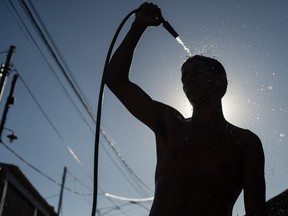
New bill would protect Ontario renters from extreme heat
Ontario landlords are required to keep tenants warm in the winter. Ottawa Centre MPP Catherine McKenney says it’s time the province offered the same protection from extreme heat in the summer.
McKenney has introduced a private member’s bill that would require Ontario landlords to keep rental units at or below 26 C during the summer months by adding cooling to the definition of a vital service under the Residential Tenancies Act.
The proposal comes as climate change drives hotter summers and more frequent heat waves, raising concerns about residents living in apartments without air conditioning.
“We know that people suffer, and often die, from extreme heat in their homes,” McKenney said. “While landlords have to provide a minimum temperature for cold, this is to establish that maximum heat temperature so that people are kept safe.”
The Ford government has not committed to supporting the bill. In a statement, Housing Minister Rob Flack’s office said municipalities already had the authority to implement their own rules.
—Ottawa Citizen
Researchers at the University of B.C. say millions of amphibians and reptiles, including threatened species, are being moved to make way for development in the province, but with no monitoring requirement to ensure they survive.
The UBC study, published in the Journal of Wildlife Management, found more than five million frogs and salamanders from 28 species were moved in B.C. due to construction from 2019 to 2022. Of the 28 reptiles and amphibians, 15 were at-risk species.
The study is the first of its kind to track the large-scale movement of amphibians and reptiles for infrastructure projects such as pipelines, culverts and other development, said Megan Winand, lead author and recent UBC master of science graduate.
“A lot of people don’t know this is happening,” she said Thursday. “It’s the reason I did this study, to bring attention to this whole topic.”
The researchers say the practice, known as mitigation translocation, has become routine in B.C., but there are no regulations when it comes to checking whether some of the most threatened species survived the move.
—Tiffany Crawford