
B.C. nurses end strike, prepare for binding arbitration on wages
In a news release shared Friday afternoon, the Nurses Bargaining Association and the province said they had each accepted recommendations for settlement put forward by mediators Amanda Rogers and Vince Ready.
By Stephanie Ip
Last updated 2 days ago
You can save this article by registering for free here. Or sign-in if you have an account.
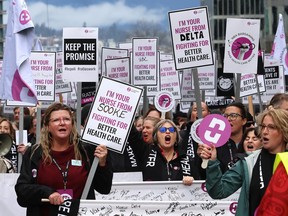
B.C. nurses were set to end their strike after accepting recommendations from mediators, the union announced Friday.

Subscribe now to read the latest news in your city and across Canada.
- Unlimited online access to articles from across Canada with one account.
- Get exclusive access to the Vancouver Sun ePaper, an electronic replica of the print edition that you can share, download and comment on.
- Enjoy insights and behind-the-scenes analysis from our award-winning journalists.
- Support local journalists and the next generation of journalists.
- Daily puzzles including the New York Times Crossword.
Subscribe now to read the latest news in your city and across Canada.
- Unlimited online access to articles from across Canada with one account.
- Get exclusive access to the Vancouver Sun ePaper, an electronic replica of the print edition that you can share, download and comment on.
- Enjoy insights and behind-the-scenes analysis from our award-winning journalists.
- Support local journalists and the next generation of journalists.
- Daily puzzles including the New York Times Crossword.
Create an account or sign in to continue with your reading experience.
- Access articles from across Canada with one account.
- Share your thoughts and join the conversation in the comments.
- Enjoy additional articles per month.
- Get email updates from your favourite authors.
Create an account or sign in to continue with your reading experience.
- Access articles from across Canada with one account
- Share your thoughts and join the conversation in the comments
- Enjoy additional articles per month
- Get email updates from your favourite authors
Sign In or Create an Account
However, the two sides remain far apart on the outstanding issue of wages, with the province offering 12 per cent over four years and the nurses’ union seeking 32 per cent. The parties will now head into binding arbitration to resolve the matter of compensation.
In separate statements Friday, the Nurses Bargaining Association and the province said they had accepted recommendations put forward by mediators Amanda Rogers and Vince Ready, following just over a week of mediation.
The three main recommendations relating to outstanding issues are detailed in a report to Labour Minister Jennifer Whiteside, a copy of which has been obtained by Postmedia News.
One recommendation suggests conducting “a meaningful study to identify where nurses and other employees in health care are most at risk for violence,” and whether hospital “relational security” officers should be made special constabless. Mediators also recommend the study consider the pros and cons of a flagging system for violent patients.
The mediators also recommend that the Health Ministry undertake a review “of the work presently being performed by nurses” and identify ways to “maximize the time nurses spend on performing (direct patient) care” instead of non-nursing duties, described by the Nurses Bargaining Association as tasks like portering, transport, clerical and administration, and housekeeping and maintenance.
“It is an understatement to say this is an extremely complex issue due to the varying circumstances in health-care facilities across the province,” the mediators note in their report. “Put another way, this is not a one-size-fits-all issue that can easily be dealt with through recommendations.”
Meanwhile, the final matter of wages will be sent to binding arbitration under Rogers and Ready, who noted that “due to the colossal difference between these parties on these issues, it is impossible to mediate a satisfactory resolution to these matters.”
In a previous agreement rejected by members in May, the province had offered 12 per cent over four years, in line with the mandate of 14 per cent set by the government. The mediators’ report detailed how the nurses had sought eight per cent per year, for a total of 32 per cent over four years, along with a signing bonus and a reduction in steps on the wage grid.
“Neither party has offered any indication they are prepared to soften their position — both sides seem intractable on the issue of compensation,” wrote Rogers and Ready.
The province has stated that agreeing to such an increase for nurses would trigger ‘me-too’ clauses, totalling “billions of dollars” of increases they would have to extend to other public-sector unions.
B.C. Nurses’ Union president Adriane Gear credited the “collective strength, determination and solidarity of more than 55,000 nurses” for helping the Nurses Bargaining Association reach this point: “Our members changed the conversation by forcing government and health employers to confront the realities of nursing and the challenges facing our public health-care system.”
The parties had been bargaining since October 2025, with talks hitting a roadblock earlier this year. In early May, 98.2 per cent of members voted to strike, forcing the nurses and government back to the table.
The result was a tentative deal that was later rejected on May 22 by 67 per cent of the membership. That proposal had offered a 12 per cent wage increase over four years and additional funding to improve minimum nurse-to-patent ratios, but members felt it fell short of a general wage increase.
Strike action was later launched July 2, when nurses enacted a ban on non-essential overtime and a refusal to perform non-nursing duties. The union described it as “the first phase of a broader escalation plan.”
During the first week of limited strike action, the union said it received more than 2,300 reports from members of intimidation, coercion and warnings or threats of discipline for not performing non-nursing duties. That prompted the union to file an unfair labour practice case with the B.C. Labour Relations Board to halt employer interference of job action.
In the mediators’ report, the union said the number of reports received by members had grown to 5,200.
Under the B.C. Labour Relations Code, employees are legally allowed to strike if bargaining has broken down, a strike vote has been conducted and a majority of members support strike action.
On July 10, special mediators Ready and Rogers were appointed to help navigate the negotiations, just as the nurses’ union prepared to expand picket lines to facilities in Surrey and on Vancouver Island.
The union later paused all picket-line job action on July 14 as a sign of good faith as mediation began. However, the provincewide ban on non-nursing duties and OT remained.
Following Friday’s announcement, the union said the recommendations had been forwarded to members for review “over the coming days.”