
Vancouver park board backs $4.5 million tree canopy expansion on city’s east side
A complex set of historical factors have contributed to the lower tree canopy on Vancouver’s east side
By Denise Ryan
Last updated 8 hours ago
You can save this article by registering for free here. Or sign-in if you have an account.

Residents on Vancouver’s east side will see some long-term relief from sun and heat after the park board voted to increase the tree canopy.

Subscribe now to read the latest news in your city and across Canada.
- Unlimited online access to articles from across Canada with one account.
- Get exclusive access to the Vancouver Sun ePaper, an electronic replica of the print edition that you can share, download and comment on.
- Enjoy insights and behind-the-scenes analysis from our award-winning journalists.
- Support local journalists and the next generation of journalists.
- Daily puzzles including the New York Times Crossword.
Subscribe now to read the latest news in your city and across Canada.
- Unlimited online access to articles from across Canada with one account.
- Get exclusive access to the Vancouver Sun ePaper, an electronic replica of the print edition that you can share, download and comment on.
- Enjoy insights and behind-the-scenes analysis from our award-winning journalists.
- Support local journalists and the next generation of journalists.
- Daily puzzles including the New York Times Crossword.
Create an account or sign in to continue with your reading experience.
- Access articles from across Canada with one account.
- Share your thoughts and join the conversation in the comments.
- Enjoy additional articles per month.
- Get email updates from your favourite authors.
Create an account or sign in to continue with your reading experience.
- Access articles from across Canada with one account
- Share your thoughts and join the conversation in the comments
- Enjoy additional articles per month
- Get email updates from your favourite authors
Sign In or Create an Account
Vancouver park board staff recommended the approval of a $4.5 million plan to improve tree canopies in Marpole, Sunset, Kensington-Cedar Cottage, and Renfrew-Collingwood, as well as Strathcona, Grandview-Woodland and Hastings-Sunrise.

tap here to see other videos from our team.
Vancouver park board backs $4.5 million tree canopy expansion on city’s east side Back to video
tap here to see other videos from our team.
The plan, which was supported unanimously by park board commissioners on Monday, expands existing street tree planting programs by adding about 3,000 new trees in the targeted areas in an effort to address inequities in urban tree canopy coverage.
“The city has a good overall tree canopy goal, but some neighbourhoods are falling far short,” said Sara Barron, program director in urban forestry leadership at the University of B.C.
While the city’s tree canopy maps show Sunset has about 14 per cent coverage, Barron said her research has shown some areas in Sunset have as little as eight per cent tree coverage.
While tree shade is a huge benefit during heat waves, and helps prevent urban heat islands where buildings and pavement trap heat, people who live in higher canopy neighbourhoods have better health outcomes overall.
“Those who live in lower canopy neighbourhoods don’t enjoy the same benefits,” said Barron. “Studies have shown that living in a neighbourhood with a lot of tree canopy increases people’s sense of pride in a place, and their mental health. Prescription and antidepressant rates are lower in higher canopy neighbourhoods.”
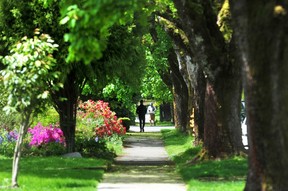
In 2025, the city approved an ambitious new urban forest strategy aimed at expanding Vancouver’s urban forest, which includes the trees on both public and private land, from about 25 per cent to 30 per cent by 2050.
-
Advertisement 1Story continues belowThis advertisement has not loaded yet, but your article continues below.
The city’s urban forest strategy report showed that although tree canopy has steadily expanded on both public and private land in Vancouver since 2013, it’s still unequally distributed across the city with more tree canopy coverage concentrated on Vancouver’s west side.
Barron said a complex set of historical factors have contributed to the lower tree canopy on Vancouver’s east side.
“The lots are larger on the west side, with potential for more private tree canopies. In some areas, street trees have been growing for a long time providing quite a broad canopy, and a lot of east side neighbourhoods that I have looked at have redeveloped more recently. Often when there is redevelopment the trees get lost, and they are not protected adequately or there could be damage during development.”
Development requires underground infrastructure for utilities and parking garages, which can impact the space required for healthy root volume as well, said Barron.

Barron called the 30 per cent goal for tree canopy coverage by 2050 “ambitious and achievable,” although several Canadian cities, including Maple Ridge, have set targets at 40 per cent.
“You get a huge return on investment if you put money in early in a tree’s life with proper pruning, watering and establishment in the first three to five years of a tree’s life,” said Barron.
One potential challenge is that many of the easier areas to plant trees, where there are wider sidewalks, less soil compaction and pavement, have already been used.
“We are running out of easy-to-plant spaces,” said Barron. Trees require space for roots, good soil, adequate drainage, and protection from cars, wind and sometimes humans.
A 2025 staff memo says the cost of planting new trees ranges widely depending on site conditions and tree type, from less than $100 a tree to as much as $20,000 a tree.
Tree infrastructure work in some areas could include the removal of paving, excavating and remediation to increase soil volume and quality.
“It does cost more per tree in some neighbourhoods that might have been historically focused on industry and have a lot more paved surfaces,” said Barron.
The project will be funded by the Federation of Canadian Municipalities growing Canada’s community canopies grant and matched by the city’s housing accelerator funding.
With Postmedia News files