
UN experts raise ‘serious concerns’ over potential India link to threats against Surrey Sikh activist
The special rapporteurs are urging the Canadian government to advance investigations into the threats
By Sobia Moman
You can save this article by registering for free here. Or sign-in if you have an account.
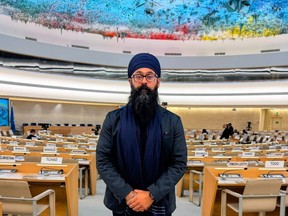
A group of human rights experts from the United Nations are encouraging Canada to investigate credible threats received by a Sikh activist from Surrey.

Subscribe now to read the latest news in your city and across Canada.
- Unlimited online access to articles from across Canada with one account.
- Get exclusive access to the Vancouver Sun ePaper, an electronic replica of the print edition that you can share, download and comment on.
- Enjoy insights and behind-the-scenes analysis from our award-winning journalists.
- Support local journalists and the next generation of journalists.
- Daily puzzles including the New York Times Crossword.
Subscribe now to read the latest news in your city and across Canada.
- Unlimited online access to articles from across Canada with one account.
- Get exclusive access to the Vancouver Sun ePaper, an electronic replica of the print edition that you can share, download and comment on.
- Enjoy insights and behind-the-scenes analysis from our award-winning journalists.
- Support local journalists and the next generation of journalists.
- Daily puzzles including the New York Times Crossword.
Create an account or sign in to continue with your reading experience.
- Access articles from across Canada with one account.
- Share your thoughts and join the conversation in the comments.
- Enjoy additional articles per month.
- Get email updates from your favourite authors.
Create an account or sign in to continue with your reading experience.
- Access articles from across Canada with one account
- Share your thoughts and join the conversation in the comments
- Enjoy additional articles per month
- Get email updates from your favourite authors
Sign In or Create an Account
The five UN special rapporteurs wrote to Ottawa expressing concern about the safety of Moninder Singh, who has been warned by Canadian police on four different occasions about threats to his life.
“Since Canadian authorities issued the latest ‘duty to warn’ notice in February 2026, according to the information received there is no publicly available evidence that any further protective and monitoring measures have been taken to ensure Mr. Moninder Singh’s safety,” the letter released over the weekend states.
Singh is a prominent Sikh activist in Surrey, who has been advocating for the Khalistan separatist movement and is an outspoken critic of human rights in India. He also heads the Sikh Federation Canada.
The letter states that the threats against Singh may be an attempt from India to intimidate him over his advocacy and work with the United Nations.
He first received a “duty to warn” notice from police in 2022, at the same time Hardeep Singh Nijjar was also warned, 11 months before Nijjar was gunned down as he was leaving the gurdwara in Surrey where he was president.
Singh received three more warnings, in August 2023, March 2025, and February 2026. The notice stated that police received “a credible and imminent threat to his life and that of his family” this year, also including Singh’s wife and two children.
“We are concerned that such threats fall within a broader pattern of transnational repression by Indian authorities against Sikh activists in different countries, including Canada,” the letter states.
When speaking with Postmedia on Tuesday, Singh said he did not know the letter was coming, but welcomed it, especially after law enforcement and some Canadian politicians have walked back previous statements saying India had a role in crimes in Canada.
After Nijjar’s killing, then-Canadian Prime Minister Justin Trudeau publicly accused India of being involved in the assassination, which was backed by Canadian intelligence. The Indian government denied all charges made, but the statements created tensions between the two countries.
-
Advertisement 1Story continues belowThis advertisement has not loaded yet, but your article continues below.
Relations improved after Mark Carney took office, followed by trade talks. Canadian officials downplaying the previous threat assessment.
“I think it’s a quite accurate assessment of India’s operations in Canada, regarding transnational repression,” Singh said. “There’s a bit of vindication here that the highest authority for human rights that is set up internationally has done an independent investigation and is finding that India is conducting transnational repression and targeting Sikh activists.”
The letter, signed by rapporteurs Ben Saul, Gina Romero, Andrea Bolanos Vargas, George Katrougalos and Nazila Ghanea, also notes that Singh was at times targeted either before or after he was scheduled to meet with UN members about the targeting of Sikh activists by Indian authorities.
UN special rapporteurs and experts are independent figures appointed by the Human Rights Council to report their findings. They are not officials with the UN or speak on behalf of it.
“We also urge the authorities to accelerate the investigations into these allegations, hold perpetrators accountable, ensure adequate remedy to victims and take all steps to prevent reoccurrence,” the letter states.
Singh’s focus, however, isn’t on himself as an individual.
“I’m not looking for protection for me. I’m an activist in the Sikh community and have a leadership role. I know exactly what I’m involved in when it comes to the freedom of our people,” Singh said.
“But I think the bigger question here is protecting Canada, its democratic institutions, its election processes — extortion, threats and coercion, and political assassination.”
The threats to Singh’s life are increasing, but he says he and his family are strong enough to handle it.
“This is much bigger than just one person,” Singh said.
“I think the silence that India wants — basically scaring people or forcing them into silence. That’s not something they’re going to get from myself, my family, or the Sikh community. I think the sentiment is that we’d rather be dead than silent because there is still some type of victory in that type of death.”