
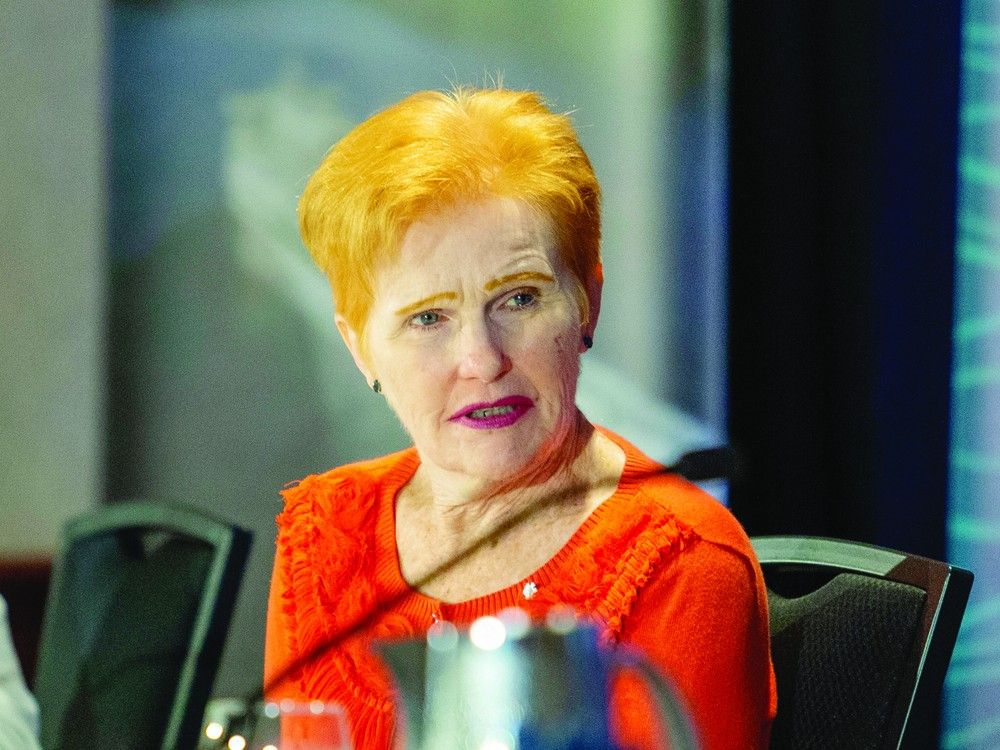
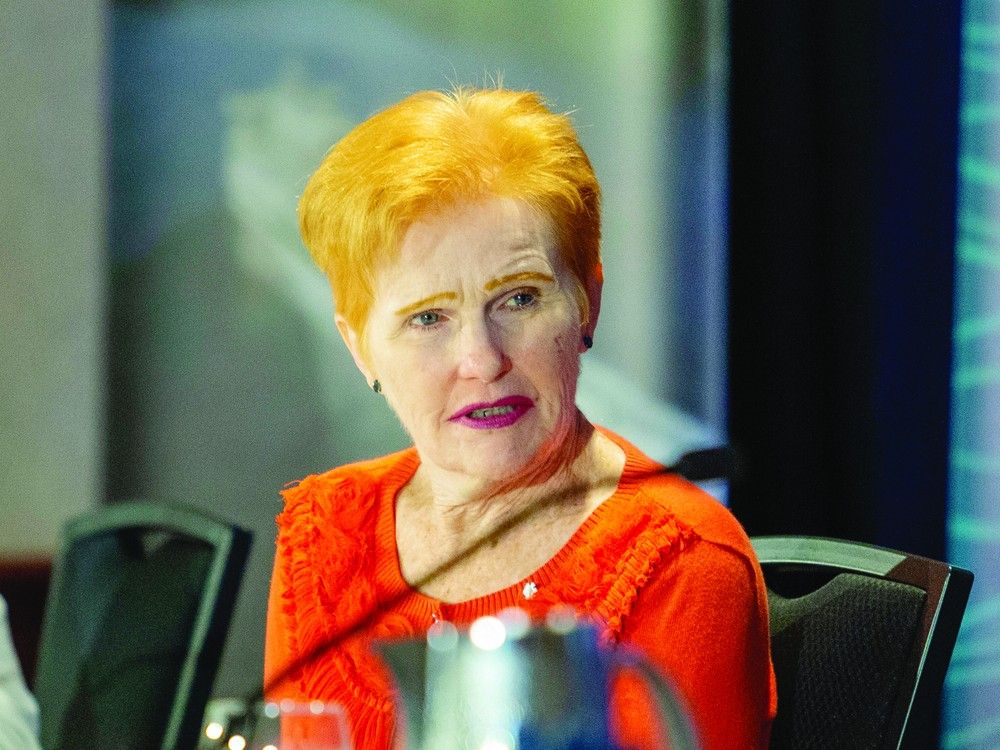
When Vancouver Magazine recently published its “Power 50 List,” Joy MacPhail emerged as the highest-ranking woman.
“Though she’s retired from politics, MacPhail remains a major influence on the NDP, being
for everything from ICBC to housing plans,” said Vancouver Magazine.
Such kudos touch just the tip of MacPhail’s vast influence, including over billions of public dollars involved in government-regulated ferries, ICBC and housing.
Now 73, the one-time spokesperson for the B.C. Federation of Labour has been taking part in some of the most impactful financial and policy decisions of the NDP government under premiers John Horgan and David Eby.
“Joy is a force of nature,” the late Horgan once said. “She has spent a lifetime fighting for affordable housing and economic equality. … She tackles even the thorniest problems with exuberance. She has what you might call a joy de vivre.”
Let’s look at some of MacPhail’s many spheres of influence where she has shown she’s not afraid of controversy.
In 2017, Horgan put enough trust in MacPhail to appoint her chair of the board of directors of the Insurance Corp. of B.C., where she served until 2022.
During that time she worked with then-attorney general David Eby to bring in his much-debated no-fault insurance model.
MacPhail’s ICBC board instituted Eby’s program to reduce rates, lower debt, minimize payouts, limit legal wrangling and ostensibly improve care for accident victims. Critics, however, say ICBC’s no-fault model often severely shortchanges people who suffer life-altering injuries in accidents.
Three years ago, MacPhail moved on to chair the board of directors of B.C. Ferries, one of the largest ferry systems in the world.
She was at the helm this year when the government-regulated corporation made its contentious decision to buy four new large vessels from a state-run shipyard in the People’s Republic of China.
The move has been controversial across the country and the world, given strained diplomatic relations between the West and China’s autocratic Communist leaders. B.C. Ferries refuses to name the total price tag for the four ferries; It states only that it saved $1.2 billion by making the deal with China. Last year MacPhail’s fee as B.C. Ferries chair was $100,000.
MacPhail is also involved in housing strategy. She has been chair for three years of the board at Nch’kay Corporation, the economic development arm of the Squamish Nation.
In 2002, MacPhail joined then Liberal prime minister Justin Trudeau and Eby to celebrate the Canada Mortgage and Housing Corporation giving a $1.4-billion low-interest loan to an arm of Nch’Kay to construct rental apartments at its Sen̓áḵw
The loan, which is the largest in CMHC history, is making possible a massive multi-tower project on Squamish Nation reserve land next to the Burrard Bridge in Kitsilano.
The Squamish Nation is also a co-owner in the MSTA Partnership, which has been called the largest real estate company in Canada. It was formed by the Squamish, Musqueam and Tsleil-Waututh Nations (collectively known as the MST Nations), along with Aquilini Developments.
MSTA intends to construct more than 60 residential towers throughout Metro Vancouver, particularly on Vancouver’s extensive Heather and Jericho Lands, which were in the past decade transferred to the Indigenous communities by the federal and provincial governments. Last month, MSTA asked the city of Vancouver to approve 16 towers up to 46 storeys on the Heather Lands, a substantial increase from its earlier application for buildings up to 28 storeys.
MacPhail had shown her pro-developer instincts a few years earlier. Before being appointed chair of Nch’kay Corp., McPhail was appointed by the provincial and federal governments to put together an expert panel on housing unaffordability in B.C.
It turned out the two governments’ experts panel, and its advisers, were dominated by the development industry and its allies, who convinced MacPhail and the NDP the solution to unaffordability was to cut municipal red tape to make it easier to build more housing supply.
Critics says the 2021 report released by the expert panel, which was chaired by MacPhail, paved the way for the NDP’s legislation to upzone much of the province, weaken local democracy and
to automatically approve small apartment buildings on virtually all detached properties, as well as towers around transit hubs.
On top of all this
,
MacPhail was in 2018 appointed chair of the board of trustees of private Adler University in Vancouver, which trains roughly 1,400 students for various mental health professions at what its website describes as “Canada’s only university dedicated to social justice.”
In an overlap of psychology and housing development, high-profile Vancouver condo marketer Bob Rennie a few years ago hosted an Adler University fundraising event for scholarships in MacPhail’s name.
These days, MacPhail tends to stay out of the public eye. That’s even while she received membership in the Order of Canada in 2021 and the Order of B.C. in 2022. She continues to take part in a variety of philanthropic, social-justice efforts. Postmedia attempted to reach her for an interview.
It’s not clear how much she participates in the politics of the provincial NDP, for which she once ran to be leader.
Online data from Elections B.C. show MacPhail donated roughly $2,000 in small payments to the provincial NDP, mostly in 2007 and 2008 — with an additional one-time donation of $370 in 2022. Her husband, TV producer James Shavick, with whom she co-owns a cable television station focused on LGBTQ issues, has donated more than $25,000 to the B.C. NDP since 2005. Such donations are not uncommon.
There is little doubt MacPhail is a top contender for the province’s most powerful woman, with a history of bold decisions over a long career. MacPhail could be seen as a model for women and men who want to contribute in their senior years, showing what some might call fearless leadership.
That said, she’s been involved in a number of controversial decisions that continue to warrant debate.