
No society in history has improved its standard of living without low-cost energy: B.C. expert
Douglas Todd: The energy debate in Canada has flipped upside down. People are still concerned about climate change, but polls suggest people are ready for the realistic “energy literacy” advanced by Don Wright.
By Douglas Todd
Last updated 9 hours ago
You can save this article by registering for free here. Or sign-in if you have an account.
Canada’s energy debate has suddenly flipped upside down.

Subscribe now to read the latest news in your city and across Canada.
- Unlimited online access to articles from across Canada with one account.
- Get exclusive access to the Vancouver Sun ePaper, an electronic replica of the print edition that you can share, download and comment on.
- Enjoy insights and behind-the-scenes analysis from our award-winning journalists.
- Support local journalists and the next generation of journalists.
- Daily puzzles including the New York Times Crossword.
Subscribe now to read the latest news in your city and across Canada.
- Unlimited online access to articles from across Canada with one account.
- Get exclusive access to the Vancouver Sun ePaper, an electronic replica of the print edition that you can share, download and comment on.
- Enjoy insights and behind-the-scenes analysis from our award-winning journalists.
- Support local journalists and the next generation of journalists.
- Daily puzzles including the New York Times Crossword.
Create an account or sign in to continue with your reading experience.
- Access articles from across Canada with one account.
- Share your thoughts and join the conversation in the comments.
- Enjoy additional articles per month.
- Get email updates from your favourite authors.
Create an account or sign in to continue with your reading experience.
- Access articles from across Canada with one account
- Share your thoughts and join the conversation in the comments
- Enjoy additional articles per month
- Get email updates from your favourite authors
Sign In or Create an Account
Federal and B.C. politicians, once mostly opposed to pipelines, are now falling over themselves to promise new gas, oil and hydro-electric mega-projects.

tap here to see other videos from our team.
No society in history has improved its standard of living without low-cost energy: B.C. expert Back to video
The era of the “de-growth movement” has slammed to an end. Few advocate anymore for dismantling capitalism and reducing production in hopes of achieving social and ecological well-being.
Canadian opinion polls reveal the public still want to combat climate change, but it’s no longer their top issue. Polls reveal more support for economic growth, including a hunger for new sources of energy — especially wind and solar, but also LNG, nuclear and crude oil.
Under pressure from the public and conservative politicians, both the federal Liberals and B.C. NDP have chopped their carbon taxes. In a year in which billionaire Bill Gates, a climate activist, declared that global warming “will not lead to humanity’s demise,” Canadian politicians are rushing to build pipelines.
It’s hard to keep track of all the flip-flops. Fortunately, one reliable source, who has no axe to grind and a refreshing balance of idealism and pragmatism, has come up with a timely, long-range analysis of just how we could be thinking about the future of energy. It’s already provoking debate.
Harvard-trained economist Don Wright, the former head of B.C.’s civil service under John Horgan and a senior minister under Gordon Campbell, put out a primer this fall on “energy literacy”.
He reminds us no society in history has ever improved its standard of living without inexpensive energy.
The so-called energy transition — which posits the planet is destined to shift away from fossil fuels — still symbolizes an important ambition, Wright says. But it will be harder to attain than expected.
That is despite the hope many are putting in solar and wind power. Only last month, optimists such as Elon Musk claimed “solar electricity will become by far the biggest source of power for civilization.”
While Wright is more skeptical, even his opponents accept he has integrity and impeccable credentials.
Canadian environmentalist Max Fawcett, who publicly critiqued Wright’s arguments, nevertheless respects his “thoughtfulness,” and his range of senior roles in the public and private sectors, including as president of both the B.C. Institute of Technology and Central 1 Credit Union. Wright maintains positions with the Public Policy Forum of Canada, C.D. Howe Institute and Global Public Affairs.
One chart that Wright posts in his data-filled, four-part Substack series makes it clear that cheap energy, in whatever form, has been crucial to humans escaping lives that were once nasty, brutish and short.
Hundreds of millions of people around the world began escaping subsistence living in the early 1800s largely because of a “thermodynamic” revolution, Wright says. It has led to more wealth per person, drastically lowered extreme poverty, reduced child mortality and increased life expectancy.
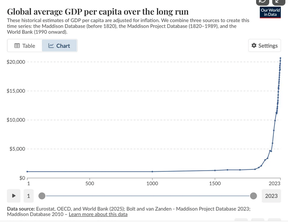
“It is no coincidence that the exponential growth in GDP per capita starting after 1820 coincides with the rapid growth of coal use,” Wright says. “Coal was subsequently supplemented with other sources of energy — oil, natural gas, hydroelectricity, nuclear, and over the past 20 years, growing amounts of solar, wind and other sources,” he says.
“At a fundamental level, the explanation of the increasing standard of living of the past 200 years is a thermodynamic one. … There are no high-income, low-energy countries.”
The famous American architect and visionary Buckminster Fuller came up with a vivid analogy for how the energy revolution was occurring.
Fuller introduced the notion of “energy slaves”. The inventor of the geodesic dome (like Vancouver’s Science World) explained that the amount of work done by a human slave is now widely available through the labour-augmenting power of inanimate energy sources.
“In 1950, Fuller calculated there were approximately 38 energy slaves for every actual person in the world,” Wright says. “I calculate there are now roughly 76 energy slaves for every living person. Those energy slaves are spread unequally around the world. Canadians ‘employ’ about 340 energy slaves each. People living in the Central African Republic have access to only one energy slave each.”
Clearly, poorer countries still have a tremendous amount of catching up to do on energy. While most Canadians don’t have the 2,000-year, geo-historical perspective of Wright, many seem to be suddenly more open to his kind of message.
The proportion of Canadians who believe climate change is the top issue has dropped to 18 per cent in 2025, down from 44 per cent six years ago, according to the Angus Reid Institute. The number who believe “energy policy should prioritize economic growth” has doubled since 2023, to 43 per cent.
“Support for the expansion of wind (72 per cent) and solar (77 per cent) is still high but has declined by five and seven points, respectively, from 2021,” says the Institute. More than half of Canadians now also want to see more LNG, crude oil, and nuclear expansion.
Yet, contrary to the hopes and dreams of many of us that solar, wind, hydroelectric (and even carbon-free nuclear) power are rapidly taking over from fossil fuels, Wright offers a dose of hard reality.
In the past 20 years, wind and solar power have indeed been expanding as a proportion of all energy sources.
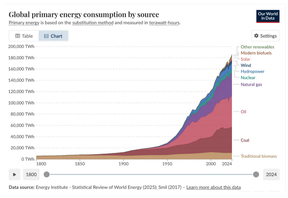
But coal, oil and natural gas are not being phased out. Their consumption continues to increase too.
Take, for example, China, which many cite as a champion of “ecological civilization,” symbolizing the planet’s inevitable transition to sustainable energy.
There is something to China’s boasts, since wind and solar power now account for about one-third of its energy production. China is also building a hydro dam of unbelievable proportions. The Yarlung Tsangpo project will produce 66 gigawatts of electricity — 50 times that of B.C.’s Site C Dam.
The trouble is China also continues to build more coal plants, while expanding natural gas production and escalating oil consumption. “Why,” asks Wright, “would it be doing this if it believed that the future will be dominated by wind and solar?”
Not to despair, however.
Even though the energy transition “will be slower than advertised,” Wright says, “I am not saying that (clean) electrification of many activities will not be an important part of the decarbonization path. The challenge will be building out an electricity system that is reliable, inexpensive and less carbon intense.”
Wind and solar will become more important in producing electricity. Nuclear and geothermal power are also proving valuable. And storage batteries are now much better.
Yet, if we want to be “energy literate,” we must realize there is a long road ahead.
x.com@douglastodd
Get the latest from Douglas Todd straight to your inbox