
Carney to scrap EV mandate for emissions reduction plan and incentive for cars under $50k
The government is also expected to announce $1.5 billion in new funding to help grow the EV charging network across the country
By Christopher Nardi, Stephanie Taylor
Last updated 7 hours ago
You can save this article by registering for free here. Or sign-in if you have an account.
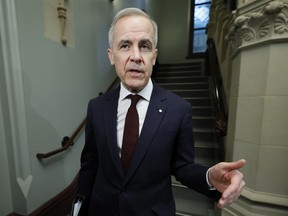
OTTAWA — Prime Minister Mark Carney announced Thursday he was scrapping the controversial electric vehicle mandate implemented by his Liberal predecessor, replacing it with more stringent tailpipe regulations and introducing a new purchase incentive for electric vehicles priced under $50,000.

Subscribe now to read the latest news in your city and across Canada.
- Unlimited online access to articles from across Canada with one account.
- Get exclusive access to the Vancouver Sun ePaper, an electronic replica of the print edition that you can share, download and comment on.
- Enjoy insights and behind-the-scenes analysis from our award-winning journalists.
- Support local journalists and the next generation of journalists.
- Daily puzzles including the New York Times Crossword.
Subscribe now to read the latest news in your city and across Canada.
- Unlimited online access to articles from across Canada with one account.
- Get exclusive access to the Vancouver Sun ePaper, an electronic replica of the print edition that you can share, download and comment on.
- Enjoy insights and behind-the-scenes analysis from our award-winning journalists.
- Support local journalists and the next generation of journalists.
- Daily puzzles including the New York Times Crossword.
Create an account or sign in to continue with your reading experience.
- Access articles from across Canada with one account.
- Share your thoughts and join the conversation in the comments.
- Enjoy additional articles per month.
- Get email updates from your favourite authors.
Create an account or sign in to continue with your reading experience.
- Access articles from across Canada with one account
- Share your thoughts and join the conversation in the comments
- Enjoy additional articles per month
- Get email updates from your favourite authors
Sign In or Create an Account
Carney released the details of the government’s new auto sector strategy at a press conference in Vaughan, Ont. National Post obtained details from a provincial source briefed on the announcement beforehand.

tap here to see other videos from our team.
Carney to scrap EV mandate for emissions reduction plan and incentive for cars under $50k Back to video
tap here to see other videos from our team.
“This is a great day,” the prime minister said.
He announced the Liberals would officially kill the increasingly unpopular 100 per cent zero-emission vehicle sales target by 2035, colloquially called the EV sales mandate. Most auto manufacturers and industry representatives as well Ontario Premier Doug Ford have called for the elimination of the Justin Trudeau-era policy, arguing it was an unrealistic timeline.
It comes after Carney announced back in September that he would pause the policy, which was set to take effect for the 2026 model year, with his government consulting with industry.
Carney announced on Thursday that the mandate, known by its technical title as the “Electric Vehicle Availability Standard,” which was first released back in 2023, would be replaced by more stringent tailpipe emissions regulations, which aim to reduce the amount of pollutant gases emitted by vehicles.
He said replacing the mandate with other standards “focuses on the results that matter to Canadians, while avoiding placing undue burdens on the Canadian auto industry,” the prime minister said.
“This approach allows manufacturers to use a wide range of technologies to meet the standards and to respond to consumer preferences in the near term, all while driving EV adoption over time.”
Officials, who spoke to reporters on a not-for-attribution briefing, said companies would be forced to use more zero-emission vehicles as the regulations were strengthened, with more details to come, including on specific estimates for the reduction of emissions.
The government said the goal was to drive a 75 per cent adoption rate for zero-emission vehicles by 2035, with the goal of hitting 90 per cent by 2040. The new regulations would be reviewed in five years.
Rick Smith, president of the Canadian Climate Institute, a policy think-tank, said in a statement that whether the newly announced suite of measures drives more Canadians to purchase electric vehicles “will be determined by how — and how quickly — these policies are finalized and implemented.”
“For instance, while the improved vehicle efficiency standards provide manufacturers with greater compliance flexibility, they don’t guarantee more EVs will be available to Canadians,” Smith said.
On top of that, Carney announced his government would partially resume popular EV purchase incentives that expired after the original federal program ran out of money in 2024. This time, the government will offer purchase incentives ranging from $2,000 to $5,000, but only on vehicles with a price tag under $50,000 that are covered by a free-trade agreement with Canada.
That means the Chinese EVs that are expected to be imported to Canada under a new agreement with China lifting nearly all tariffs on 49,000 vehicles annually will not be eligible for the new incentive. Instead, it is most likely to apply mainly to vehicles from American manufacturers covered by the Canada-U.S.-Mexico free trade deal.
Carney said on Thursday the goal was for roughly half of those 49,000 Chinese-made electric vehicles to be priced at $35,000 or less.
“The incentive is in the price,” the prime minister said.
The government plans to make the incentives, the return of which Carney campaigned on during last year’s federal election, available starting on Feb. 16.
It has earmarked spending $2.3 billion over five years on the new program, with the goal of driving new purchases of 840,000 electric vehicles
The program has been structured to see the incentives decrease over time, with slightly more than 20 vehicle models eligible for the new rebates, including the Tesla Model Y, with officials saying dealerships may be open to shifting their price points on other vehicles to qualify.
Carney said the $50,000 cap for incentives would not apply to Canadian-made battery electric or plug-in hybrid vehicles.
The Canadian Automobile Dealers Association welcomed the government’s decision, with its president and CEO, Tim Reuss, saying in a statement that it showed the Carney government’s willingness to “respond to market realities and consumer demand.”
The Opposition Conservatives criticized the months it took for Carney to announce it was getting rid of the electric vehicle mandate, saying that it only fuelled “uncertainty” within the auto-sector.
The party also said the rebates would benefit American companies over Canadian workers, saying it amounted to subsidizing “foreign-made EVs.”
“In fact, the rebate will now help American EV producers that relocated to the US from Canada because of American tariffs,” reads a joint statement from Raquel Dancho and Kyle Seeback, the Conservative critics for industry and labour, respectively.
The government also announced $1.5 billion in new funding to help grow the EV charging network across the country.
Carney acknowledged that many Canadians worry about charging capacity, especially in rural Canada.
“So wherever you live in Canada, charging your vehicle should become as simple as filling your gas tank,” he said.
The strategy also includes the purchase of billions in supports for Canadian vehicle and auto part manufacturers, such as $3 billion in new funding for auto parts manufacturers via the federal Strategic Response Fund. In addition, the government earmarked $750 million in training supports for workers.
The prime minister also announced the start of a consultation on an auto sector tariff remittance plan as Canada, the U.S. and Mexico begin a major review of CUSMA. The plan will look into ways to remit tariffs to vehicle and auto part manufacturers who are heavily impacted by the ongoing tariff war with the U.S. amid the uncertainty of what will come of the CUSMA review.
Carney said Canada maintains its position that it wants to see zero tariffs within the auto industry, as U.S. President Donald Trump has staked his promise on attracting more manufacturing jobs south of the border through the imposition of tariffs.
“But if the U.S, through the CUSMA review, insists on some form of auto tariffs, we’ll ensure that companies that sell vehicles in Canada are strongly incentivized to produce in Canada,” the prime minister said.
Brian Kingston, president and CEO of Canadian Vehicle Manufacturers’ Association, that represents Ford, General Motors and Stellantis and had pressed Carney to repeal the EV mandate, said in a statement that the top priority for industry was “the removal of U.S. tariffs and the renewal of CUSMA.
The strategy announced Thursday is a flagship policy for Carney, who is working to pull Canada’s auto sector away from total dependence on the United States by attracting new investment from European and, increasingly, Asian manufacturers.
Last month, the prime minister visited China and announced Canada would drop its 100 per cent tariffs on Chinese EVs — considered by many analysts to be the cheapest and most technologically advanced in the world thanks to heavy government subsidies — on 49,000 vehicles this year and up to 70,000 within five years.
In exchange, Carney expects Chinese vehicle companies to invest in building up local manufacturing in Canada, including an auto plant within the next few years, he told reporters in Beijing.
National Post
cnardi@postmedia.com
Our website is the place for the latest breaking news, exclusive scoops, longreads and provocative commentary. Please bookmark nationalpost.com and sign up for our politics newsletter, First Reading, here.