
B.C. climate news: Carney amends EV mandate for emissions, replaces with incentive for cars under $50,000 | China to boost batteries sector in push for clean energy transition
Here’s all the latest local and international news concerning climate change for the week of Feb. 2 to Feb. 8, 2026.
You can save this article by registering for free here. Or sign-in if you have an account.
Here’s the latest news concerning climate change and biodiversity loss in B.C. and around the world, from the steps leaders are taking to address the problems, to all the up-to-date science.

Subscribe now to read the latest news in your city and across Canada.
- Unlimited online access to articles from across Canada with one account.
- Get exclusive access to the Vancouver Sun ePaper, an electronic replica of the print edition that you can share, download and comment on.
- Enjoy insights and behind-the-scenes analysis from our award-winning journalists.
- Support local journalists and the next generation of journalists.
- Daily puzzles including the New York Times Crossword.
Subscribe now to read the latest news in your city and across Canada.
- Unlimited online access to articles from across Canada with one account.
- Get exclusive access to the Vancouver Sun ePaper, an electronic replica of the print edition that you can share, download and comment on.
- Enjoy insights and behind-the-scenes analysis from our award-winning journalists.
- Support local journalists and the next generation of journalists.
- Daily puzzles including the New York Times Crossword.
Create an account or sign in to continue with your reading experience.
- Access articles from across Canada with one account.
- Share your thoughts and join the conversation in the comments.
- Enjoy additional articles per month.
- Get email updates from your favourite authors.
Create an account or sign in to continue with your reading experience.
- Access articles from across Canada with one account
- Share your thoughts and join the conversation in the comments
- Enjoy additional articles per month
- Get email updates from your favourite authors
Sign In or Create an Account
Check back every Saturday for more climate and environmental news or sign up for our Sunrise newsletter HERE.

tap here to see other videos from our team.
B.C. climate news: Carney amends EV mandate for emissions, replaces with incentive for cars under $50,000 | China to boost batteries sector in push for clean energy transition Back to video
tap here to see other videos from our team.
In climate news this week:
• Carney amends EV mandate for emissions, brings in incentive for cars under $50,000
• Calgary among diminishing number of locations cold enough to host Winter Olympic Games
• China to boost batteries sector with new grid backup policy in push for clean energy transition
Human activities like burning fossil fuels and farming livestock are the main drivers of climate change, according to the UN’s intergovernmental panel on climate change. This causes heat-trapping greenhouse gas levels in Earth’s atmosphere, increasing the planet’s surface temperature.
The panel, which is made up of scientists from around the world, including researchers from B.C., has warned for decades that wildfires and severe weather, such as the province’s deadly heat dome and catastrophic flooding in 2021, would become more frequent and intense because of the climate emergency. It has issued a code red for humanity and warns the window to limit warming to 1.5 C above pre-industrial times is closing.
According to NASA climate scientists, human activities have raised the atmosphere’s carbon dioxide content by 50 per cent in less than 200 years, and “there is unequivocal evidence that Earth is warming at an unprecedented rate.”
As of Feb. 5, carbon dioxide in the atmosphere was 428.62 parts per million, up from 427.49 ppm last month and 426.46 in December, according to the latest available data from the NOAA measured at the Mauna Loa Observatory, a global atmosphere monitoring lab in Hawaii. The NOAA notes there has been a steady rise in CO2 from under 320 ppm in 1960.

-
Advertisement 1Story continues belowThis advertisement has not loaded yet, but your article continues below.
Quick facts:
• The global average temperature in 2023 reached 1.48 C higher than the pre-industrial average, according to the EU’s Copernicus Climate Change Service. In 2024, it breached the 1.5 C threshold at 1.55 C.
• 2025 was the third warmest on record after 2024 and 2023, capping the 11th consecutive warmest years.
• Human activities have raised atmospheric concentrations of CO2 by nearly 49 per cent above pre-industrial levels starting in 1850.
• The world is not on track to meet the Paris Agreement target to keep global temperature from exceeding 1.5 C above pre-industrial levels, the upper limit to avoid the worst fallout from climate change including sea level rise, and more intense drought, heat waves and wildfires.
• UNEP’s 2025 Emissions Gap Report, released in early December, shows that even if countries meet emissions targets, global temperatures could still rise by 2.3 C to 2.5 C this century.
• In June 2025, global concentrations of carbon dioxide exceeded 430 parts per million, a record high.
• There is global scientific consensus that the climate is warming and that humans are the cause.

Latest News
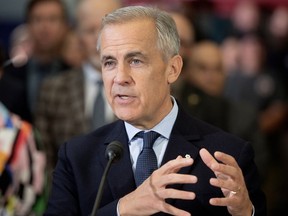
Prime Minister Mark Carney announced Thursday he was amending the controversial electric vehicle mandate implemented by his Liberal predecessor, replacing it with more stringent tailpipe regulations and introducing a new purchase incentive for electric vehicles priced under $50,000.
Carney released the details of the government’s new auto sector strategy at a press conference in Vaughan, Ont. National Post obtained details from a provincial source briefed on the announcement beforehand.
“This is a great day,” the prime minister said.
He announced the Liberals would officially kill the increasingly unpopular 100 per cent zero-emission vehicle sales target by 2035, colloquially called the EV sales mandate. Most auto manufacturers and industry representatives as well Ontario Premier Doug Ford have called for the elimination of the Justin Trudeau-era policy, arguing it was an unrealistic timeline.
The government said the goal was to drive a 75 per cent adoption rate for zero-emission vehicles by 2035, with the goal of hitting 90 per cent by 2040. The new regulations would be reviewed in five years.
—Christopher Nardi, Stephanie Taylor
Calgary chose not to bid for this year’s Winter Olympics and Paralympics, but by 2050, it may be one of the few cities in the world with the weather capable of hosting the Games.
A study published in January found that of the 93 mountain locations that have the winter infrastructure required to host the Winter Olympics, only 52 cities will still have a reliably cold enough climate to do so by the 2050s.
It’s a much more sombre outlook for the Paralympics, where authors found only 22 locations could be considered reliable hosts by 2050 — and down to 16 by 2080.
The study was led by University of Waterloo professor Daniel Scott, co-authored by University of Innsbruck associated professor Robert Steiger and University of Toronto professor Madeleine Orr.
It builds on research published two years ago, with suggestions on how the Games could be adapted to account for rising temperatures around the world — for example, merging the two events, shifting schedules by a few weeks or relying on multiple countries to host the event.
—Calgary Herald
The Chinese government will help underpin the nationwide boom in large-scale batteries by expanding its subsidies for energy storage.
Beijing has for the first time instructed provinces to include batteries in a payment program that’s designed to ensure reliable electricity supplies and enhance the green transition, according to a notice from economic planners late last week. The move could boost revenues and unlock even more growth in an industry already marked as a key driver of economic development.
The new payments will provide “missing money” for struggling grid projects, said Ian Yao, a senior manager focusing on electricity markets at consultancy The Lantau Group. “It’s definitely a positive signal,” he said. “If you invest in battery storage, you can get a payment based on your capacity, so you don’t need to always worry about whether you get dispatched.”
China’s rapid adoption of renewable energy requires a flexible power source to smooth out fluctuations in wind and solar generation. China’s old policy, formulated in 2023 after a spate of severe blackouts, rewarded the country’s vast fleet of coal-fired power plants for maintaining readiness to meet peak electricity demand.
—Bloomberg News
The Saskatchewan Environmental Society is looking to get the dismissal of a legal action it brought against the provincial government for plans to keep using coal power overturned.
The SES, along with Citizens for Public Justice and three private citizens, is asking the Saskatchewan Court of Appeal to overturn a Jan. 12 ruling out of Saskatoon Court of King’s Bench, which struck down their legal challenge.
The environmental society said the court found the decision to continue using coal power was a matter of government policy and therefore not subject to judicial review. The group added the court did not review evidence or decide if the decision was lawful or justified as it had requested.
The province said it was “pleased” with the court’s decision to strike the legal action. The government has defended its plan to keep running coal fire power plants past 2030 in defiance of federal regulations as necessary to preserve grid reliability and affordability.
—Saskatoon StarPhoenix
One of the possible reasons for the increase in falls among older adults observed over the past two decades is climate change, suggests Dr. Sidonie Pénicaud, a physician with Montreal’s public health department specializing in public health and preventive medicine.
“The winters we have are not the winters we had years ago,” she told The Gazette. “There is more freezing and thawing — conditions that lead to icy roads and sidewalks: maybe more freezing rain. All these things can lead to more slippery conditions and more falls.”
It is known that the number of falls increases with age, starting at 60, Pénicaud said. Of the 6,575 Montrealers hospitalized because of a fall in 2021, more than four out of five were older than 65 and, among them, 2,624 were 85 or older. That year, there were 275 deaths attributable to falls.
Two recent studies, collaborations between Montreal’s department of public health and Urgences-santé, provided portraits of falls among older adults in the Montreal area. A study on outdoor falls between 2016 and 2020 came out in 2023 and a complementary study on indoor falls between 2015 and 2021 was published in 2025.
Article content
—Montreal Gazette
China’s clean energy industries drove more than 90 per cent of the country’s investment growth last year, making the sectors bigger than all but seven of the world’s economies, according to a report by The Guardian.
The media outlet reported on new analysis from the Centre for Research on Energy and Clean Air, which showed the manufacture, installation and export of batteries, electric cars, solar, wind and related technologies accounted for more than a third of China’s economic growth.
The Guardian notes that despite the chilling effect of U.S. President Donald Trump’s tariffs and support for fossil fuels, the new data highlighted the continuing momentum behind the shift towards renewables.
It found that China’s clean-energy sectors nearly doubled in real value between 2022 and 2025.
—The Guardian
Saudi Arabia will invest around $2 billion to build solar power plants in Turkey, in the first stage of a broader renewable-energy deal between the countries. Turkish energy stocks rose on the news.
Saudi companies will initially develop solar projects capable of generating 2,000 megawatts in Turkey’s Sivas and Karaman provinces, followed by 3,000MW of additional wind and solar capacity to be finalized later, according to an intergovernmental agreement signed in Riyadh on Tuesday.
The deal includes a 50 per cent localization rate, which “will make a significant contribution to the electrical equipment and service sectors” in Turkey, the country’s Energy Minister Alparslan Bayraktar wrote on X. Bayraktar added that the projects will use external financing, including from international institutions.
Shares of Turkish energy companies rallied after the announcement. Renewable energy firms led the gains, with solar panel producers Kalyon Gunes Teknolojileri Uretim AS and Smart Gunes Enerjisi Teknolojileri AS rising 10 per cent and 6.4 per cent, respectively. Utility Zorlu Enerji Elektrik Uretim AS climbed 4.4 per cent.
—Bloomberg News
The Australian arm of Octopus Energy Group Ltd. will acquire two local battery projects worth more than A$3 billion ($2.1 billion), expanding the UK company’s footprint in a country that’s seeking to rapidly replace its aging coal fleet with clean energy sources.
Octopus Australia bought the A$2.4 billion Hanworth Battery Energy Storage System in New South Wales as well as the Dunmore Solar Farm and Battery project in Queensland, which is worth about $900 million, the company said in a statement.
Australia has become a bellwether for the energy transition, as it seeks to replace its rapidly aging coal power stations and meet an ambitious target to more than double renewable energy generation to 82 per cent by 2030. This has helped to drive a boom in batteries, which can soak up surplus electricity generated by the country’s world-leading solar panel fleet through the day and release it in the evening, when demand is highest and output wanes.
“Australia still needs new power stations to replace ageing coal plants,” Octopus Australia Chief Executive Officer Sam Reynolds said in the statement. “The difference is that today we can build them using a mix of solar, wind and batteries instead of smokestacks.”
Octopus is seeking new avenues for growth overseas after reporting a full-year loss, which was driven by lower gas consumption and one-time costs. The company, in which Australian utility Origin Energy Ltd. is an investor, took an initial step in spinning off its software unit at an $8.7 billion valuation late last year.
—Bloomberg News
I’m a breaking news reporter but I’m also interested in writing stories about health, the environment, climate change and sustainable living, including zero-waste goals. If you have a story idea related to any of these topics please send an email to ticrawford@postmedia.com