
Most Canadians agree with David Eby that Alberta separatists asking U.S. for help is treasonous: poll
‘Canadians treat appeals to foreign governments for help in breaking up the country as beyond the pale,’ said the pollster
By Chris Lambie
Last updated 16 hours ago
You can save this article by registering for free here. Or sign-in if you have an account.
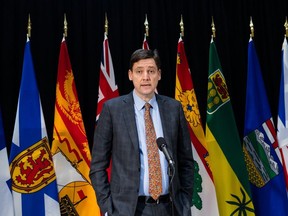
Seventy-one per cent of Canadians agree with B.C. Premier David Eby’s recent statement that “to go to a foreign country and to ask for assistance in breaking up Canada, there’s an old-fashioned word for that, and that word is treason,” according to a new poll from Canada Pulse Insights.

Subscribe now to read the latest news in your city and across Canada.
- Unlimited online access to articles from across Canada with one account.
- Get exclusive access to the Vancouver Sun ePaper, an electronic replica of the print edition that you can share, download and comment on.
- Enjoy insights and behind-the-scenes analysis from our award-winning journalists.
- Support local journalists and the next generation of journalists.
- Daily puzzles including the New York Times Crossword.
Subscribe now to read the latest news in your city and across Canada.
- Unlimited online access to articles from across Canada with one account.
- Get exclusive access to the Vancouver Sun ePaper, an electronic replica of the print edition that you can share, download and comment on.
- Enjoy insights and behind-the-scenes analysis from our award-winning journalists.
- Support local journalists and the next generation of journalists.
- Daily puzzles including the New York Times Crossword.
Create an account or sign in to continue with your reading experience.
- Access articles from across Canada with one account.
- Share your thoughts and join the conversation in the comments.
- Enjoy additional articles per month.
- Get email updates from your favourite authors.
Create an account or sign in to continue with your reading experience.
- Access articles from across Canada with one account
- Share your thoughts and join the conversation in the comments
- Enjoy additional articles per month
- Get email updates from your favourite authors
Sign In or Create an Account
The survey comes in the wake of claims that leaders of the Alberta Prosperity Project — a separatist group pushing for the energy province’s independence — have met with U.S. government officials three times in Washington since last spring. The group has said they are trying to secure a US$500 billion line of credit.

tap here to see other videos from our team.
Most Canadians agree with David Eby that Alberta separatists asking U.S. for help is treasonous: poll Back to video
tap here to see other videos from our team.
“My sense was overall Canadians treat appeals to foreign governments for help in breaking up the country as beyond the pale. It’s effectively a red line that most are prepared to call treason,” Canada Pulse Insights CEO John Wright said in a recent interview.
Even though they were told ahead of time that none of the activities of the Alberta Prosperity Project met the definition of treason or sedition under the Criminal Code, those polled in Saskatchewan and Manitoba were most likely to agree with Eby (82 per cent), followed by Atlantic Canada (78 per cent), Ontario (77 per cent), British Columbia (75 per cent), Quebec (63 per cent) and Alberta (56 per cent).
Canadians aged 65 and up were most likely to agree with Eby’s treason comment (79 per cent), as were people earning less than $99,000 annually (74 per cent).
Nationally, 29 per cent of those polled disagreed with Eby’s treason comment, as did 44 per cent of Albertans, followed by Quebec (37 per cent), British Columbia (25 per cent), Ontario (23 per cent), Atlantic Canada (22 per cent), as well as Saskatchewan and Manitoba at 18 per cent.
Canadians between the ages of 35 and 54 (36 per cent) and those earning more than $100,000 a year (35 per cent) were most likely to disagree with the treason statement.
-
Advertisement 1Story continues belowThis advertisement has not loaded yet, but your article continues below.
Eighty-one per cent of Canadians agree with Eby’s statement that “it is completely inappropriate to seek to weaken Canada, to go and ask for assistance to break up this country from a foreign power,” according to the poll.
British Columbians were most likely to side with their premier’s “foreign power” comment (86 per cent), followed by Ontario residents (83 per cent) and Atlantic Canadians (83 per cent), Saskatchewan and Manitoba (82 per cent), Quebec (78 per cent) and Alberta (69 per cent).
Canadians over the age of 54 were most likely (86 per cent) to agree with Eby on that front, as were women (82 per cent) and those earning less than $50,000 yearly (83 per cent).
Nineteen per cent of Canadians disagreed with Eby, including 31 per cent of Albertans, followed by Quebec (22 per cent), Saskatchewan and Manitoba (18 per cent), Ontario (17 per cent) and British Columbia (14 per cent). Adults under the age of 54 (23 per cent) and men (21 per cent) were most likely to disagree with this view.
“In Alberta, basically a third of the people push back on this,” Wright said. “And I don’t know whether or not that means we have a third of the people who are so aggrieved that if there were a referendum they would come forward and vote in that way. We haven’t yet had the debate.”
More than half of those polled (53 per cent) disagreed with Alberta Premier Danielle Smith’s statement that: “The idea that we are somehow committing treason because we are discussing what an independent Alberta would look like is a desperate attempt to chill free speech.”
People were most likely to disagree in Ontario (58 per cent) and British Columbia (57 per cent), followed by those living in Atlantic Canada (50 per cent), Quebec (49 per cent) and Alberta (45 per cent).
Women were more likely to disagree with Smith (57 per cent), as were those with a postsecondary education (56 per cent), and Canadians older than 34 (56 per cent).
Just under half (47 per cent) of Canadians agree with Smith’s statement about chilling free speech — led by those living in Alberta (55 per cent), and followed by residents of Quebec (51 per cent), Atlantic Canada (50 per cent), Saskatchewan and Manitoba (45 per cent), British Columbia (43 per cent) and Ontario (42 per cent).
While most disagreed with Smith’s view on that count, the majority of Canadians sided with this statement from the Alberta premier: “I’m not going to demonize or marginalize a million of my fellow citizens when they’ve got legitimate grievances.”
Fifty-nine per cent of Canadians embrace that view, with Alberta residents being the most likely to agree (64 per cent), followed by those living in Saskatchewan, Manitoba, Quebec, and Atlantic Canada (all at 62 per cent) and British Columbia and Ontario (55 per cent). Canadians ages 18 to 34 (65 per cent) and men (60 per cent) are most likely to support this view, according to the poll.
“There is some sympathy here,” Wright said. “They don’t want leaders to write-off or stigmatize the citizens who are angry enough to flirt with separatist ideas. Canadians expect leaders to address the underlying grievances, not just condemn the most extreme expressions.”
Forty-one per cent of Canadians polled disagreed with Smith’s legitimate grievances statement, lead by British Columbia and Ontario residents (45 per cent), followed by those living in Saskatchewan, Manitoba, Québec, and Atlantic Canada (all at 38 per cent) and Alberta (36 per cent). Canadians 55 and up have the strongest pushback on this sentiment (46 per cent), according to the pollster.
Most Canadians (72 per cent) agreed that Prime Minister Mark Carney, who hosted a meeting with the premiers on Jan. 29, “is doing a good job of unifying Canada, not dividing it.”
Quebecers (75 per cent), followed by those living in British Columbia (73 per cent), Ontario and Atlantic Canada (72 per cent), as well as Alberta, Saskatchewan and Manitoba (67 per cent) indicated Carney is pulling the country together.
Only 28 per cent of Canadians disagreed. In Alberta, Saskatchewan and Manitoba that number climbed slightly to 33 per cent, followed by Ontario and Atlantic Canada (28 per cent), British Columbia (27 per cent), and Quebec (25 per cent). Canadians aged 35 to 54 were most likely to take this view (37 per cent).
“The numbers on Mark Carney are remarkable,” Wright said. “Going into this debate (over Alberta separation) he’s got enormous political capital.”
The online poll surveyed 1,510 Canadian adults between Jan. 29 and Feb. 2. The data was weighted according to census benchmarks. The margin of error for a comparable probability-based random sample of the same size would be plus or minus 2.5 percentage points, 19 times out of 20.
Our website is the place for the latest breaking news, exclusive scoops, longreads and provocative commentary. Please bookmark nationalpost.com and sign up for our daily newsletter, Posted, here.