
Internal documents show B.C. considered buying landslide-risk properties that are now worthless, but didn’t
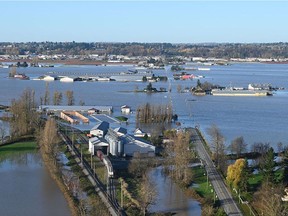
Examination took place after the deadly 2021 atmospheric rivers caused flooding, debris flows and landslides that caused billions in damages and displaced thousands of people.
Last updated 1 day ago
You can save this article by registering for free here. Or sign-in if you have an account.
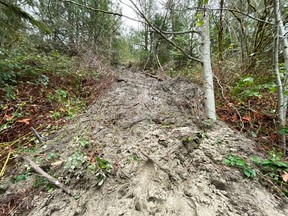
After the devastating November 2021 atmospheric river, the B.C. government examined how it could help homeowners whose residences had become unsafe because of increased landslide risk yet were not eligible for financial relief because there was no structural damage.

Subscribe now to read the latest news in your city and across Canada.
- Unlimited online access to articles from across Canada with one account.
- Get exclusive access to the Vancouver Sun ePaper, an electronic replica of the print edition that you can share, download and comment on.
- Enjoy insights and behind-the-scenes analysis from our award-winning journalists.
- Support local journalists and the next generation of journalists.
- Daily puzzles including the New York Times Crossword.
Subscribe now to read the latest news in your city and across Canada.
- Unlimited online access to articles from across Canada with one account.
- Get exclusive access to the Vancouver Sun ePaper, an electronic replica of the print edition that you can share, download and comment on.
- Enjoy insights and behind-the-scenes analysis from our award-winning journalists.
- Support local journalists and the next generation of journalists.
- Daily puzzles including the New York Times Crossword.
Create an account or sign in to continue with your reading experience.
- Access articles from across Canada with one account.
- Share your thoughts and join the conversation in the comments.
- Enjoy additional articles per month.
- Get email updates from your favourite authors.
Create an account or sign in to continue with your reading experience.
- Access articles from across Canada with one account
- Share your thoughts and join the conversation in the comments
- Enjoy additional articles per month
- Get email updates from your favourite authors
Sign In or Create an Account
The idea was to find a way outside the regular disaster relief program to help move people out of homes that had become unsafe or uninhabitable.

tap here to see other videos from our team.
Internal documents show B.C. considered buying landslide-risk properties that are now worthless, but didn’t Back to video
tap here to see other videos from our team.
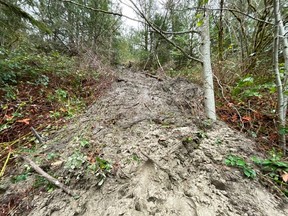
After those torrential rains, geotechnical reports said debris flows and landslides on a dozen homes, in areas including the Chilliwack River Valley and in Mount Currie east of Pemberton, made them unsafe to live in.
The province considered buying these properties and helping move houses to reduce risk. Restrictive covenants would be put on properties to warn future property owners and limit their use.
The idea was to align provincial policy with the United Nation’s Sendai framework on disaster risk reduction, so that people would not remain in unsafe or uninhabitable homes.
But the province never went ahead with the proposed policy.
The policy deliberations are outlined in hundreds of pages of records from the B.C. Ministry of Emergency Management and Climate Readiness obtained by Postmedia through a freedom of information request.
The records show the province was having an in-depth discussion involving senior officials in the ministry including Bowinn Ma, then the minister, other cabinet ministers and the office of Premier David Eby.
The disclosure comes as little relief to Chris Rampersad, one of the Chilliwack River Valley property owners whose home was deemed unsafe to live in and, in 2024, was valued at $2 by the province’s property assessor.
-
Advertisement 1Story continues belowThis advertisement has not loaded yet, but your article continues below.
Rampersad said he had been led to believe the province was working on a solution, but did not know the details.
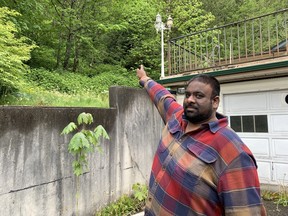
He said that if government had started working on a policy outside of the existing relief program, it meant it had acknowledged there was a gap in disaster relief in B.C.
“I’m not too sure why they didn’t follow through with putting the policy in place,” he said last week.
Rampersad, like others in the Chilliwack River Valley, is paying a mortgage on a property that has been valued as worthless. He has also been told there is no way to fix the landslide problem on his property.
Last December, heavy rain triggered another landslide on his property, and that is expected to happen again. Scientists forecast atmospheric rivers — huge plumes of moisture from tropical storms carried across the Pacific Ocean — will increase in severity and frequency because of climate change.
The ministry has continued to say there is no way to help property owners like Rampersad, and repeated last week that a structure must be physically damaged to be eligible for disaster relief.
In responses to Postmedia questions on the internal documents, the ministry said after significant disasters it assesses the effectiveness of government programs and may consider program adjustments.
“While this analysis is routinely done, changes are not always adopted,” said the ministry in an email from communications director Ashley Taylor.
The ministry did not make anyone available for an interview.
The policy gap noted by Rampersad has been highlighted by the Union of B.C. Municipalities, which has called on the province to address situations like his.
The organization that represents 161 municipalities and 28 regional districts has said these sorts of issues require collaboration, and it would be a positive step if the province worked with local governments and others to develop policy options.
About half of the more than 700 pages of records were redacted, with the province citing various reasons. Those included cabinet confidence, legal advice, disclosure harmful to law enforcement and intergovernmental relations, disclosure harmful to financial or economic interests, disclosure harmful to individual or public safety, disclosure harmful to business interests and disclosure harmful to personal privacy.
In one case, the name of the senior government official or minister that a decision briefing note was prepared for was redacted. The province cited cabinet confidences and policy advice, but usually the name of a person for whom government briefing is prepared for is not redacted.
An eight-page decision briefing note from November 2023 explains that the Emergency Management Ministry had “developed criteria to prioritize landslide-affected properties that require provincial support and has developed options outlining how compensation may be structured and disbursed.”
The finance options were redacted, with the province citing the policy advice exemption for withholding the information.
The briefing note says the interim landslide policy differs from standard disaster assistance policy in two key ways: “It does not render a property owner inadmissible for financial assistance based on previous risk associated with the property and it does not require a structure to be damaged in order to receive payment.”
The note says as a result of the 2021 atmospheric rivers, the interim policy would likely apply to six properties in the Fraser Valley Regional District — the properties in the Chilliwack River Valley — and three properties in the Squamish-Lillooet Regional District, which are in Mount Currie.
It adds there were three other properties, in areas not named, that could possibly fall under the interim landslide policy.
Those properties make up a tiny fraction of the disaster relief applications the province received following the 2021 atmospheric rivers, less than one per cent of 2,298 applications.
The briefing note also notes the land associated with landslide-affected properties is unusable for any civic purpose related to safety hazards, unlike so-called managed retreats where properties are bought and typically used to build additional protective or mitigative structures such as dikes, or social benefit such as walking trails.
That’s what the province is doing in Merritt, which was severely hit by floods in November 2021, where it provided $60 million to buy properties so that dikes can be upgraded and moved further from the river to create more space for flooding.