People ‘want to help’: GoFundMe has changed the way many British Columbians donate to causes
GoFundMe campaigns connected to the shooting in Tumbler Ridge and the Lapu Lapu Day tragedy received more than $7.5 million in donations
Last updated 1 day ago
You can save this article by registering for free here. Or sign-in if you have an account.
In rural Prince Edward Island, Mary White read about the school shooting in Tumbler Ridge last month and wanted to help.

Subscribe now to read the latest news in your city and across Canada.
- Unlimited online access to articles from across Canada with one account.
- Get exclusive access to the Vancouver Sun ePaper, an electronic replica of the print edition that you can share, download and comment on.
- Enjoy insights and behind-the-scenes analysis from our award-winning journalists.
- Support local journalists and the next generation of journalists.
- Daily puzzles including the New York Times Crossword.
Subscribe now to read the latest news in your city and across Canada.
- Unlimited online access to articles from across Canada with one account.
- Get exclusive access to the Vancouver Sun ePaper, an electronic replica of the print edition that you can share, download and comment on.
- Enjoy insights and behind-the-scenes analysis from our award-winning journalists.
- Support local journalists and the next generation of journalists.
- Daily puzzles including the New York Times Crossword.
Create an account or sign in to continue with your reading experience.
- Access articles from across Canada with one account.
- Share your thoughts and join the conversation in the comments.
- Enjoy additional articles per month.
- Get email updates from your favourite authors.
Create an account or sign in to continue with your reading experience.
- Access articles from across Canada with one account
- Share your thoughts and join the conversation in the comments
- Enjoy additional articles per month
- Get email updates from your favourite authors
Sign In or Create an Account
“We’ve lost people in the past, and when we did, it was the coming together that offered comfort,” she said.

tap here to see other videos from our team.
People ‘want to help’: GoFundMe has changed the way many British Columbians donate to causes Back to video
tap here to see other videos from our team.
The grandmother turned to GoFundMe to start a campaign called Maritime Love for Tumbler Ridge, raising $350. She plans to mail a money order to the Tumbler Ridge community centre next time she goes into her nearby town. She hopes it can be used to help fund a community gathering.
“There’s no good or bad way for them to use it,” she said. “I hope they will know that we are thinking of them.”
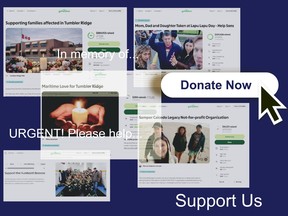
After the school shooting, dozens of campaigns popped up on GoFundMe, an online platform that allows people to share personal causes and seek donations. Together, they have raised more than $4.5 million for the people of Tumbler Ridge.
Some campaigns, like the one started by White, are small, while others have moved beyond the organizer’s social circle, receiving donations from people around the world, including $508,000 to support Maya Gebala, the 12-year-old girl critically injured in the shooting, and $885,000 to support families through the school district’s parent advisory council.
A similar outpouring of financial support came after the Lapu Lapu Day killings last April, with $3 million raised through more than a dozen GoFundMe campaigns.
The crowdfunding site has become particularly popular in B.C. In 2025, seven B.C. cities made GoFundMe’s list of the top 10 “most generous” cities in Canada based on number of donors per capita. Victoria topped the list, followed by North Vancouver and Vancouver.
While GoFundMe hasn’t replaced support for traditional charities in B.C. — United Way B.C. received $44.7 million in donations in the 2025 fiscal year — it has changed how many British Columbians support various causes.
-
Advertisement 1Story continues belowThis advertisement has not loaded yet, but your article continues below.
Experts said the shift is not surprising, as GoFundMe provides an immediate way for people to help after tragedies. But they also urged caution, pointing to research that shows how crowdfunding can amplify societal inequalities and leave some people behind.
‘Unwavering culture of philanthropy’
In a statement, GoFundMe said B.C’s largest campaign remains Life for Lucy, which raised $2.4 million to fund a gene therapy treatment for a baby with spinal muscular atrophy several years ago. A long-running campaign to provide feed for 100-plus animals at Beacon Hill Children’s Farm in Victoria has raised $188,000 since 2020.
GoFundMe campaigns also helped people after flooding in Abbotsford, Merritt and Princeton in late 2021, and after the wildfire that destroyed Lytton earlier that year. Campaigns between 2019 and 2024 raised more than $5.6 million to help people struggling with homelessness and the cost of living, according to GoFundMe.

The company said that while the province’s “population density, economic status, and vulnerability to natural disasters all play a role” in its prominence, “one key element stands out: an unwavering culture of philanthropy and people who want to help each other.”
The crowdfunding platform encourages some of the best human impulses, such as care for people and communities, generosity and connection. It also allows people to give directly to people who need help, rather than through an intermediary agency that might have more nebulous goals.
One of the main criticisms of the Kapwa Strong Fund, which was temporarily managed by the United Way after the Lapu Lapu Day tragedy, was that of the $2 million raised, not enough went to victims. A large portion, about $1.5 million, went in grants to 40 non-profit and charitable organizations, including $451,570 to Filipino B.C., as specified by donors.
In a previous response to Postmedia News, Filipino B.C. defended its use of funds, saying all grant decisions for the broader Kapwa Strong Fund were made independently by United Way B.C. Two grant streams were offered: emergency grants of $25,000 and a subsequent stream of $50,000 grants intended to support longer-term recovery efforts over a six-month to one-year period.
“As outlined by United Way B.C., eligible initiatives included immediate to midterm recovery and ongoing strategic support for those impacted by the emergency, healing supports and basic needs, mental health and counselling services, opportunities for community members to grieve and community-led events,” Filipino B.C. said in a statement.
GoFundMe provides a way for people to give directly to the person or family that needs support. The site also allows families to keep supporters informed, as Maya Gebala’s mother, Cia Edmonds, has done by posting photos and updates on the campaign page, in addition to thanking people for their support.
But academics said the rise of GoFundMe has some possible downsides.
Social inequalities
One of the most glaring is the way in which it can amplify social inequalities, said Nora Kenworthy, a professor in the school of nursing at the University of Washington Bothell who studies digital environments.
“When we encounter (a GoFundMe campaign), we are asked to make a personal decision about whether it deserves a donation,” she said.
That encounter tends to happen on social media, which crowdfunding has been designed to optimize. Various studies have shown that algorithms can augment social biases around race, gender and socioeconomic status, with content that looks a certain way receiving priority placement, said Kenworthy.
Our own social biases also factor into our decisions about what to support, as well as what sociologists call the homophily principle, or the idea that we are drawn to others who share similar characteristics to us.
And because crowdfunding campaigns typically begin with family and friends, more privileged crowd funders are often able to tap into more privileged donators.
“It really becomes unequal at every step,” said Kenworthy.
She pointed to a study that looked at viral medical campaigns over a 10-year period and found young white men were overrepresented. The study, which examined about 800 campaigns that raised over $100,000, found that white people accounted for 80 per cent of overall campaign recipients, while Black people represented only three per cent.
“That points to a pretty intense racial disparity,” she said.
In contrast, a more traditional charity may be able to direct funds to where they are needed most.
“Donating to personal crowdfunding campaigns … offers a sense of immediacy and specificity of impact that a traditional charity cannot easily replicate,” said Matthew Wade, a senior lecturer in social inquiry at La Trobe University in Victoria, Australia, who researches crowdfunding. “Charities, broadly speaking, will aim to more equitably distribute funds raised in accordance with addressing the most urgent needs and achieving the best overall impact.”
That’s particularly striking in light of the fact that most GoFundMe campaigns fail to reach their goals.
In a 2024 book, GoFailMe: The Unfulfilled Promise of Digital Crowdfunding, Martin Lukk, a postdoctoral research fellow at the University of Toronto’s Data Sciences Institute, and sociology professor Erik Schneiderhan found that only 17 per cent of U.S. campaigns for health care and emergency costs met their goal between 2018 and 2021. Many didn’t make a single dollar.
“Someone described it to us as yelling into a well of sadness,” said Lukk.
The social scientist said people often forget GoFundMe is a for-profit company. Having only some campaigns succeed may not present a “business problem” if those that are successful provide a large payout.
How much GoFundMe makes
While it is free to start and manage a fundraiser on the platform, GoFundMe takes 2.9 per cent of each donation as a transaction fee, plus 30 cents per donation. That means that if a person raises $500 from five donors, they receive $484, with GoFundMe taking $16.
Lukk said the company plays a role by promoting some campaigns to the home page of the platform, where they are more likely to achieve “runaway” fundraising success.
“There really is so much more to it than having a worthy campaign,” he said.
Wade said it is not surprising to see British Columbians turning to GoFundMe to provide support to people after two significant tragedies.
“Particularly during times of mass catastrophe, we can easily feel overwhelmed by a sense of helplessness in witnessing such extraordinary harms and suffering,” he said. “Not only do we seek to offer some form of remedy to alleviate this suffering, but in doing so also reaffirm our collective values.”

Since GoFundMe began in 2010, more than $40 billion has been raised in campaigns in 20 countries. The first Canadian campaign was created in 2013, and since then, 20 million donations have been made to fundraisers across the country, with more than $1 billion raised in the last five years alone.
Recipients generally do not have to pay taxes on the money, which is considered a gift, although strict criteria must be met. Businesses and commercial endeavours are not tax exempt nor are donations where a product, service or benefit is provided.
The largest campaign in Canadian history remains for the players and families affected by the Humboldt Broncos tragedy, which raised $15 million in 2018. When the campaign organizer, a hairstylist who lived in Humboldt, felt unqualified to distribute the money, a new non-profit was established to manage it.
The non-profit asked the Saskatchewan courts for assistance through a provincial act that helps resolves disputes around crowdfunding. A court-appointed committee heard from families before deciding how to divide the money between survivors and the families of those who had died.
B.C. does not have a similar act, although a model act was created by the Uniform Law Conference of Canada with some input from the B.C. Law Institute. It has not been enacted here.
GoFundMe said when a fundraiser is created to support another individual, funds are held and only transferred to the recipient of the fundraiser.
Verification process
GoFundMe also verifies certain fundraisers: “For our team to verify a fundraiser, it must be clear who the organizer is, as well as the person, business, or charity they are raising funds for, the organizer’s relationship to the recipient of the funds, and how the funds will be used,” the company said in a statement.
“In this case, we would reach out to the organizer for more information and ensure the funds safely reach the family. All funds remain safely held by our payment processors during this review.”
The crowdfunding site also guarantees a full donation refund when there is evidence of fraud or misuse.
Many of the verified campaigns connected to the shooting in Tumbler Ridge and the Lapu Lapu Day tragedy have posted detailed descriptions of how they intend to use the money on their pages.
For example, the Tumbler Ridge parent advisory committee said the first funds received were immediately directed to support victims’ families, including the families of the two girls in hospital, with mortgage or rent payments, fuel and travel expenses, and costs associated with transporting loved ones to be with family members.
After urgent needs were met, funds were allocated to help with funeral and burial arrangements, possibly including transportation, said a message on the campaign page.
“Our primary goal has been to provide a secure, trusted place for our community to contribute collectively in support of these devastated families, ensuring they do not have to carry financial burdens during this incredibly difficult time.”