B.C. climate news: Metro Vancouver anticipates Stage 3 watering restrictions in June | Vancouver council votes to bring back natural gas heating in new buildings
Here’s all the latest local and international news concerning climate change for the week of May 18 to May 24, 2026
Last updated 5 hours ago
You can save this article by registering for free here. Or sign-in if you have an account.
Here’s the latest news concerning climate change and biodiversity loss in B.C. and around the world, from the steps leaders are taking to address the problems, to all the up-to-date science.

Subscribe now to read the latest news in your city and across Canada.
- Unlimited online access to articles from across Canada with one account.
- Get exclusive access to the Vancouver Sun ePaper, an electronic replica of the print edition that you can share, download and comment on.
- Enjoy insights and behind-the-scenes analysis from our award-winning journalists.
- Support local journalists and the next generation of journalists.
- Daily puzzles including the New York Times Crossword.
Subscribe now to read the latest news in your city and across Canada.
- Unlimited online access to articles from across Canada with one account.
- Get exclusive access to the Vancouver Sun ePaper, an electronic replica of the print edition that you can share, download and comment on.
- Enjoy insights and behind-the-scenes analysis from our award-winning journalists.
- Support local journalists and the next generation of journalists.
- Daily puzzles including the New York Times Crossword.
Create an account or sign in to continue with your reading experience.
- Access articles from across Canada with one account.
- Share your thoughts and join the conversation in the comments.
- Enjoy additional articles per month.
- Get email updates from your favourite authors.
Create an account or sign in to continue with your reading experience.
- Access articles from across Canada with one account
- Share your thoughts and join the conversation in the comments
- Enjoy additional articles per month
- Get email updates from your favourite authors
Sign In or Create an Account
Check back every Saturday for more climate and environmental news or sign up for our Sunrise newsletter HERE.
In climate news this week:
• Metro Vancouver anticipates Stage 3 watering restrictions in June
• Vancouver council votes to bring back natural gas heating in new buildings
• Metro Vancouver will spend $600,000 this year on campaigns to reduce waste. But do they work?
Human activities like burning fossil fuels and farming livestock are the main drivers of climate change, according to the UN’s intergovernmental panel on climate change. This causes heat-trapping greenhouse gas levels in Earth’s atmosphere, increasing the planet’s surface and ocean temperature.
The panel, which is made up of scientists from around the world, including researchers from B.C., has warned for decades that wildfires and severe weather, such as the province’s deadly heat dome and catastrophic flooding in 2021, would become more frequent and intense because of the climate emergency. It has issued a code red for humanity and warns the window to limit warming to 1.5 C above pre-industrial times is closing.
According to NASA climate scientists, human activities have raised the atmosphere’s carbon dioxide content by 50 per cent in less than 200 years, and “there is unequivocal evidence that Earth is warming at an unprecedented rate.”
As of May 5, 2026, carbon dioxide in the atmosphere was 431.12 parts per million, up from 429.35 ppm the previous month, according to the latest available data from the NOAA measured at the Mauna Loa Observatory, a global atmosphere monitoring lab in Hawaii. The NOAA notes there has been a steady rise in CO2 from under 320 ppm in 1960.

-
Advertisement 1Story continues belowThis advertisement has not loaded yet, but your article continues below.
Quick facts:
• The global average temperature in 2023 reached 1.48 C higher than the pre-industrial average, according to the EU’s Copernicus Climate Change Service. In 2024, it breached the 1.5 C threshold at 1.55 C.
• 2025 was the third warmest on record after 2024 and 2023, capping the 11th consecutive warmest years.
• Human activities have raised atmospheric concentrations of CO2 by nearly 49 per cent above pre-industrial levels starting in 1850.
• The world is not on track to meet the Paris Agreement target to keep global temperature from exceeding 1.5 C above pre-industrial levels, the upper limit to avoid the worst fallout from climate change including sea level rise, and more intense drought, heat waves and wildfires.
• UNEP’s 2025 Emissions Gap Report, released in early December, shows that even if countries meet emissions targets, global temperatures could still rise by 2.3 C to 2.5 C this century.
• In June 2025, global concentrations of carbon dioxide exceeded 430 parts per million, a record high.
• There is global scientific consensus that the climate is warming and that humans are the cause.

Latest News
Metro Vancouver says residents should be prepared for Stage 3 water restrictions to start in June as a low snowpack and a hot-and-dry summer are expected to strain the region’s drinking water supply.
As well, work is underway to build a new water supply tunnel through Stanley Park but, to do that work, one of the region’s key supply pipes from the reservoirs on the North Shore has been out of service since last fall.
Staff say if water use increases excessively while the supply pipe is offline, it could decrease water pressure and affect the ability of first responders to use water for emergencies.
For the first time, the region skipped directly to Stage 2 watering restrictions in May, instead of beginning with Stage 1 rules that normally allow residents to water lawns once a week. Stage 2 bans residential and non-residential lawn watering until mid-October.
Under Stage 3, lawn watering will still be prohibited and there will be more restrictions on watering trees and gardens, filling pools and hot tubs, and washing surfaces, vehicles and boats. Watering rules for public and private sports fields also would get tighter.
— Tiffany Crawford
Vancouver city council has approved Mayor Ken Sim’s motion to align the municipal building code with the provincial one, a change that brought back a contentious debate around allowing natural gas heating in new home construction.
Sim and his ABC Vancouver colleagues argued that Vancouver does not need its own building code independent from the rest of the province, and said these changes aim to improve housing affordability.
But opponents disputed the claims of affordability, and said the changes will prevent the city from hitting its climate targets. The push to reintroduce natural gas heating puts Vancouver council at odds with both the provincial and federal housing ministers, both of whom happen to be former Vancouver council members.
On Tuesday, one day before the motion came to council, B.C. Housing Minister Christine Boyle, a former Vancouver councillor, urged Sim and council to delay the proposed changes to building code and green building policies.
Boyle wrote that buildings are the largest source of greenhouse gas emissions in Vancouver, contributing nearly 60 per cent of total carbon pollution in the city (buildings are roughly 10 per cent of emissions provincewide).
— Joanne Lee-Young and Dan Fumano

Prime Minister Mark Carney came to Vancouver on Wednesday to begin negotiations with Premier David Eby on B.C.’s priorities for his nation-building agenda, although their agreement to do so did not resolve the premier’s opposition to the idea of a new bitumen pipeline from Alberta to B.C.’s north coast.
Before meeting with Carney at his government’s Vancouver cabinet offices, Eby noted the federal moratorium on oil tanker traffic off the north coast remains a “crucially important” condition for First Nations and many British Columbians.
Their negotiations over nation-building projects, however, “will be an important discussion because together, we’re going to be building the critical infrastructure, the clean energy projects, the critical metals and mineral projects that will deliver national security, growth in the Canadian economy, jobs for British Columbians, and help us for those public services that British Columbians depend on,” Eby said.
Carney called it a “positive agenda,” in which Ottawa will work in partnership with B.C. and First Nations. He also vowed that a new oil pipeline will only go ahead after full consultation with First Nations, respecting government’s duty under Section 35 of the Constitution.
— Derrick Penner
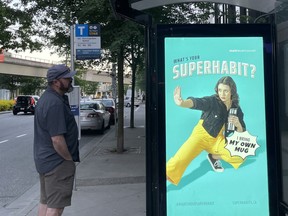
Walking past a bus-stop billboard that asks how you reduce waste might not make you stop and think, but behavioural science experts say campaigns aimed at the elusive eco-conscious consumer can be successful over time.
Metro Vancouver plans to spend $600,000 this year on campaigns to influence consumer habits to reach a zero-waste goal, but with a waste-diversion rate that has stalled at around 65 per cent for more than a decade, are they working?
Sixty-five per cent is the highest diversion rate in North America with efforts made in recycling and keeping food scraps out of the landfills. Still, the region has a goal of 80 per cent diversion over the next 25 years, so there’s a lot of work to be done.
For instance, there’s still consumer demand for single-use items — which increased during the pandemic with disposable masks and takeaway containers — and cheap clothing that gets tossed out quickly.
The need to expand and build more landfills, skyrocketing methane emissions that contribute to a warming climate, and toxic run-off contaminating groundwater are just some of the challenges with a continued overreliance on landfills.
— Tiffany Crawford

Activist investors are pushing technology companies to explain how they’re reconciling surging electricity demand for AI with their climate commitments. Shareholders at Amazon.com Inc. voted on a proposal asking the firm to disclose more information. Voting is open for shareholders at Meta Platforms Inc. and Alphabet Inc. and will conclude later this month and in early June at each company’s annual meeting.
Support for such initiatives has declined in recent years amid underwhelming outcomes and a broader political backlash in the US against environmental, social and governance investing. Heavyweight investment firms, including BlackRock Inc., Vanguard Group Inc. and State Street Corp., have also pulled back from these types of measures.
The new effort shows that green shareholder activism, while quieter than in its heyday in the early 2020s, persists. The proposals were filed by the non-profit As You Sow, along with Presbyterian Life & Witness, Mercy Investment Services and Trillium Asset Management.
“In the AI race, tech giants risk undermining their climate commitments at precisely the moment disciplined, long-term decision-making matters most,” said Andrea Ranger, director of shareholder advocacy at Trillium Asset Management. “Shareholders are asking for a credible strategy that preserves both climate goals and leadership in the AI economy.”
In each proposal, shareholders request that the company “issue a report explaining how it will meet the climate change-related commitments it has made on greenhouse gas emissions, given the massively growing energy demand from artificial intelligence and data centres.”
— Bloomberg News