
Five years after Kamloops graves announcement, not a single confirmed burial site has been found. Here’s what we know
The announcement sent shockwaves throughout Canada and garnered global attention. But in the years since, the Tk’emlups te Secwepemc First Nation has walked back its initial claims
Last updated 1 day ago
You can save this article by registering for free here. Or sign-in if you have an account.

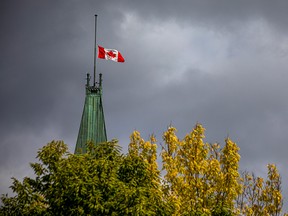
It’s been five years since the Tk’emlups te Secwepemc First Nation announced that it had discovered hundreds of unmarked graves in Kamloops, B.C., using ground-penetrating radar (GPR). The announcement sent shockwaves throughout Canada and brought the residential school controversy to global attention. Then prime minister Justin Trudeau ordered flags flown at half-mast at all federal buildings and they remained lowered for more than five months, the longest period in Canadian history. But in the years since the announcement, the Tk’emlups te Secwepemc has walked back its initial claims about graves at a former Kamloops residential school. Here’s what we know about Canada’s graves controversy.

Subscribe now to read the latest news in your city and across Canada.
- Unlimited online access to articles from across Canada with one account.
- Get exclusive access to the Vancouver Sun ePaper, an electronic replica of the print edition that you can share, download and comment on.
- Enjoy insights and behind-the-scenes analysis from our award-winning journalists.
- Support local journalists and the next generation of journalists.
- Daily puzzles including the New York Times Crossword.
Subscribe now to read the latest news in your city and across Canada.
- Unlimited online access to articles from across Canada with one account.
- Get exclusive access to the Vancouver Sun ePaper, an electronic replica of the print edition that you can share, download and comment on.
- Enjoy insights and behind-the-scenes analysis from our award-winning journalists.
- Support local journalists and the next generation of journalists.
- Daily puzzles including the New York Times Crossword.
Create an account or sign in to continue with your reading experience.
- Access articles from across Canada with one account.
- Share your thoughts and join the conversation in the comments.
- Enjoy additional articles per month.
- Get email updates from your favourite authors.
Create an account or sign in to continue with your reading experience.
- Access articles from across Canada with one account
- Share your thoughts and join the conversation in the comments
- Enjoy additional articles per month
- Get email updates from your favourite authors
Sign In or Create an Account
What were the original allegations about graves in Kamloops?

tap here to see other videos from our team.
Five years after Kamloops graves announcement, not a single confirmed burial site has been found. Here’s what we know Back to video
tap here to see other videos from our team.
On May 27, 2021, Chief Rosanne Casimir of the Tk’emlups te Secwepemc First Nation announced the discovery of the “remains of 215 children” following an examination of land at the former Kamloops Indian Residential School. The residential school was one of the largest operated in Canada and was open from 1890 to 1978. Casimir called the development an “unthinkable loss that was spoken about but never documented” and said that some of the victims were as young as three.
“This past weekend, with the help of a ground penetrating radar specialist, the stark truth of the preliminary findings came to light — the confirmation of the remains of 215 children who were students of the Kamloops Indian Residential School,” the statement said.
The following day, The New York Times published a story with the headline, ‘Horrible History’: Mass Grave of Indigenous Children Reported in Canada, although the original statement from Casimir did not make any reference to a mass grave.
Five years later, there are many outstanding questions and the Times story remains uncorrected.
Sarah Beaulieu, an anthropology instructor at the University of the Fraser Valley, conducted the original GPR survey of the land: an orchard near the residential school where former students reportedly recalled finding human remains. Beaulieu cautioned in July 2021 that more research needed to be done on the site and that the number of potential gravesites had dropped to 200.
- FIRST READING: Tkʼemlúps blames feds, church, ‘spiritual protocols’ for why it hasn’t exhumed graves
-
Advertisement 1Story continues belowThis advertisement has not loaded yet, but your article continues below.
“We need to pull back a little bit and say that they are ‘probable burials,’ they are ‘targets of interest,’ for sure,” Beaulieu said during a press conference at the time. The sites “have multiple signatures that present like burials,” but she underscored the need for excavations to verify the claim.
The First Nation’s messaging has continued to change over the years. In 2024, on the third anniversary of the event, the alleged graves were referred to as “anomalies” in the Tk’emlups te Secwepemc’s Day of Reflection statement. The chief would also refer to them as “unmarked burials.” In February 2026, a statement from the Office of the Chief described “our ongoing investigation into potential burials” at the former residential school and did not make any mention children’s bodies.
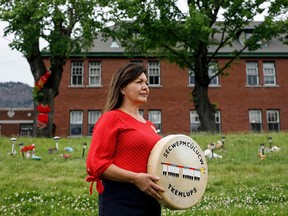
In the February statement, Tk’emlups te Secwepemc said that while it had pursued a “multi-pronged” approach since 2021 — involving combing through public records and those of the Roman Catholic Church — the process has been “more complex” than expected.
“Obtaining 88 years of government records and sacramental records from the Roman Catholic Church of Canada is critical to confirming the identities of the children who attended the school and those who never returned home, along with the community to which they belonged,” the statement said.
“Each Nation upholds its own cultural and spiritual protocols for how ancestral remains must be treated,” the statement continued. “Possible future outcomes could be to preserve the orchard as a Sacred Site — a place of memory and healing — or excavate. Any remains would need to be repatriated to their home communities, an extremely complex and sensitive process involving extensive consultation with the Nations, DNA analysis, forensic expertise, and adherence to appropriate laws and protocols.”
Were alleged graves discovered at other residential school sites?
In late June, the Cowessess First Nation reported finding 751 unmarked graves near a former residential school in Marieval, Sask. Trudeau visited the site in July and laid a teddy bear at the site. However, Cowessess Chief Cadmus Delorme clarified during a news conference at the time: “This is not a mass grave site. These are unmarked graves.”
That same month, a band from the Ktunaxa Nation near Cranbrook, B.C., reported finding another 182 unmarked graves in a cemetery using ground-penetrating radar. The burials were said to be shallow, just feet below the ground.
“ʔaq̓am leadership would like to stress that although these findings are tragic, they are still undergoing analysis and the history of this area is a complex one,” the First Nation said in a statement.
There have been no recent updates on the Ktunaxa Nation’s investigation into unmarked graves.
In Marieval, the use of GPR led to the discovery of “anomalies” which might indicate “possible grave locations,” Cowessess First Nation said. Cowessess has since built an interactive digital cemetery map based on the GPR findings, including “the coordinates of known graves (those having headstones) and possible unmarked graves.”
Neither site appears to have been excavated to confirm whether there were unmarked graves.
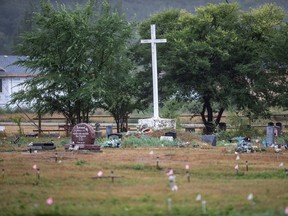
The Penelakut Tribe of the Southern Gulf Islands, B.C., announced in July 2021 the discovery of “160+ undocumented and unmarked graves in our grounds and foreshore.” However, as of August 2025, tribal elders had yet to decide whether to excavate the potential burial area.
In January 2022, Williams Lake First Nation reported finding “93 potential burials (which) correlate with the historic and modern extent of the cemetery” they were discovered in. The following year, the tribe announced the discovery of an additional 66 potential unmarked graves. Chief William Sellars said during a press conference in January 2023 that the Williams Lake First Nation was seeking government funding that might go to finance the excavation of the site. However, the site has not yet been excavated.
The Stó:lō Nation reported that 158 children were in unmarked burial sites in the Fraser Valley, B.C., in September 2023. Two years earlier, the community had assembled a team to examine archival material, oral history records and used ground-penetrating radar. An excavation does not appear to have been conducted to date.
This month, the Sturgeon Lake Cree Nation in northern Alberta announced they had found 62 potential unmarked graves, however all but nine of them were found on sites of known former graveyards.
What money was allocated to investigate, and how was it spent?
In August 2021, the federal government announced the creation of a $320-million Residential Schools Missing Children Community Support Fund. During the first three years of the program, $216.6 million was reportedly spent supporting nearly 150 Indigenous communities across Canada.
The initiative, according to the Chiefs of Ontario, is designed “to help Indigenous communities respond to and heal from the ongoing impacts of residential schools.” Such activities “could include local research, engagement and knowledge gathering, memorialization or commemoration, bringing children home, and more.” First Nation communities could apply for $3 million a year under the program to support such efforts.
In July 2024, that was reduced to $500,000 annually in an attempt to keep a “sustainable approach” to such projects. The cap was reversed shortly after.
Some of the public funds went to Kimberly Murray, the former executive director of the Truth and Reconciliation Commission (TRC) of Canada, who was appointed by the federal government to be an independent special interlocutor for missing children, unmarked graves and burial sites. Murray was given a two-year mandate and a budget of over $10 million. During her tenure, Murray published several reports and hosted consultations across Canada. Her last report was published in October 2024.
Did First Nations excavate the sites?
So far, no excavations have proceeded at the Kamloops site, but recent reporting suggests the Tk’emlups te Secwepemc First Nation is still seeking to do so.
The Globe and Mail reported on Friday morning that the Tk’emlups te Secwepemc First Nation is planning to excavate the site in 2027, “pending consent from Tk’emlúps and the roughly 120 communities throughout western Canada that sent children to the school.”
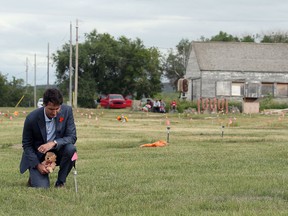
Pine Creek First Nations, in western Manitoba, may be the only First Nation to have actually physically excavated an alleged burial site. After the tribe reported “71 anomalies” were found using ground-penetrating radar in May 2022, the following summer, the First Nation began the process of digging and investigating the grounds around a local church to verify whether any graves existed. However, noevidence was found to confirm a burial ground on the site.
Cultural sensitivities remain a factor influencing investigations. Murray, the former independent special interlocutor for missing children, unmarked graves and burial sites, said in July 2023 that some First Nations communities had put “barriers up around the cemetery to mark it and commemorate it and they’re done” rather than disrupt the grounds with a physical investigation.
However, people from outside the community have also illegally sought entry to sites. Murray described an incident in a 2023 report in which “denialists entered the site (Kamloops) without permission” at night with shovels to “‘see for themselves’ if children are buried there.”
How have media covered the topic?
Despite calls for The New York Times to correct its story alleging “mass graves,” the outlet has never issued a correction. Instead, the Times continued to publish similar accounts and shaped the tone of much of the early coverage.
Quillette editor Jonathan Kay published a detailed social media thread showing other mainstream Canadian and international news outlets claimed that the remains of 215 children had been found. A Canadian Press survey from 2021 polling dozens of editors found the Kamloops story to be the most important one of the year, outpacing even pandemic coverage.
Terry Glavin’s feature, The Year of the Graves, published in National Post on the first anniversary of the controversy, began to change the public discourse on the subject. “The New York Times headline illustrates the way the story was almost universally reported. Except that’s not what happened in Kamloops,” Glavin wrote. “As for the most recent uproars: not a single mass grave was discovered in Canada last year.”
Accounts published throughout 2024 by the Fraser Institute and The Wall Street Journal questioned the evidence of the existence of unmarked graves.
Indigenous press and mainstream Canadian outlets have sincemoved away from descriptions of “mass graves” or confirmed remains and unmarked graves at Kamloops and other former residential schools, instead using terms like “potential unmarked graves” and “suspected unmarked graves” instead.
What were residential schools like? What do we know about any deaths there?
There were roughly 150,000 Indigenous children who attended residential schools over the century and a half they operated in Canada. The first residential school was opened in Brantford, Ont., in 1831. The Roman Catholic Church may have operated as many as 60 per cent of Canadian residential schools. Sexual abuse was prevalent. Over 30,000 claims of sexual abuse or sexual assault have been filed by former students, with $2.8 billion in compensation paid as of April 2015.
The residential school system was “a systematic, government-sponsored attempt to destroy Aboriginal cultures and languages and to assimilate Aboriginal peoples so that they no longer existed as distinct peoples,” the TRC concluded.
In 2015, the Truth and Reconciliation Commission said that as many as 6,000 Indigenous children died in the system, which included 139 schools over the century and a half they operated in Canada. The rate of Indigenous children dying in the first decades of the residential school system was high mostly due to tuberculosis and influenza. Many children’s bodies were never returned home.
Some former students recalled priests and sisters with mixed emotions.
“The residential school was a place so that Indian kids could go to school, but we lost our culture,” Fred Sasakamoose, the first ever Canadian Indigenous National Hockey League (NHL) player, recalled of his childhood years at a residential school in Duck Lake, Sask. “The priests and the sisters, although some of them were kind, some of them were harsh.”
Others remembered the lifelong community they built despite unbelievable hardships.
“Starvation was the order of the day,” Eugene Arcand of the Muskeg Lake Cree Nation said as part of his survivor testimonial before the TRC.
“You may hear, ‘Well, it couldn’t have been that bad. Something good must have come out of those residential schools.’ Well, I’m not here to tell you everything about residential schools was bad but I am here to tell you that not a helluva lot of it was good. And the only thing I’ve come out of it with that is worth anything is my life-long friendships; the safety of being with my former schoolmates and other residential school survivors. Today, being with my fellow survivors is the only place where I truly feel comfortable. It’s the only place I can think straight, other than maybe being on a golf course or watching a hockey game or a ball game.”
In 2015, there were an estimated 80,000 former students of residential schools still alive.
Our website is the place for the latest breaking news, exclusive scoops, longreads and provocative commentary. Please bookmark nationalpost.com and sign up for our daily newsletter, Posted, here.