
How these volunteers are helping Metro Vancouver women and children flee violent homes with their clothes, toys, pets
Shelter Movers’ 150 volunteers helped 800 vulnerable women, 1,300 children and 200 pets flee violent homes in Metro Vancouver since 2018.
By Lori Culbert
Last updated 8 hours ago
You can save this article by registering for free here. Or sign-in if you have an account.

Inside a Vancouver storage facility, fluorescent lights flicker above a hallway lined with grey metal doors that roll up to reveal lockers packed with broken dreams — and the possibilities of a better future.

Subscribe now to read the latest news in your city and across Canada.
- Unlimited online access to articles from across Canada with one account.
- Get exclusive access to the Vancouver Sun ePaper, an electronic replica of the print edition that you can share, download and comment on.
- Enjoy insights and behind-the-scenes analysis from our award-winning journalists.
- Support local journalists and the next generation of journalists.
- Daily puzzles including the New York Times Crossword.
Subscribe now to read the latest news in your city and across Canada.
- Unlimited online access to articles from across Canada with one account.
- Get exclusive access to the Vancouver Sun ePaper, an electronic replica of the print edition that you can share, download and comment on.
- Enjoy insights and behind-the-scenes analysis from our award-winning journalists.
- Support local journalists and the next generation of journalists.
- Daily puzzles including the New York Times Crossword.
Create an account or sign in to continue with your reading experience.
- Access articles from across Canada with one account.
- Share your thoughts and join the conversation in the comments.
- Enjoy additional articles per month.
- Get email updates from your favourite authors.
Create an account or sign in to continue with your reading experience.
- Access articles from across Canada with one account
- Share your thoughts and join the conversation in the comments
- Enjoy additional articles per month
- Get email updates from your favourite authors
Sign In or Create an Account
A white stuffed teddy bear. Electric keyboard. Pink suitcase crammed with clothes. Paintings. Birth certificates and journals. Boxes of binders and schoolbooks. Mattresses and bed frames. Kitchen supplies. Christmas decorations and Halloween costumes.
They belong to women and children who have fled gender-based violence. They were put in these lockers by a unique Canadian charity, Shelter Movers, that relocates people escaping violence for free.
The reality, experts say, is that most victims either stay with their abuser because they don’t have the ability or the money to leave, or they flee with little more than what they’re wearing.
“We break the cycle of violence when we’re out on a move. And you can see a person’s life change … just by literally driving and moving boxes,” said Jessie Kaur Lehail, chapter director of Shelter Movers Vancouver. “This is a lifeline.”
Shelter Movers’ Vancouver chapter has 150 volunteers who, since 2018, have handled nearly 1,700 moves, helping 800 women, 1,300 children and 200 pets in 19 municipalities across the Lower Mainland and Fraser Valley.
Chetna Panwar, 23, is one of those women.
The charity moved her belongings last August from a residence where she was “traumatized and depressed” to a storage facility while she sought temporary refuge at a transition house. Volunteers later moved her belongings again, this time to a new home in Surrey where she now lives violence-free.
“I (was) not able to move by myself because I was really not in a condition to do anything,” she said. “I was feeling really helpless. I had no help and also I didn’t own a vehicle. And I was not doing good physically.”
-
Advertisement 1Story continues belowThis advertisement has not loaded yet, but your article continues below.
Panwar is deeply appreciative of the volunteers’ compassionate, life-saving intervention: “They even assembled the bed for me.”
People interviewed for this story, who all work with victims of violence, believe Shelter Movers is the only charity in Canada to offer free moving services for victims of abuse.
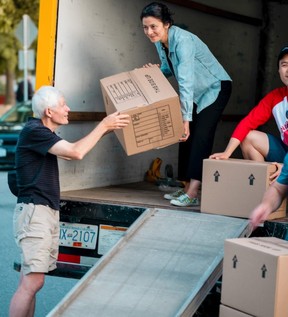
And demand, tragically, is high.
“We don’t have enough staff and volunteers to cover the full magnitude of what’s actually out there,” said Lehail.
At least 135 people died as a result of intimate partner violence in B.C. between 2016 and 2024, and most of those deaths were preventable, a B.C. coroner’s report released last month concluded.
Vancouver-area women enduring gender-based violence are referred to Shelter Movers through about 200 organizations, which include police, Crown prosecutors, health authorities and community agencies, such as the YWCA or Surrey’s Harmony House.
‘Difficult decision to leave’
“It’s a really difficult decision for women to leave,” said Erin Seeley, CEO of YWCA B.C. “What Shelter Movers offers is that kind of short-term, safe, supportive transition to get to the place where a woman’s going to feel like she can actually move on in her life … Otherwise, she might not leave. She might stay in an unsafe environment.”
Before the move, Shelter Movers staff speak with the women about what needs to be relocated, and determine any risks at the scene, such as whether the abusers will be home.
One of every four moves is considered medium- or high-risk, usually requiring police or security to escort the volunteers to the homes.
The remaining three-quarters are lower-risk moves, taking place either when the victims are safely in transition houses and their abusers have consented to their belongings being collected, or when the women are being relocated from temporary lodgings to permanent homes.
Their furniture, clothes and toys stay in storage lockers, sometimes for weeks or months, until the women can find new homes — a far from easy feat in expensive Metro Vancouver. Dozens of these metal units, spanning from North Vancouver to Chilliwack, have been donated to the charity, but more are needed, Lehail said.

On some higher-risk moves, volunteer Sarah Stuart remembers feeling on edge as she approached a home, unsure what she might encounter beyond the front door. But she knows she has the backup of her team members, who have been trained in safety precautions and making decisions during difficult situations while treating clients with empathy.
“In those moments, I just try to take a breath and remember that whatever I’m feeling is a tiny fraction of what our clients are feeling,” said Stuart, a New Westminster resident who has volunteered for six years.
If the abuser is at home and causing problems, or there are any other developments that make the team feel unsafe, the volunteers will leave and reschedule the move.
Stuart said she and her fellow volunteers had to abandon one high-risk, police escorted move because the abuser was unco-operative, which was disappointing for the victim, who was safely out of the home but wanted her belongings. A few weeks later, the team returned when the man wasn’t there and had success.
Clients are ‘just so grateful’
“She was just so grateful,” Stuart said, recalling “how moving it was for everyone on the move team and our client, just to know that we persevered and really helped her out.”
Neena Randhawa has been referring vulnerable women to Shelter Movers for nearly a decade, first with a Richmond transition house and now as the coordinator of Surrey’s Harmony House, which provides multicultural temporary housing for women and children who have experienced violence.
Some women flee with just their passports or kids’ birth certificates, and then rely on Shelter Movers to get the rest of their belongings.
“Imagine the place where you thought was your home,” Randhawa said, “and now you have to go back, (sometimes) with a police escort just because your safety is a concern. So there’s lots of emotions involved.”
The provincial government provides some money for women on income assistance to move, but it doesn’t cover all expenses and requires time-delaying paperwork. Shelter Movers, by comparison, is free, acts with urgency and the volunteers have more trauma-informed training than an average moving company employee, she said.

The Vancouver chapter recently doubled the number of cities they serve to 19, adding communities such as the Fraser Valley, Abbotsford and Chilliwack. There is a need in other parts of the province, but Shelter Movers doesn’t have enough funding or volunteers, Lehail said.
Shelter Movers had $6 million in revenue nationally in the 2024-25 fiscal year, a quarter from government and the rest from donations. It has a goal to raise $30 million by 2030 to expand its services into more areas of Canada, such as the Prairie provinces, beyond its current locations in B.C., Ontario, Nova Scotia and New Brunswick.
Founder Marc Hull-Jacquin said the charity receives discounted rates from corporations such as trucking companies, and free services from others such as storage facilities.
Future growth to protect more women from intimate partner violence should involve “all of society,” ideally with more government funding, additional corporate backing, and more citizens donating or volunteering, he said.
Only service like this in Canada
“Because Shelter Movers is the only service of its kind in Canada, we’re inundated with calls in every city every day,” Hull-Jacquin said. “If we’re going to take the problem of gender-based violence seriously in Canada, we need to 100 (times) the resources available to address this.”
Shelter Mover clients are typically women with young children, who span a wide range of ages, ethnicities and financial stability.
“Gender-based violence,” Lehail said, “is agnostic to economics, culture, race, religion.”
In the last two years, Shelter Movers Vancouver has grown from supporting about 18 clients a month to more than 30, which includes a recent increase in rescuing abused women from homeless encampments, said Shana Slater, Shelter Movers operations manager.
Another growing area is helping female victims of human trafficking, which can include international students; wives in some cultures who are “discarded”; or escorts forced to work during large events, Slater said.
In the lead-up to the World Cup in Vancouver this June and July, Shelter Movers is working with community, business and government organizations “to proactively plan for the (human-trafficking) surge that we’re anticipating during FIFA,” Lehail added.
The charity’s volunteers include retirees and students such as Stuart, who is studying to be a naturopath; people who speak multiple languages; and men, who Slater calls “allies” against a type of violence usually perpetrated by male attackers.

Carraugh Brouwer of Vancouver began volunteering in 2020. She does three to four moves a month, motivated by the determination of the clients to seek a safer future.
The team recently moved a woman with a baby, and Brouwer can recall a volunteer commenting that the infant “won’t remember their life before, and now they’ll get to grow up in a life free from violence.”
Brouwer, 25, recently bumped into a former client who thanked her for a move that happened six months earlier.
‘Making an important difference’
“That was just so special to see. You know she’s in a better place now,” said Brouwer, who just completed her masters in chemistry. “It made me feel like we were really making an important difference.”
Each move involves between three and six volunteers, depending on the number of items.
“Clients are quite stressed at the beginning of the move,” she added, but “will visibly relax after we’ve moved their stuff out and we’re driving away.”
When police are involved, they often remain behind to ensure no one follows the truck, protecting the woman’s new location, which is usually in temporary lodging.
“Because of the housing crisis, it’s really difficult for our clients to find stable housing, especially if they have children,” Brouwer said.
Seeley said non-profits typically locate the emergency housing where Shelter Movers take the women, but she pointed out that is contingent on availability in an expensive market. The YWCA, for example, has a wait-list of 1,400 people for its 504 subsidized units in the Lower Mainland.
Shelter Movers plays an important role in rescuing these women because organizations like the YWCA increasingly don’t have enough funding to cover additional expenses such as moving costs, she added.
Seeley argued more government funding for organizations that support abused women would actually benefit taxpayers. A recent YWCA report concluded that failing to prevent gender-based violence costs B.C. up to $1.12 billion each year, including police investigations, court costs and lost wages.
“We know women move five to seven times if they’re trying to flee an unsafe, violent relationship. So you can imagine the costs associated with that,” she said. “We’re not seeing any new funding out of the federal government, and yet rates of intimate partner violence remain really high.”
In April, Ottawa announced new funding to support victims of crime, including intimate partner violence, but it’s not clear yet how much money will come to B.C. and what impact it will have here. The money, to be distributed across Canada, includes $8.8 million to support victims of crime, $1 million to help human-trafficking survivors and $3.3 million for children subjected to abuse.
In response to the coroner’s report that found intimate-partner deaths were largely preventable, B.C. Attorney General Niki Sharma said in April that a new roundtable of government representatives and anti-violence sector experts would explore how to reduce risk for these women. She promised a public update after the meeting.
Public Safety Minister Nina Krieger said the province spends $60 million annually to support more than 475 victims services and violence-against-women programs, but made no new spending commitment.
Also in April, Burnaby East NDP MLA Rohini Arora paid tribute to Shelter Movers in the B.C. legislature: “Their work reminds us that safety can look like a truck arriving at the right time, a box carefully packed and a simple message: ‘You do not have to do this alone.’ ”
Women in B.C. who need help from Shelter Movers, but aren’t connected to a non-profit agency for a referral, should call the 211 help line or a local transition home, because emergency lodging must be arranged before a move is scheduled, Hull-Jacquin said. That is more efficient than contacting the charity directly, he added.

The charity was started in Toronto a decade ago by Hull-Jacquin while he was on paternity leave after the birth of his daughter. He wanted to help other children have the type of safe, secure home that his kids had, so came up with the concept to help at-risk mothers flee abuse.
He argues supporting the organization is a wise investment in a safer future for the next generation, so they can break the cycle of violence and therefore consume fewer social and justice services.
“Those little boys and little girls who we’re moving out now, 10 years from now when they become adults, they will be statistically less likely to become survivors and abusers,” said Hull-Jacquin.
‘We knew he was going to kill us’
He recently met a young woman with a good job who told him Shelter Movers had moved her and her mother four years earlier. Hull-Jacquin recalled the woman telling him: “I don’t know if my mom would still be alive had you not got us out that day, because we knew he was going to kill us.”
Stuart, the New Westminster volunteer, often feels a deep connection with the women because she’s lending them a hand during a traumatic time.
“Often clients will look at us after a move and say, ‘I can’t begin to explain how grateful I am because this wouldn’t be possible for a lot of women,’ ” the 27-year-old said. “It’s especially powerful when we can help a client who’s also a mom, because you’re thinking of how that’s impacting the child’s life in the future as well.”
Panwar is relieved to be surrounded by her belongings as she carves a new life path while feeling physically and mentally stronger.
“When I moved out of the transition house, I wasn’t stressed that I have to buy everything all over again … It was really important to get all my stuff,” said Panwar, who is now focusing on building her career.
“I’m doing great.”