Buried in Fred Herzog’s archives for years, a true gem is unveiled for a new Vancouver exhibit
Andy Sylvester spent six years looking through Herzog’s archive to come up with photos for a new exhibit: Fred Herzog, A Colour Legacy
By John Mackie
Last updated 13 hours ago
You can save this article by registering for free here. Or sign-in if you have an account.

In 1969, Vancouver photographer Fred Herzog took a trip to Halifax.

Subscribe now to read the latest news in your city and across Canada.
- Unlimited online access to articles from across Canada with one account.
- Get exclusive access to the Vancouver Sun ePaper, an electronic replica of the print edition that you can share, download and comment on.
- Enjoy insights and behind-the-scenes analysis from our award-winning journalists.
- Support local journalists and the next generation of journalists.
- Daily puzzles including the New York Times Crossword.
Subscribe now to read the latest news in your city and across Canada.
- Unlimited online access to articles from across Canada with one account.
- Get exclusive access to the Vancouver Sun ePaper, an electronic replica of the print edition that you can share, download and comment on.
- Enjoy insights and behind-the-scenes analysis from our award-winning journalists.
- Support local journalists and the next generation of journalists.
- Daily puzzles including the New York Times Crossword.
Create an account or sign in to continue with your reading experience.
- Access articles from across Canada with one account.
- Share your thoughts and join the conversation in the comments.
- Enjoy additional articles per month.
- Get email updates from your favourite authors.
Create an account or sign in to continue with your reading experience.
- Access articles from across Canada with one account
- Share your thoughts and join the conversation in the comments
- Enjoy additional articles per month
- Get email updates from your favourite authors
Sign In or Create an Account
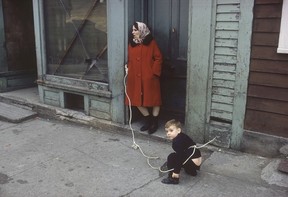
Walking down the street, he came across a woman in a red coat and pink scarf, yawning as she leaned against a somewhat dilapidated wooden building.
Beside her is a white rope, tied up to a hook. The rope cascades down to the sidewalk, where it’s tied around the waist of a young boy in dark clothes, squatting so you can see the top of his bum.
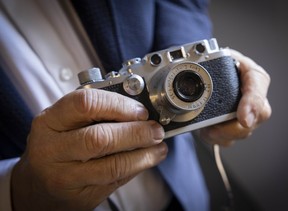
Herzog caught the moment with his Leica camera, funny and touching and a glorious mix of colours — the deep red of her jacket standing out against a black door and the faded blue-green of the building, which has a cracked window.
The image lay hidden among Herzog’s 80,000 slides for decades before his art dealer Andy Sylvester discovered it.
Sylvester had undertaken the daunting task of going through Herzog’s collection after the photographer died in 2019, two weeks shy of his 89th birthday.
Towards the end, Herzog had Sylvester over to his house to go through some slides.
“He started projecting lots and lots of slides, and I had the feeling that I’ve never seen any of these,” Sylvester said.
“Finally, after a few trays I said, ‘Fred, I’ve never seen these.’ And that caused him to question his system of 50 years of organizing slides. He went to the lawyers and said, ‘After I die, here’s what I want to happen. I want one editor to go through everything.’”
Sylvester was a natural for the job. But it took six years to go through all of Herzog’s slides.
Finally, 69 of Herzog’s lost images have been unveiled to the world in a new exhibition at the Equinox Gallery called Fred Herzog, A Colour Legacy, which runs through June 27.
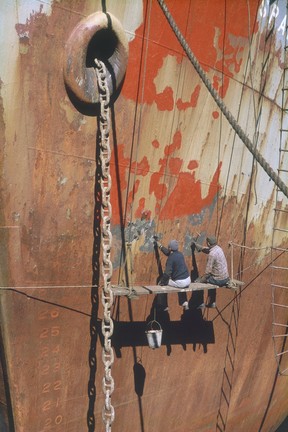
Born in Germany, Herzog moved to Vancouver in the 1950s, where he set out to document the real life of the city, in colour. In the new show, this means a series of arrows in a parking lot, a stylish Pepsi sign in Caracas, Venezuela, or waterfront workers scraping a giant freighter. Herzog could make art of almost anything.
But he was a stickler for quality, and didn’t make prints of his colour slides for decades because he didn’t like the way the colour reproduced. He was unknown outside the local art world until his breakthrough exhibition at the Vancouver Art Gallery in 2007.
Now internationally acclaimed, Herzog is known for his photographs of Vancouver. But he travelled to 30 countries, and the new exhibit includes many shots from his travels.
Sylvester used Herzog’s own Zeiss slide projectors to go through the collection, but it took time.
“I would project them, and then do what I called a distillation method, which is the method that he used when we worked together,” he explains.
“If there’s one image in the slide tray of 60 that you thought was great, you moved it to a new slide tray, and when that tray filled up with really good pictures, you took the best of that tray and moved into another tray.
“You kept going down the line until you had maybe 500, 1000 slides of the best of the best.”
Sylvester felt like he could hear Herzog’s voice when he was going through the slides, telling him whether he approved of the photo or what the image was about.
He thinks Fred would have loved his photo of the woman in red and the kid on a rope.
“When I was projecting it, I, I could hear Fred talking about this picture,” he said with a laugh.
“‘I’ll tell you, Andy, about this woman. I think she has four other kids, and she’s made them lunch in little tin cans, and they’ve gone to school, and this fifth child keeps running out onto the street, and she wants to have a smoke, and she’s had enough, so she just tied him to the door.’”
It was a one-take shoot — there were no other photos of the pair in the slides. He did return to several themes, though.
Herzog seemed to love orange. Hence there’s an elegant photo of orange taxis curving in a line over a waterfront overpass in 1968, background buildings in the fog.
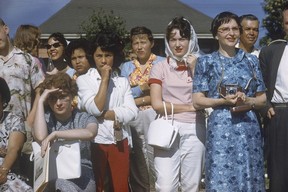
He loved crowds, and the new show has a colourful photo, People Watching, which shows the masses watching Queen Elizabeth on the royal tour of B.C. in 1959.
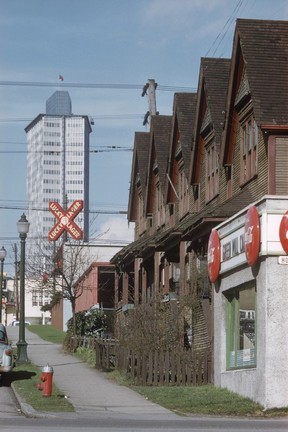
He also loved contrasting the old city and the new one. Lucky Lager shows a tiny café at the end of a row of five ramshackle wooden cottages that look like they haven’t been painted since 1900, with the ultramodern 1957 B.C. Electric building looming in the looming in the background. In between is a Lucky Lager sign, criss-crossed like it’s for a railway crossing.
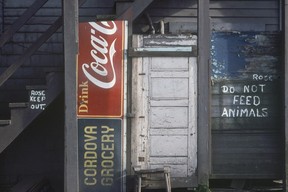
He loved signs, even if they were chopped up, like a Coca-Cola sign on a Cordova Grocery sign that was sliced up, mounted sideways and turned into part of a wall on a building that bears the hand-painted message “Rose Keep Out” and “Rose Do Not Feed Animals.”
Lord knows who Rose was, but she was immortalized by Fred Herzog.
jmackie@postmedia.com