
B.C. climate news: Glacial lake outburst triggers flooding northeast of Pemberton| First Nations seek details on proposed pipeline | Western Europe braces for repeated heat waves through July
Here’s all the latest local and international news concerning climate change for the week of June 30 to July 5, 2026.
You can save this article by registering for free here. Or sign-in if you have an account.

Here’s the latest news concerning climate change and biodiversity loss in B.C. and around the world, from the steps leaders are taking to address the problems, to all the up-to-date science.

Subscribe now to read the latest news in your city and across Canada.
- Unlimited online access to articles from across Canada with one account.
- Get exclusive access to the Vancouver Sun ePaper, an electronic replica of the print edition that you can share, download and comment on.
- Enjoy insights and behind-the-scenes analysis from our award-winning journalists.
- Support local journalists and the next generation of journalists.
- Daily puzzles including the New York Times Crossword.
Subscribe now to read the latest news in your city and across Canada.
- Unlimited online access to articles from across Canada with one account.
- Get exclusive access to the Vancouver Sun ePaper, an electronic replica of the print edition that you can share, download and comment on.
- Enjoy insights and behind-the-scenes analysis from our award-winning journalists.
- Support local journalists and the next generation of journalists.
- Daily puzzles including the New York Times Crossword.
Create an account or sign in to continue with your reading experience.
- Access articles from across Canada with one account.
- Share your thoughts and join the conversation in the comments.
- Enjoy additional articles per month.
- Get email updates from your favourite authors.
Create an account or sign in to continue with your reading experience.
- Access articles from across Canada with one account
- Share your thoughts and join the conversation in the comments
- Enjoy additional articles per month
- Get email updates from your favourite authors
Sign In or Create an Account
Check back every Saturday for more climate and environmental news or sign up for our Sunrise newsletter HERE.
In climate news this week:
• B.C. First Nations want details, consultations on $44-billion proposed oil pipeline to Roberts Bank
• Western Europe braces for repeated heat waves through July
• Glacial lake outburst triggers flooding northeast of Pemberton
• Evacuation alert issued for out-of-control wildfire near Boston Bar
Human activities like burning fossil fuels and farming livestock are the main drivers of climate change, according to the UN’s intergovernmental panel on climate change. This causes heat-trapping greenhouse gas levels in Earth’s atmosphere, increasing the planet’s surface and ocean temperature.
The panel, which is made up of scientists from around the world, including researchers from B.C., has warned for decades that wildfires and severe weather, such as the province’s deadly heat dome and catastrophic flooding in 2021, would become more frequent and intense because of the climate emergency. It has issued a code red for humanity and warns the window to limit warming to 1.5 C above pre-industrial times is closing.
According to NASA climate scientists, human activities have raised the atmosphere’s carbon dioxide content by 50 per cent in less than 200 years, and “there is unequivocal evidence that Earth is warming at an unprecedented rate.”
As of June 5, 2026, carbon dioxide in the atmosphere was 432.34 parts per million, up slightly from 431.12 ppm the previous month, according to the latest available data from the NOAA measured at the Mauna Loa Observatory, a global atmosphere monitoring lab in Hawaii. The NOAA notes there has been a steady rise in CO2 from under 320 ppm in 1960.

-
Advertisement 1Story continues belowThis advertisement has not loaded yet, but your article continues below.
Quick facts:
• The global average temperature in 2023 reached 1.48 C higher than the pre-industrial average, according to the EU’s Copernicus Climate Change Service. In 2024, it breached the 1.5 C threshold at 1.55 C.
• 2025 was the third warmest on record after 2024 and 2023, capping the 11th consecutive warmest years.
• Human activities have raised atmospheric concentrations of CO2 by nearly 49 per cent above pre-industrial levels starting in 1850.
• The world is not on track to meet the Paris Agreement target to keep global temperature from exceeding 1.5 C above pre-industrial levels, the upper limit to avoid the worst fallout from climate change including sea level rise, and more intense drought, heat waves and wildfires.
• UNEP’s 2025 Emissions Gap Report, released in early December, shows that even if countries meet emissions targets, global temperatures could still rise by 2.3 C to 2.5 C this century.
• In June 2025, global concentrations of carbon dioxide exceeded 430 parts per million, a record high.
• There is global scientific consensus that the climate is warming and that humans are the cause.
Latest News
A day after Alberta and Canada announced a southern route ending in Roberts Bank in Delta for a proposed new oil pipeline, First Nations say they will need to see more project details and be adequately consulted before taking a position.
“The main message is that we need meaningful engagement, and consultation in alignment with our constitutionally protected treaty rights,” Tsawwassen First Nation executive councillor Valerie Cross told Postmedia.
The estimated $35 billion to $44 billion proposed project includes a pipeline that would largely follow the existing Trans Mountain oil pipeline from Alberta south through B.C., with a 2.6 square kilometre terminal that will include storage tanks and two berths that can accommodate supertankers.
Part of the project, including the marine terminal at Roberts Bank, is located within Tsawwassen First Nation Treaty lands, according to a project description filed by Alberta with the federal government’s major projects office.
Cross noted that to date there have been no consultations with the Tsawwassen Nation and that the community has not taken a position on the project. Cross said considerations will be given to the impact on the lands, waters, fisheries, marine ecosystems, the Fraser River Estuary, Roberts Bank, community well-being, and future generations.
—Gordon Hoekstra

Glacial lake outburst triggers flooding northeast of Pemberton
An evacuation order remains in place for properties in a Sea to Sky community northeast of Pemberton after a glacial lake burst its banks, triggering flooding in the area.
Officials are warning residents and visitors to stay away from nearby waterways as the glacial lake at the edge of Place Glacier has burst, sending debris and floodwaters through Place Creek and other waterways.
In an advisory issued Tuesday, the Squamish-Lillooet Regional District confirmed an “outburst is underway.”
“Hazardous debris floods are expected in Place Creek and downstream water channels, with the potential for elevated water levels, erosion, and unstable stream banks,” it said.
Officials say flows are expected to be comparable to the 2024 outburst flood and greater than those recorded during last year’s event.
—Cheryl Chan
Evacuation alert issued for out-of-control wildfire near Boston Bar
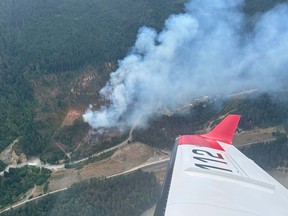
An evacuation alert has been issued by the Fraser Valley Regional District for properties near an out-of-control wildfire close to Boston Bar.
The B.C. Wildfire Service says the .14-square-kilometre Brunswick Creek blaze, believed to be human caused, is burning along Chaumox Road near Brunswick Creek.
Four properties on Chaumox Road north of North Bend are on evacuation alert.
B.C. Wildfire Service crews are assisting the Boston Bar Fire Department in response to wildfire. Air support has been limited due to weather and terrain.
As of Friday evening there were 19 active wildfires in the province, including three considered out of control.
Fire officials say, despite a cooler weather pattern moving throughout the province, temperatures are expected to increase over the weekend and drought remains a concern.
—Tiffany Crawford
Environment Canada has issued weather alerts across the country as temperatures as high as 37 C are expected to arrive this week.
The warnings, which cover Alberta, Ontario, Quebec and a handful of areas in the Northwest Territories and Saskatchewan, are classified as either yellow or orange, depending on how high temperatures are expected to soar.
Environment Canada says these warnings are put in place when hazardous weather may cause damage, disruption, or health impacts. For yellow warnings, impacts are moderate, localized and/or short-term, while orange warnings indicate major impacts that are widespread and/or may last a few days.
In Ontario, there were 38 orange warnings for heat at the time of writing, as well as 40 yellow warnings. Alberta has 31 yellow heat warnings in place, while there are seven in the Northwest Territories, 60 in Quebec and four in Saskatchewan.
—Ellie Hutchings

As Europe’s record-breaking heat wave recedes, the elements for the next hot spell are coalescing over the Atlantic Ocean.
Over the next few days, a region of high pressure is forecast to approach the continent and spread, pushing out cooler weather and resurrecting unusually hot conditions across Spain, France and the U.K. Highs over Portugal and southern Spain are expected to reach 43 C and 41 C, respectively, this week, while Paris hit 30 C by Friday and London will hit 31 C on Monday.
Climate change is increasing the frequency and intensity of heat waves on the world’s fastest-warming continent, straining health, transport and power systems, while exposing the housing vulnerabilities of cities like London. Still, the third heat wave to hit western Europe since the last week of May is unlikely to bring the extreme temperatures that seared the region last month, according to U.K. Met Office meteorologist Alex Burkill.
“At this stage it doesn’t look like it will be as exceptionally hot or as humid as it was for many of us last week,” Burkill said in a video briefing. The high pressure is set to raise average temperatures from 3 C to 7 C across the region next week.
—Bloomberg News
July heat wave threat keeps European power prices elevated
The risk of more heat waves this month is keeping European power prices elevated after June’s record temperatures pushed costs to their highest levels since the 2022 energy crisis.
Power prices surged as record temperatures swept across Europe, boosting demand for cooling while constraining supply. The episode highlighted how increasingly extreme heat linked to climate change can disrupt electricity markets in multiple ways, a pattern seen around the world.
Forecasts show an elevated risk of further heat waves across the UK, Spain, Germany and France this month. The next spell of hot weather, while not expected to match June’s extremes, could meet the UK’s heat-wave threshold as early as this weekend, said the Met Office.
Temperatures across much of Europe are forecast to run 2 C to 8 C above seasonal norms, according to Vaisala meteorologist Matthew Dross. By mid-month, France could again become the epicentre of extreme heat as high pressure, unusually warm seas and soils dried out by previous heat waves reinforce one another, he said.
—Bloomberg News
Climate-fuelled heat waves increasing in Canada: climate scientists
Climate change, primarily from the burning of fossil fuels, is causing more frequent and intense heat waves that are threatening the safety and health of Canadians — even in cities that have historically had more moderate climates, such as Vancouver, Whitehorse, and Halifax, the Canadian Climate Institute warned this week.
In an updated fact sheet posted Thursday, scientists with the institute said globally, 2025 was one of the hottest years on record, while the past 11 years have been the warmest on record.
Scientists said climate change increases the frequency of extreme heat, and makes heat waves hotter, longer, and more widespread.
The latest climate projections show that by the second half of this century, many Canadian cities will see two to four times as many days over 30 C days per year and is increasingly stalling weather patterns and making long-lasting heat domes nearly three times more common today than in the 1950s.
In 2025, Canada experienced 12 extreme heat events, each made two to 10 times more likely due to climate change, the scientists said.
—Tiffany Crawford