
B.C. researchers discover deadly bacterial disease in wild chinook
UBC and the Pacific Salmon Foundation scientists have found tenacibaculosis — a bacterial disease that causes lesions and death — in wild Pacific salmon.
Last updated 13 hours ago
You can save this article by registering for free here. Or sign-in if you have an account.
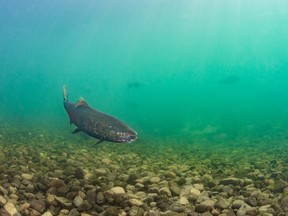
For the first time, B.C. researchers have discovered a deadly bacterial disease in wild chinook salmon in the Pacific Ocean off Vancouver Island.

Subscribe now to read the latest news in your city and across Canada.
- Unlimited online access to articles from across Canada with one account.
- Get exclusive access to the Vancouver Sun ePaper, an electronic replica of the print edition that you can share, download and comment on.
- Enjoy insights and behind-the-scenes analysis from our award-winning journalists.
- Support local journalists and the next generation of journalists.
- Daily puzzles including the New York Times Crossword.
Subscribe now to read the latest news in your city and across Canada.
- Unlimited online access to articles from across Canada with one account.
- Get exclusive access to the Vancouver Sun ePaper, an electronic replica of the print edition that you can share, download and comment on.
- Enjoy insights and behind-the-scenes analysis from our award-winning journalists.
- Support local journalists and the next generation of journalists.
- Daily puzzles including the New York Times Crossword.
Create an account or sign in to continue with your reading experience.
- Access articles from across Canada with one account.
- Share your thoughts and join the conversation in the comments.
- Enjoy additional articles per month.
- Get email updates from your favourite authors.
Create an account or sign in to continue with your reading experience.
- Access articles from across Canada with one account
- Share your thoughts and join the conversation in the comments
- Enjoy additional articles per month
- Get email updates from your favourite authors
Sign In or Create an Account
It’s a finding that could shed light on what is contributing to the rapid decline of B.C.’s southern resident orcas.
The new study, by scientists at UBC and the Pacific Salmon Foundation and published in Scientific Reports, says tenacibaculosis — a bacterial disease that causes lesions and death in fish — was found in 16 per cent of the 99 chinook sampled.
Tenacibaculosis has been well documented in farmed Atlantic salmon, but not found in wild-caught Pacific salmon until now, said Emiliano Di Cicco, a fish health researcher with the Pacific Salmon Foundation and lead author of the study.
The disease was likely caused by a common type of marine bacterium called Tenacibaculum dicentrarchi, he said, which is found in high concentrations at fish farms around the world.
Di Cicco says the next step is to determine what causes the disease in wild salmon and figure how the fish become infected.
“We don’t know when and where these fish got infected since this study was to assess causation because it was an accidental finding,” said Di Cicco.
The initial study at UBC’s pacific salmon ecology and conservation laboratory was sampling wild chinook in 2022 for a study on the impact of recreationally caught and released salmon.
A few days into the study, UBC researchers noticed unusual bacterial lesions on some of the fish, just in front of the tail. They called in Di Cicco and his team at the Pacific Salmon Foundation.
“This is important because the disease itself is not a new disease. The disease is pretty well known in farmed fish, and it’s a pretty severe disease where it can kill fish in a matter of days. So if they develop the disease and then they die in the wild, you never find it. That’s why this study was so unique.”
He explained that outbreaks tend to happen at farms during the process of transferring juvenile fish from fresh water to salt water. B because there are a lot of fish in one area, the disease spreads rapidly.
-
Advertisement 1Story continues belowThis advertisement has not loaded yet, but your article continues below.
Chinook is the main source of food for B.C.’s critically endangered southern resident killer whales. There are only 74 of these orcas left, according to the Center for Whale Research in Washington state.
Although tenacibaculosis is unlikely to harm orcas, sea lions or humans, the disease could spread to other types of salmon or fish and cause food shortages for some predators, Di Cicco added.

The study was also done in collaboration with the University of California Davis, the University of Toronto, and Fisheries and Oceans Canada.
The findings provide new evidence that is not accounted for in the DFO’s existing disease risk assessment, said Di Cicco.
As a result, these bacteria are currently not regulated in B.C. as a risk to wild Pacific salmon, while other variants of the bacteria are not even considered in the assessment.
“We are working on more studies to figure out exactly where the fish pick it up and how the diseases develop once they pick it up. So that’s part of the questions that we haven’t answered completely yet, and we are looking toward that,” said Di Cicco.
Tenacibaculosis is one of the most common diseases in farmed Atlantic salmon raised in open-net pens in B.C. and a leading cause of farm mortality, according to the foundation.
It has also been found in farmed and hatchery-origin Pacific salmon in California, Chile, New Zealand, and Alaska. Common symptoms include lethargy, loss of balance, abnormal swimming behaviour, skin, fins and oral ulcers, and high mortality.