
How uprooted Ukrainians are finding a sense of belonging on a Langley farm
Over the past two years, the Venechuk Farm has become one of the places where members of Metro Vancouver’s Ukrainian community gather and catch their breath.
Last updated 2 days ago
You can save this article by registering for free here. Or sign-in if you have an account.
In Ukraine, Natalya Rukavchuk’s home was always full of people. Feeding a crowd was second nature.

Subscribe now to read the latest news in your city and across Canada.
- Unlimited online access to articles from across Canada with one account.
- Get exclusive access to the Vancouver Sun ePaper, an electronic replica of the print edition that you can share, download and comment on.
- Enjoy insights and behind-the-scenes analysis from our award-winning journalists.
- Support local journalists and the next generation of journalists.
- Daily puzzles including the New York Times Crossword.
Subscribe now to read the latest news in your city and across Canada.
- Unlimited online access to articles from across Canada with one account.
- Get exclusive access to the Vancouver Sun ePaper, an electronic replica of the print edition that you can share, download and comment on.
- Enjoy insights and behind-the-scenes analysis from our award-winning journalists.
- Support local journalists and the next generation of journalists.
- Daily puzzles including the New York Times Crossword.
Create an account or sign in to continue with your reading experience.
- Access articles from across Canada with one account.
- Share your thoughts and join the conversation in the comments.
- Enjoy additional articles per month.
- Get email updates from your favourite authors.
Create an account or sign in to continue with your reading experience.
- Access articles from across Canada with one account
- Share your thoughts and join the conversation in the comments
- Enjoy additional articles per month
- Get email updates from your favourite authors
Sign In or Create an Account
“It’s our trait of hospitality,” she said.
In Langley, where she has lived for just over a year, she and her child share a basement suite with no room to host anyone.
So her gatherings now happen on a farm.
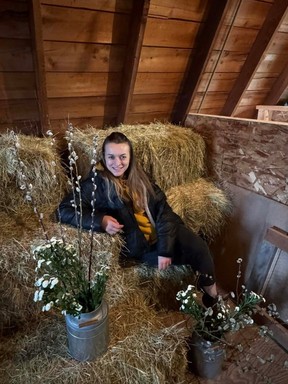
Every few weeks, women drive out to a property in rural Langley for an evening that belongs to no one’s schedule but their own. Ukrainian women mostly, but Canadian, Georgian and Uzbek women too.
They sweat in a wood-fired sauna, eat food Rukavchuk has cooked, and talk. There is one rule: Nobody who supports Russia’s war is welcome.
For a few hours, Rukavchuk said, they get to be “not a mother, not a wife, not an employee.”
“A lot of people are missing connection,” she said. “Just talking — not about business, not rushing anywhere.”
Over the past two years, the Venechuk Farm has become one of the places where members of Metro Vancouver’s Ukrainian community — swelled by tens of thousands of arrivals since Russia’s full-scale invasion in 2022 — gather, eat, mark their holidays, and catch their breath.

The evidence is everywhere on the property.
This year the farm raised Ossabaw hogs, a breed with an unusually thick cap of fat, because so many Ukrainian families asked for salo, the cured pork fat that requires exactly that. The garden plots are tended mostly by Ukrainian women. The parking lot has been expanded three times and still runs out of room.
Dozens of Ukrainian families come weekly for blueberries, eggs and vegetables through a partnership with Raphael House, a Langley non-profit that supports families struggling to afford food.
Its managing director, Scott Thiessen, said these families stand out for their determination.
-
Advertisement 1Story continues belowThis advertisement has not loaded yet, but your article continues below.
“They’re actively trying to restart and trying to get moving,” he said. But the in-between years wear on people: “You have one hand in Ukraine and one hand in Canada.”

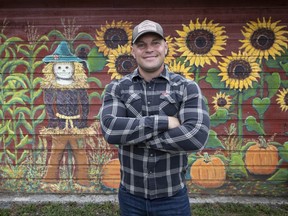
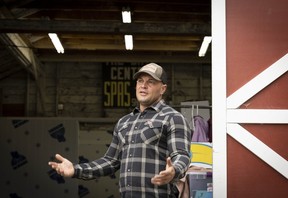
The land is owned by Blake Venechuk, a fourth-generation farmer whose great-grandfather left Ukraine after the First World War for southern Alberta.
The family worked the land for generations, until commodity prices collapsed in the late 1990s and they sold, like many Prairie families.
Blake moved to B.C. and spent 20 years feeling the absence of something he couldn’t replace — the community-hall Easters and Christmases of his childhood, the unwritten Prairie rule that, “Your life could literally depend on you stopping for somebody else.”
Ukrainians arriving after 2022 were missing the same things, more sharply. Blake had been hosting community events for years on leased land. After buying the Langley farm, he threw it open to the newcomers.
“It’s allowed me to have greater contact with my roots,” he said. “And it’s given me the chance to create almost a cultural hug for Ukrainians.”
Word travels the way it does in a scattered community — Facebook groups, Telegram chats, a flyer at school.
Yulia Osetska, who arrived in late 2023, heard about a week-long children’s summer camp at the farm and signed up her six-year-old daughter Kristina, who spent the days feeding animals and swimming.
“My child was so happy. I’ve never seen anything like it,” Osetska said. “She’s very hyperactive, it’s hard for her to focus. But there, she was completely present.”

The family kept coming back, and not for the produce.
“I lacked home,” she said. “I went there on purpose to talk to girls from Ukraine, to find new friends.”
Liubov Moroz found the farm through a Facebook post about an Easter market and drove out with a friend. The women selling cherry buns told her about the gatherings. Now she buys her eggs there every week.
The farm, she said, offers the thing that is hardest to find here.
“It creates a kind of homey warmth that you really miss in Canada, when you’re constantly in your routine, and your family is far away.”
It isn’t the only farm Ukrainians seek out. Several women mentioned a berry farm in Richmond they also visit. But that one, Rukavchuk said, is for picking fruit.
“People don’t come to Blake’s to pick berries. They come to rest,” she said.
Not everyone who comes is a newcomer to Canada.
At an Easter festival and pysanka-painting workshop that organizer Iryna Mitnovych brought to the farm, longtime Canadians and older diaspora turned up alongside the recent arrivals, reaching for something half-remembered.
“They had such a nostalgic burst of emotion,” she said. My grandmother used to paint these, they told her.
Celene Hoag knows the feeling. A second-generation Canadian raised in Delta, she lost her Ukrainian heritage early — her grandfather died when she was two, her Ukrainian grandmother when she was six.
“After that, there wasn’t a lot of Ukrainian culture, because there was nobody to pass it on,” she said.
At the farm’s Ukrainian Christmases, the food and the music handed some of it back, and gave her something to pass on to her own children.
Her grandfather’s story is the one she keeps returning to.
He arrived from Ukraine in 1929, at 17, with no English and no one but an uncle who ran a logging camp in Revelstoke. When the camp closed during the Depression, he rode the rails, sleeping rough and going hungry. Once, starving, he was given a jar of honey by a woman near the tracks — he ate it so fast, so desperately, that he was sick. He never touched honey again.
He settled in New Westminster, married another Ukrainian, and started the family Hoag was born into.
A century later, Hoag keeps bees and makes honey of her own. She won’t say her grandfather is the reason — she’s loved bees all her life — but, she said, “It makes it more meaningful to me.”
The parallel she draws is between him and the Ukrainians arriving now. He came alone, with nothing, and no one waiting.
“He didn’t have any community or support. He was just all alone, trying to build this,” Hoag said.
The families finding their way to the farm in Langley are, in one sense, where he was — displaced, starting over, far from home.
In another, they are luckier. They have somewhere to go.
Reporter Oksana Shtohryn is a Postmedia summer intern who was born and raised in Ukraine before moving to Canada in 2023. Some interviews for this story were conducted in Ukrainian and translated by the reporter.