
Converting raw sewage into precious resource, Vancouver’s Sen̓áḵw development aims for low-carbon future
The Vancouver company that developed Sen̓áḵw’s district energy centre, Creative Energy, says this is likely North America’s most efficient energy system and one of the first large-scale, net-zero housing projects in the world.
By Dan Fumano
Last updated 12 hours ago
You can save this article by registering for free here. Or sign-in if you have an account.
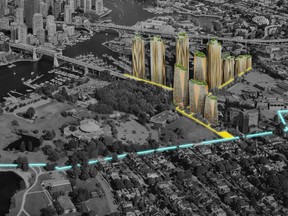
The Squamish Nation’s high-density Sen̓áḵw development has already transformed Vancouver’s skyline with the first three of 11 planned residential towers soaring high above Kitsilano, drawing international attention in the process. But there is a fascinating and lesser-known story far below the ground there too.

Subscribe now to read the latest news in your city and across Canada.
- Unlimited online access to articles from across Canada with one account.
- Get exclusive access to the Vancouver Sun ePaper, an electronic replica of the print edition that you can share, download and comment on.
- Enjoy insights and behind-the-scenes analysis from our award-winning journalists.
- Support local journalists and the next generation of journalists.
- Daily puzzles including the New York Times Crossword.
Subscribe now to read the latest news in your city and across Canada.
- Unlimited online access to articles from across Canada with one account.
- Get exclusive access to the Vancouver Sun ePaper, an electronic replica of the print edition that you can share, download and comment on.
- Enjoy insights and behind-the-scenes analysis from our award-winning journalists.
- Support local journalists and the next generation of journalists.
- Daily puzzles including the New York Times Crossword.
Create an account or sign in to continue with your reading experience.
- Access articles from across Canada with one account.
- Share your thoughts and join the conversation in the comments.
- Enjoy additional articles per month.
- Get email updates from your favourite authors.
Create an account or sign in to continue with your reading experience.
- Access articles from across Canada with one account
- Share your thoughts and join the conversation in the comments
- Enjoy additional articles per month
- Get email updates from your favourite authors
Sign In or Create an Account
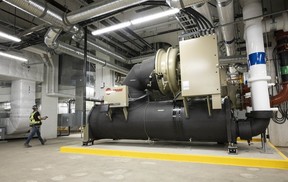
Postmedia recently toured Sen̓áḵw’s district energy system, a cavernous underground facility that is already heating and cooling the first tower (now about half tenanted), and will eventually service all 6,000 homes for an expected 9,000 residents. That works out to more than the population of Merritt or Gibsons living in 11 tall buildings on the 4.7-hectare property.

tap here to see other videos from our team.
Converting raw sewage into precious resource, Vancouver’s Sen̓áḵw development aims for low-carbon future Back to video
tap here to see other videos from our team.
The Vancouver company that developed Sen̓áḵw’s district energy centre, Creative Energy, says this is likely the most efficient system in North America, helping make Sen̓áḵw one of the first large-scale, net-zero housing projects in the world.
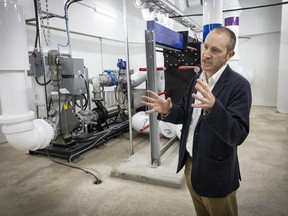
As Creative Energy’s director of engineering Keith Bate explained during a recent tour, a key element of the system is the massive Metro Vancouver sewage main that crosses underneath False Creek and then passes, underground, right past Sen̓áḵw.
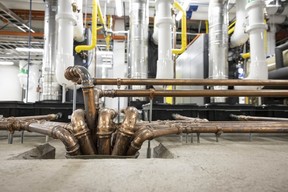
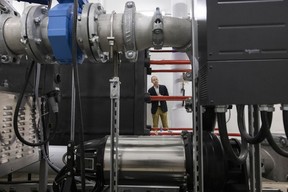
Sen̓áḵw’s energy facility draws raw sewage from Metro’s main and through a macerator (a machine with teeth chomping up the “nasty solids”), and then a filter. The remaining fluid from the sewer then enters a room in the facility where it doesn’t mix with or touch the fluid inside Sen̓áḵw’s energy system, but heats it through metal plates that allow heat transfer, which then serves the towers with massive heat pumps.
Using this liquid sewage — which is expected to range between 10 and 25 C over the year and was 21 C during a recent visit — is far more efficient than if the heat pump were to operate in a more traditional way, drawing in cold air from outside and heating it up, Bate says. The key is doing more with less electricity.
It provides a glimpse of how we might heat and cool the cities of the future. As the world grapples with climate change, many governments are pushing to electrify buildings instead of burning gas for heating.
- See Vancouver’s Sen̓áḵw towers, from the inside out
-
Advertisement 1Story continues belowThis advertisement has not loaded yet, but your article continues below.
B.C.’s electricity is relatively clean — but B.C. Hydro is continuing to run two natural-gas-powered generating stations because of an expected 500-megawatt generating shortfall by 2030.
That means it is crucial to figure out how to use electricity more efficiently, experts say, and tap into some previously overlooked energy sources when possible — in the ocean, under the ground, and, like Sen̓áḵw, in the sewers.
“We’ve got to electrify to address climate change. The winds will blow whichever way politically, but there’s no question we have to do it,” Bate said. “In B.C., we have this amazing clean electricity, but it’s not unlimited. It’s a precious resource, and we have to be efficient with it.”
Carly Wolfe, Creative Energy’s project manager for Sen̓áḵw, said the Squamish Nation’s vision “from day one” was for the most sustainable development possible that reflected their values.
“So we partnered with them to bring that vision to life, and part of that was designing a zero-carbon energy system, which we’re looking at here, using the sewage heat recovery technology,” Wolfe said.
Creative Energy was previously Central Heat Distribution, which was a utility providing steam heat for buildings in downtown Vancouver.
In 2013, Westbank Corp. bought Central Heat for a reported $32 million, and it was rebranded the following year as Creative Energy. Today, Toronto-based private equity firm Instar is Creative Energy’s majority shareholder, and Westbank retains a minority stake.
Creative Energy now specializes in developing district energy systems, which are centralized networks distributing thermal energy to several buildings. District energy systems are not new, as shown by Central Heat, which started in 1968, and university and hospital campuses have long used such systems. Now, companies like Creative Energy are tapping new resources for these facilities.
Creative Energy has 15 systems in B.C. and Ontario, with each “tailored” to its particular environment, Bate says.
Oakridge Park, which is not near a sewage main, uses hundreds of boreholes deep underground to harness the earth’s stable temperature to provide heating in the winter and cooling in the summer. Westbank’s huge waterfront development in Horseshoe Bay exchanges heat through pipes with a submerged heat exchanger on the ocean floor.
Each district energy system, Bate says, “is very much a bespoke approach that’s optimized for that specific application.”
As cities grow and densify, civic leaders are thinking more about finding sustainable, reliable energy sources, said Brad Griffin, director of Simon Fraser University’s Canadian Energy and Emissions Data Centre.
“Lots of new ideas are coming around that we didn’t bother thinking about before, because natural gas was so cheap. Why would we bother to do anything else? Now they’re starting to think more creatively about what can we do,” Griffin said. “But it’s all sensitive to cost, just like anything.”
“Municipalities and developers are realizing (sewage heat recovery) is a resource we’ve been basically ignoring,” he said. “But it doesn’t always make sense. That big pipe needs to be relatively close to where the people are. … I think we can be more opportunistic, where we happen to want to add density for transit reasons or development reasons, and there’s a pipe there, then we’ll use it. But we typically can’t move one or the other to line up.”
To that end, Metro Vancouver’s regional planners are trying to get a sense of where those resources and opportunities might lie. Earlier this summer, the regional government issued a request for a consultant to undertake a “thermal energy networks opportunity analysis.”
Essentially, this will be a study to better understand where in the Metro region new and expanded district energy systems could be viable, in terms of existing energy sources (such as industrial heat, geothermal, and sewage heat recovery) and potential demand nearby, said Lise Townsend, division manager of air quality and climate action policy for Metro.
“This is a high-level regional scan and won’t involve designing specific systems — its purpose is to identify opportunities to support low-carbon energy solutions and reduce reliance on natural gas,” Townsend said, adding that B.C. Hydro and the Zero Emissions Innovation Centre are contributing funding to the study.
These kinds of energy networks offer several advantages, Townsend said, including better efficiency, more reliable and stable energy rates, reducing demand on the electricity system, and beneficially using energy that would otherwise be wasted.
Vancouver was a North American leader in this area. For the development of southeast False Creek ahead of the 2010 Olympics, Vancouver installed one of North America’s first sewage heat recovery systems. Today, the city-owned False Creek neighbourhood energy utility services 47 residential, commercial, and institutional buildings in False Creek and Mount Pleasant totalling 667,000 square metres of floor area, with plans to expand.
Surrey is developing its own sewer heat recovery facility, expected to eventually supply most of its downtown’s heating. Jason Owen, an engineer who previously worked for Surrey on the early design of its sewer heat recovery system, is now vice-president of project development for Corix, a low-carbon energy infrastructure company and competitor of Creative Energy.
In his current role, Owen partners with municipalities, developers, hospitals, universities and other public and private sector organizations looking to build low-carbon energy solutions. Once again, each one is different.
“Sewage heat is one of the opportunities, or sometimes there’s a nearby power plant that has a bunch of waste heat and you can use it in a similar way,” he said. “I do think it is going to be increasingly important in cities across the world. Where we’re densifying, we’re electrifying, and we need to find ways to do that really cost-effectively.”