
The dirty money behind Canada’s deadly fentanyl trade
Fentanyl traffickers using Chinese networks to buy chemicals and launder cash, federal documents show
By Zak Vescera, Kim Bolan
Last updated 1 day ago

This story is a collaboration between Postmedia and the Investigative Journalism Foundation

Subscribe now to read the latest news in your city and across Canada.
- Unlimited online access to articles from across Canada with one account.
- Get exclusive access to the Vancouver Sun ePaper, an electronic replica of the print edition that you can share, download and comment on.
- Enjoy insights and behind-the-scenes analysis from our award-winning journalists.
- Support local journalists and the next generation of journalists.
- Daily puzzles including the New York Times Crossword.
Create an account or sign in to continue with your reading experience.
- Access articles from across Canada with one account.
- Share your thoughts and join the conversation in the comments.
- Enjoy additional articles per month.
- Get email updates from your favourite authors.
Create an account or sign in to continue with your reading experience.
- Access articles from across Canada with one account
- Share your thoughts and join the conversation in the comments
- Enjoy additional articles per month
- Get email updates from your favourite authors
Sign In or Create an Account
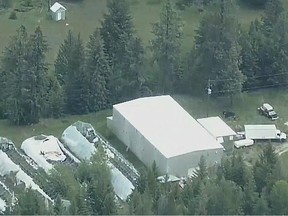
When police arrived at a rural property on Abbotsford’s Bradner Road in May, they found a large synthetic-drug lab under construction with hundreds of thousands of dollars worth of lab equipment, a pill press and chemicals used to make fentanyl and methamphetamine.
The operation was just one of an increasing number of synthetic drug labs dismantled in B.C.
Sources told Postmedia that the group behind the sophisticated setup is a Hells Angels support club.
Staff Sgt. Shawn MacNeil, of the RCMP’s clandestine laboratory enforcement and response team, said the Bradner Road property contained “large machines, and once they were up and running, and producing drugs, would produce a significant amount of drugs.”
Labs like these are part of why the Canadian government is trying to hit drug dealers where it hurts — in their wallets.
The Investigative Journalism Foundation and Postmedia have obtained internal intelligence documents from Canada’s anti-money-laundering agency that map out the dirty money behind the country’s deadly fentanyl trade, which is behind an overdose crisis that has killed more than 57,000 Canadians in the past decade.
They reveal close ties among Canadian criminals moving fentanyl and Chinese chemical makers and professional money laundering groups, which dominate the market by undercutting competitors.
The reports, obtained through access to information legislation, provide insight into the business behind the synthetic opioid trade, including how gangs buy precursor chemicals, where financial transactions are centred and how the resulting cash is laundered.
-
Advertisement 1Story continues belowThis advertisement has not loaded yet, but your article continues below.
And while many of those chemicals are still coming from China, one report says crackdowns in that country have led Canadian criminals to “to seek out more accessible, and less-regulated chemical industry markets.”
Those reports from the Financial Transactions and Reports Analysis Centre of Canada, or Fintrac, are based on suspicious transactions reported to that federal agency by banks and other financial institutions.
The reports were produced between January and March 2025, when U.S. President Donald Trump was accusing Canada of failing to stem the flow of fentanyl across the northern border into the U.S.
That declaration sparked a flurry of action from federal officials, including the appointment of a national “fentanyl czar” and the designation of some drug cartels as terrorist organizations.
A January 2025 report from the centre concluded that “sporadic and isolated fentanyl-linked financial transactions between Canada and the U.S. are not indicative of a more pervasive financial intersection in Canada-U.S. cross-border fentanyl trafficking and money laundering.”
But what Fintrac did find was close ties among Canadian drug traffickers, Chinese chemical makers and professional money-laundering groups.
One report said Fintrac had identified Chinese and Hong Kong companies “suspected of exporting precursor chemicals and other equipment used for the manufacture and trafficking of illegal fentanyl in Canada.”
The agency declined to say how many such companies it had identified.
But the reports indicate some Chinese companies had made “suspicious payments” to Canadian warehousing and trade companies.” The agency believed this was a way to “further disassociate the purchaser and seller of chemicals destined for illegal drug production.”
“It is highly likely the use of front and shell companies, the suspected use of domestic third warehousing services, below threshold transactions, and the purchase of virtual currency are all deployed to obscure the financing and laundering of funds associated with illegal drug or precursor chemical shipments,” one Fintrac report said.
The report said suspected traffickers sometimes used nominees — including romantic partners and family members — “to funnel proceeds of crime, launder funds, or conceal the beneficial ownership of front and shell companies.”
Fintrac also noted that criminal organizations have established “fentanyl and precursor chemical trafficking corridors across Canada” that “are concentrated around major urban population centres with proximity to common trade, finance and transportation infrastructure.”
The reports suggest the Toronto region is the largest of those hubs. The centre declined to say exactly how many transactions it had connected to the area.
One report described the greater Toronto and Montreal areas as “central hubs for fentanyl trafficking” with a “concentration of fentanyl trafficking in central and southern Ontario.” It said the Toronto, Montreal and Vancouver areas were “also identified as central hubs for precursor chemical trafficking in Canada.”
“Fentanyl trafficking corridors likely travel from west to east across Canada, with observed connections to more remote communities along these routes,” another report said.
The reports reflect a renewed push from Fintrac to map out the dirty money behind Canada’s fentanyl trade.
The centre’s 2025-2026 annual report said it produced 268 intelligence disclosures for law enforcement about the fentanyl trade, more than double the year before.
The Fintrac reports also examined how criminal groups buy and import precursors used to make the deadly drug.
One report said that a crackdown on precursor chemicals by Chinese authorities may push some Canadian crime groups to start getting those supplies from other countries.
A Fintrac spokesperson said India and eastern Europe are now also considered “high-risk jurisdictions for the procurement and diversion of precursor and essential chemicals.”
The Canada Border Services Agency declined to provide an interview and said it “does not publicly discuss details of its intelligence assessments of drug-smuggling trends pertaining to specific countries.”
The agency said it was cracking down on fentanyl and precursor imports through detector dogs, “new detection technology tools” and incoming investments in “imaging and trace detection tools, regional satellite laboratories and hand-held chemical analyzers.”
But even if other countries are the source of more precursors, the Fintrac reports predicted that “Chinese money-laundering organizations will continue to be used to legitimize proceeds of fentanyl and synthetic drug trafficking through different sectors of the economy.”
Those so-called “professional” money-laundering networks do not themselves make or sell fentanyl, but are commonly hired by drug traffickers to launder dirty money, the reports said.

Another internal Fintrac intelligence report — separate from the three reports on fentanyl — said the Chinese-linked networks succeed in part because they charge rates as low as 0.5 to two per cent to launder the proceeds of crime, compared to rates of five to 10 per cent charged by competitors.
“The Chinese triads have always had significant control over the money-laundering business here in Canada,” said Christian Leuprecht, a professor at the Royal Military College of Canada.
Leuprecht, who wrote a book on dirty money in Canada, agrees with Fintrac intelligence that predicts drug traffickers will increasingly use cryptocurrencies to conceal illegal trade.
“Fintrac assesses that virtual currencies will continue to be used for both the laundering of drug proceeds and the purchase of drugs and chemical precursors, due (to) their borderless nature and ability to settle transactions outside of the traditional banking system,” one report said.
Unlike in traditional money laundering, Leuprecht said cryptocurrency allows criminals to move money without the assistance of “professional enablers” like accountants or lawyers, helping keep costs down.
And while cryptocurrency can be traced, Leuprecht said criminal groups are skilled at using “tumblers” and other tools that bounce cryptocurrency among different wallet addresses, making it hard for law enforcement officials to identify who has the money.
“We’re going to see an exponential rise in the ability to move and launder illicit gains,” Leuprecht said.
He said part of the problem is Canada’s dismal record of prosecuting money laundering. In 2025, Canadian officials only charged 54 people with laundering the proceeds of crime, according to Statistics Canada.
Rob Stewart, a senior federal public servant tasked with creating a new financial crimes agency, said the complexity of those cases means police and prosecutors prefer to focus on underlying offences like drug dealing.
Speaking during a panel at the Vancouver International Security Summit last month, Stewart said that meant there was a “huge learning curve” for authorities tackling money laundering.
“Prosecution resources tend to be ill-equipped to deal with complex money laundering and proceeds of crime cases, because we don’t bring many,” Stewart said.
There have also been few prosecutions of those connected to the synthetic drug labs, though lab properties are often the subject of civil forfeiture lawsuits.
When the RCMP uncovered what was then Canada’s largest fentanyl lab in Falkland, B.C., in October 2024, they announced charges against one person — Gaganpreet Singh Randhawa.
Randhawa pleaded guilty in B.C. Supreme Court in September to attempting to export methamphetamine to the Philippines, but there was no mention of the record-setting fentanyl lab, which is the subject of a forfeiture lawsuit.
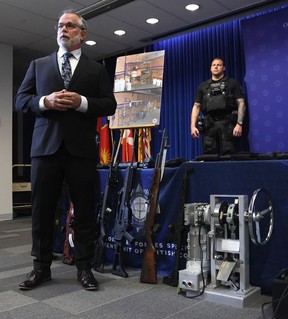
And, Sgt. Sarbjit Sangha, of B.C.’s Combined Forces Special Enforcement Unit, said the anti-gang agency is preparing a report to Crown counsel recommending charges in connection with the Bradner Road lab in Abbotsford.
Last month, the B.C. government filed a lawsuit saying the Bradner Road property, as well as a second one in Enderby, should be forfeited for links to criminal activity.
The statement of claim named Stephan Beaudry as the target of the CFSEU investigation, as well as five others it alleged were linked to him, and three companies.
A source said some of those involved have connections to the Horsemen, a motorcycle club linked to the more-notorious Hells Angels.
Nor has anyone faced charges for another large-scale lab, raided by police on Wilson Road in Chilliwack on May 1. It contained even more fentanyl than police seized in Falkland, as well as tonnes of precursor chemicals. A civil forfeiture lawsuit was filed against the property in September.
Canada’s fentanyl czar, Kevin Brosseau, was not available for an interview, but provided a statement about Canada’s progress in tackling the fentanyl crisis.
“Canada is taking a comprehensive, whole-of-government response to the fentanyl crisis that includes advancing and passing key legislation, working with U.S. partners to tighten border security, disrupting criminal networks and precursor supply chains, funding prevention, treatment, recovery, and other community-based supports, and driving co-ordinated action through strong and sustainable partnerships,” the statement said.
Brosseau noted that between June 2025 and June 2026, “we have seen the seizure of approximately 1.37 kilograms of fentanyl at the border by the Canada Border Services Agency, the seizure of 134.65 kilograms of fentanyl across the country by the RCMP and 4,930 charges and arrests involving fentanyl or fentanyl analogues.”
Health Canada spokesperson Hélène-Annie Lavoie said in a statement that “all known precursor chemicals that can be used to make fentanyl are tightly controlled in Canada.”
“Importing these chemicals into Canada is illegal unless authorized by Health Canada through its robust precursor control framework, which requires both a licence and an import permit.”
She said Health Canada “continuously monitors compliance with the Controlled Drugs and Substances Act and its regulations and can suspend or revoke licences or permits when warranted.”
She also said “there is no evidence to suggest that licensed Canadian companies are a source of precursor chemicals being used in illegal fentanyl production.”
However, in 2023, the U.S. government sanctioned former Health Canada licence holder Bobby Shah, alleging his chemical business was linked to an international network of companies producing fentanyl and other illicit synthetic drugs.
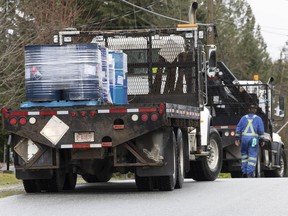
The RCMP seized more than 17 tonnes of chemicals from Shah’s Maple Ridge home a year later, including the ingredients for the deadly synthetic opioid.
Shah has not faced criminal charges, though the B.C. director of civil forfeiture has filed a claim against his $3.6 million house.
The lawsuit alleged Shah and other sanctioned parties were affiliated with a China-based criminal organization, dubbed “the syndicate,” that “manufactured and distributed large quantities of illicit drugs, opioid additives, and precursor chemicals used in the production of narcotics such as fentanyl and methamphetamine, as well as laundered the proceeds of crime, at an international level.”
“The syndicate was the source of supply for various drug traffickers in the U.S., dark web vendors, virtual currency money launderers, and Mexico-based criminal organizations,” the lawsuit said.
Shah has filed a response denying the government’s allegations that he used criminal cash to buy the house.
RCMP spokesperson Lisa McDonald-Bourg said, “Intelligence suggests that precursors and essential chemicals used in illicit drug production may be imported legally or mislabelled/mis-declared and smuggled illegally into the country, often depending on their international and/or national controlled status.”
McDonald-Bourg said the RCMP had beefed up its ability to “identify, disrupt and dismantle the financial networks that enable fentanyl trafficking and other organized crime,” including through better cryptocurrency tracing and enhanced financial intelligence.
She also said specialized RCMP teams have been targeting organized criminal groups making substances like fentanyl, including by finding and dismantling drug labs.
“Law enforcement efforts to disrupt precursor chemical trafficking means that some components needed to make synthetic drugs become harder to source for organized crime groups. This slows down their drug making cycle, and reduces the amount of drugs available at any given time,” she said.
Blueksy: @kimbolan.bsky.social