Surrey 2050 community plan projects city to outpace Vancouver in population
‘This is a major milestone in planning for the future of Surrey’ — Mayor Brenda Locke.
By Sobia Moman
Last updated 2 hours ago
You can save this article by registering for free here. Or sign-in if you have an account.
The City of Surrey has released a draft plan to support projections that it will have one million residents by 2050, making it B.C.’s most-populated city.

Subscribe now to read the latest news in your city and across Canada.
- Unlimited online access to articles from across Canada with one account.
- Get exclusive access to the Vancouver Sun ePaper, an electronic replica of the print edition that you can share, download and comment on.
- Enjoy insights and behind-the-scenes analysis from our award-winning journalists.
- Support local journalists and the next generation of journalists.
- Daily puzzles including the New York Times Crossword.
Subscribe now to read the latest news in your city and across Canada.
- Unlimited online access to articles from across Canada with one account.
- Get exclusive access to the Vancouver Sun ePaper, an electronic replica of the print edition that you can share, download and comment on.
- Enjoy insights and behind-the-scenes analysis from our award-winning journalists.
- Support local journalists and the next generation of journalists.
- Daily puzzles including the New York Times Crossword.
Create an account or sign in to continue with your reading experience.
- Access articles from across Canada with one account.
- Share your thoughts and join the conversation in the comments.
- Enjoy additional articles per month.
- Get email updates from your favourite authors.
Create an account or sign in to continue with your reading experience.
- Access articles from across Canada with one account
- Share your thoughts and join the conversation in the comments
- Enjoy additional articles per month
- Get email updates from your favourite authors
Sign In or Create an Account
Surrey’s official community plan, also called Surrey 2050, is the updated version of a plan from 2013, laying out the city’s goals for infrastructure, housing, jobs, transportation, schools and more. Changing legislation, rapid growth and shifting needs of residents have made an updated plan essential, the city states.
“This is a major milestone in planning for the future of Surrey,” Mayor Brenda Locke said in a statement.
The city boasts its new plan simplifies planning rules by reducing the number of city policies from more than 600 to about 200. It also claims to streamline land-use designations to limit the need for future bylaw amendments.
Community plans are important for homeowners, says Peter Hall, a professor of urban studies at Simon Fraser University.
“What they really are about is giving some certainty to investors and sort of setting common expectations of what’s likely to happen in the future and that has a lot of value … for individual homeowners to know that their neighbourhood is going to maintain its current character,” Hall said. “It is very valuable to them, because that tells them they can expect things to stay the way they are, or alternatively, it tells them that it’s going to change.”
Various municipalities are releasing updated community plans to adhere to provincial requirements that the plans be updated every five years and to align with the B.C. government’s legislative changes around housing supply.
For a city growing as quickly as Surrey, issues could arise around congestion, housing affordability, and stress on infrastructure and services, the plan states: “Planning and policies must anticipate the needs of a larger population and ensure that Surrey’s livability continues to rise.”
-
Advertisement 1Story continues belowThis advertisement has not loaded yet, but your article continues below.
The City of Surrey doesn’t state when it intends to approve the draft plan, but it’s expected to be over the next few months.
Surrey says its population could reach one million by 2050, beating out Vancouver to become the province’s most populated city. Currently, Surrey has a population of about 700,000, while Vancouver has over 750,000 residents.
Surrey’s prediction is on par with Metro Vancouver’s projection, which estimates in its medium growth scenario that Surrey’s population could outpace Vancouver’s by 2041, according to its most recent update from 2025.
While some experts say the prediction is likely accurate, population growth isn’t expected for most of the rest of the region or country.
“It seems as though all of Canada and the Lower Mainland is going to face, in the next few years, some of the population decline, if we continue not bringing in immigrants,” Hall said.
Andy Yan, director of the City program at SFU, agrees and says Surrey’s projections could be impacted by the country’s changing immigration policies.
“But it wouldn’t surprise me if a good hunk of that population growth is also attached towards natural growth, like aging and more people being born than dying in Surrey,” Yan said.
If the projected growth holds true in Surrey, it could result in the suburbs having more sway at the regional level, Hall said.
“Places like Surrey, Langley and so on, are going to be questioning the urban growth boundary and so as they become a larger proportion of the region’s population, their influence and regional decisions could start to change and that’s something to watch,” he added.
Population growth could also increase the number of Surrey-based political seats at the provincial and federal levels.
“Seats in the provincial legislature and the Houses of Parliament are assigned by population, so on that kind of basis, one might see certain shifts in terms of policy and in terms of spending, when, say, the city of Surrey has more seats, federal or provincial, than Vancouver,” Yan said.
Five priorities are highlighted in the city’s draft plan: housing for all, a vibrant downtown, a thriving economy, livable neighbourhoods and a healthy natural environment. These priorities come from the city’s core stated values of affordability, safety and livability.
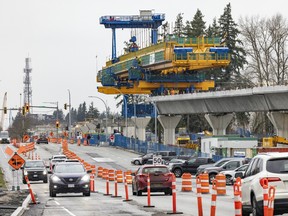
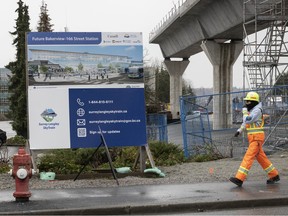
Some of the work featured in Surrey’s plan are already underway, like the Surrey-Langley SkyTrain extension, the building of SFU’s new medical school with an accompanying office tower, and the 10,000-seat arena for sports and entertainment in the heart of the city’s downtown that the mayor also wants to make into an entertainment district.
Those projects are expected to create more jobs for not just local residents, but also to attract workers from other municipalities.
With Surrey’s large supply of industrial land, the city also says it plans to allow more development on that land, and expand employment uses on it.
The draft plan also states it wants to increase the supply of purpose-built and below-market rental housing in transit-oriented areas in town centres.
Surrey also plans to increase commercial and residential density along transit corridors to reduce vehicle-usage in the city.
The city has identified six possible locations for new secondary schools in the local district and 23 sites for additional elementary schools. According to the Surrey school district’s most recent five-year capital plan for 2026-27, there is a need for 27 new schools in the city.