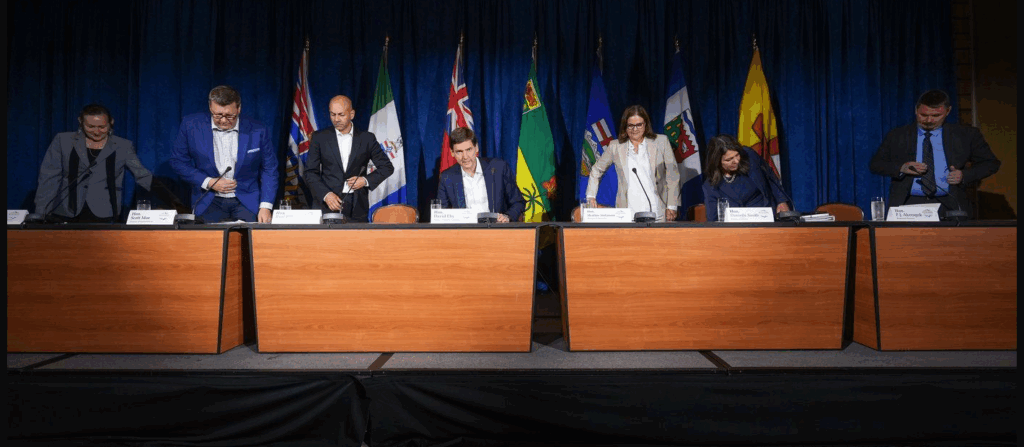
British Columbia Premier David Eby says he’s wondering why western Canadian premiers are meeting in Alberta to talk co-operation when the host premier wants to test separation.
“To say that this is the worst time to begin testing the bonds that hold this country together is a significant understatement,” he said.
CLICK HERE TO LISTEN TO 1130 NEWSRADIO VANCOUVER LIVE!
“It empowers the people who would break our country up and sell us for parts.“
The annual gathering happens as Alberta comes closer than ever to triggering a vote on separation.
Alberta Premier Danielle Smith announced last week that an October referendum question will ask Albertans if they want to remain in Canada or start the process to hold a binding referendum on separation.
Eby called the vote “reckless,” and said this week’s meeting of western and northern political leaders was supposed to be about addressing internal trade barriers, issues around national defence and economic corridors.
“These topics seem at best confusing, if not totally awkward, in light of the referendum question that Premier Smith has put forward,” he said.
Leaders of British Columbia, Alberta, Saskatchewan, Manitoba, the Northwest Territories and the Yukon are to discuss business during the two-day conference in Kananaskis, west of Calgary. Nunavut Premier John Main was to participate virtually.
Eby said while regional leaders might not always agree, it doesn’t mean now is the time to break up the country.
“Canada is a family, and we’re not always going to agree with our family members.“
He made the comments to reporters while donning a fresh pair of dark brown cowboy boots given as a gift to him by Smith.
“I’m pretty proud of them,” he said, expressing his gratitude.
While Smith said she’s looking forward to working with Eby, she also had pointed criticism of her own.
She reiterated her belief that political leaders across the country have fomented separatism in Alberta by throwing hurdles in the way of Alberta’s mainstay oil industry.
She’s pointed the finger at former prime minister Justin Trudeau, Liberal MPs in Ottawa, federal NDP Leader Avi Lewis and leadership in B.C.
On Monday, she singled out Eby and former B.C. premiers John Horgan and Christy Clark.
Smith said they’ve stifled the construction of critical infrastructure being built on the West Coast.
“These ports are not British Columbia’s ports. They’re Canada’s ports,” she said.
Despite Smith changing her own citizen initiative laws multiple times in the past year to clear the way for a separatist petition, Smith has argued that the push to secede didn’t emerge overnight.
“You get there because of successive barriers to us being able to realize our economic prosperity and be able to attract investment and be able to govern ourselves,” she said.


“I think that there just needs to be self-reflection.”
It all comes as Smith’s province moves closer to submitting a proposal for a new West Coast oil pipeline through B.C. by July.
It’s part of an agreement Ottawa has with Alberta that also includes more relaxed carbon pricing for the province.
The agreement hasn’t sat well with Eby, who has opposed a pipeline crossing the westernmost province on its way to the coast, pitched as the door to Asian oil markets, as Canada looks to diversify its trade relationships.
He said the oil tanker ban off the coast of B.C. can’t be compromised on.
Eby reiterated Monday that Prime Minister Mark Carney ought to give the same level of attention and concessions to B.C. projects as he’s giving to Alberta.
He said instead, Smith’s province is getting special treatment.
“And the response to that was to bring forward a referendum question about whether or not Albertans should separate from the rest of Canada,” he said.
On Monday, Saskatchewan Premier Scott Moe weighed in, saying he believes Smith didn’t have a choice but to announce the vote under her provincial law.
“We’ve have 10 years of unconsulted, harmful policy by the previous prime minister,” he said.
While Moe said he aligns closely with Smith’s position on Alberta remaining in Canada, as the premier of Saskatchewan, he said it’s not for him to judge Albertans.