
B.C. climate news: How sustainable are Vancouver’s AI data centres going to be? | Spring heat dome scorches parts of UK, Europe
Here’s all the latest local and international news concerning climate change for the week of May 25 to May 31, 2026
You can save this article by registering for free here. Or sign-in if you have an account.

Here’s the latest news concerning climate change and biodiversity loss in B.C. and around the world, from the steps leaders are taking to address the problems, to all the up-to-date science.

Subscribe now to read the latest news in your city and across Canada.
- Unlimited online access to articles from across Canada with one account.
- Get exclusive access to the Vancouver Sun ePaper, an electronic replica of the print edition that you can share, download and comment on.
- Enjoy insights and behind-the-scenes analysis from our award-winning journalists.
- Support local journalists and the next generation of journalists.
- Daily puzzles including the New York Times Crossword.
Subscribe now to read the latest news in your city and across Canada.
- Unlimited online access to articles from across Canada with one account.
- Get exclusive access to the Vancouver Sun ePaper, an electronic replica of the print edition that you can share, download and comment on.
- Enjoy insights and behind-the-scenes analysis from our award-winning journalists.
- Support local journalists and the next generation of journalists.
- Daily puzzles including the New York Times Crossword.
Create an account or sign in to continue with your reading experience.
- Access articles from across Canada with one account.
- Share your thoughts and join the conversation in the comments.
- Enjoy additional articles per month.
- Get email updates from your favourite authors.
Create an account or sign in to continue with your reading experience.
- Access articles from across Canada with one account
- Share your thoughts and join the conversation in the comments
- Enjoy additional articles per month
- Get email updates from your favourite authors
Sign In or Create an Account
Check back every Saturday for more climate and environmental news or sign up for our Sunrise newsletter HERE.
In climate news this week:
• How sustainable are Vancouver’s AI data centres going to be?
• Alberta wants to build a second oil pipeline to B.C.‘s coast
• Spring heat dome scorches parts of UK, Europe
Human activities like burning fossil fuels and farming livestock are the main drivers of climate change, according to the UN’s intergovernmental panel on climate change. This causes heat-trapping greenhouse gas levels in Earth’s atmosphere, increasing the planet’s surface and ocean temperature.
The panel, which is made up of scientists from around the world, including researchers from B.C., has warned for decades that wildfires and severe weather, such as the province’s deadly heat dome and catastrophic flooding in 2021, would become more frequent and intense because of the climate emergency. It has issued a code red for humanity and warns the window to limit warming to 1.5 C above pre-industrial times is closing.
According to NASA climate scientists, human activities have raised the atmosphere’s carbon dioxide content by 50 per cent in less than 200 years, and “there is unequivocal evidence that Earth is warming at an unprecedented rate.”
As of May 5, 2026, carbon dioxide in the atmosphere was 431.12 parts per million, up from 429.35 ppm the previous month, according to the latest available data from the NOAA measured at the Mauna Loa Observatory, a global atmosphere monitoring lab in Hawaii. The NOAA notes there has been a steady rise in CO2 from under 320 ppm in 1960.

-
Advertisement 1Story continues belowThis advertisement has not loaded yet, but your article continues below.
Quick facts:
• The global average temperature in 2023 reached 1.48 C higher than the pre-industrial average, according to the EU’s Copernicus Climate Change Service. In 2024, it breached the 1.5 C threshold at 1.55 C.
• 2025 was the third warmest on record after 2024 and 2023, capping the 11th consecutive warmest years.
• Human activities have raised atmospheric concentrations of CO2 by nearly 49 per cent above pre-industrial levels starting in 1850.
• The world is not on track to meet the Paris Agreement target to keep global temperature from exceeding 1.5 C above pre-industrial levels, the upper limit to avoid the worst fallout from climate change including sea level rise, and more intense drought, heat waves and wildfires.
• UNEP’s 2025 Emissions Gap Report, released in early December, shows that even if countries meet emissions targets, global temperatures could still rise by 2.3 C to 2.5 C this century.
• In June 2025, global concentrations of carbon dioxide exceeded 430 parts per million, a record high.
• There is global scientific consensus that the climate is warming and that humans are the cause.

Latest News
Plans by Telus to build artificial intelligence data centres in Vancouver look modest when compared to massive AI infrastructure in the U.S. that suck up enough electricity to power major cities.
The centres, one under construction in Mount Pleasant and one to be built downtown, along with an existing data centre in Kamloops, are part of Telus’ $1 billion AI Factory project to provide sovereign, Canadian-owned computing power for the burgeoning industry.
But the project finds itself at the centre of a global backlash against AI over the environmental impacts of data centres, and the threat the technology poses to jobs and creative industries.
A group calling itself No AI Data Centres in Vancouver led a protest on May 23 that took over part of downtown for a couple of hours. Some 750 protesters chanted “Use Your Brain” as a rallying cry to encapsulate frustration over the industry’s negative implications.
Westbank, the developer building the facilities for Telus, promises the centres will “set a new standard” for sustainability.
—Derrick Penner
Some First Nations are not immediately saying no to Alberta’s push to build another oil pipeline to the B.C. coast. But the First Nations are clear, before they make any decision, there must be meaningful consultation.
“As a matter of principle, Nak’azdli Whut’en is not opposed to development in our territory. We have a long history of working with proponents and government where projects are properly assessed,” Maddison Sam, a councillor with the Nak’azdli Whut’en in north-central B.C., said in a statement to Postmedia.
Factors the First Nation considers include impacts on its rights, title, lands and waters, and the lives of its members, families and future generations. It also looks at what benefits are on offer and what proponents suggest to accommodate its concerns.
“What we expect, and what the law requires, is meaningful consultation with rights and titleholders before decisions are made; not after,” said Sam.
The Nak’azdli said no route has been made public on the Alberta proposal and no information has been brought to them with any specifics that would allow them to understand its location or its impacts, and no consultation has been initiated by government.
—Gordon Hoekstra

Bring your own water: How drought may affect your B.C. summer travel plans
Tourists visiting some of B.C.’s hottest destinations this summer, including Vancouver Island and the Okanagan, should prepare for potential drought conditions and water conservation measures, say officials.
Some regions, like the Gulf Islands, even recommend travellers bring their own drinking water for their vacation.
Low snowpack, early snowmelt and hot-and-dry weather forecasts are elevating drought hazards, particularly for B.C.’s South Coast and southern Interior, according to the latest snow and water bulletin.
Vancouver Island — home to vacation hot spots such as Tofino, Parksville and Victoria — has a below-normal snowpack, just 11 per cent of normal as of May 15 while the rest of the South Coast is 33 per cent of normal.
Another tourist favourite, the Okanagan with its vast vineyards and lakeside resorts, also faces drought and elevated wildfire risk with a snowpack at just 16 per cent of normal.
“Without a doubt the area that’s most concerning and is a record low this year is the Okanagan,” said Jonathan Boyd, a hydrologist with B.C.’s River Forecast Centre. “The Okanagan was in a deficit for precipitation for the whole fall and winter, and that’s the area where I think the most critical focus is for the potential impact for drought.”
—Tiffany Crawford
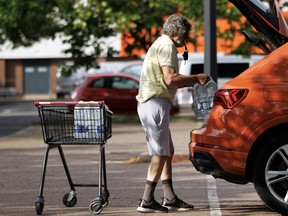
For a lot of Londoners trying to work from home a day or two a week, the latest heat wave is turning into a major headache.
On Monday, Britain had its earliest ever tropical night of the season, defined as a temperature above 20 C. On Tuesday, the daytime temperature soared above 35 C, a record for the time of year. Both extremes were registered in the country’s capital.
Gary Woodward, managing director of Airconco, an air conditioning installer based in north London, says his company is now booked out until the end of the summer.
“Even if people are only working two or three days a week from home, they’re still sitting in a converted bedroom, spare room,” Woodward said. It only takes “two or three days of extremely hot weather in which people start to become uncomfortable and unable to work, unable to sleep” for demand to shoot up, he said.
With the U.K. experiencing a faster pace of warming than the global average, having access to effective cooling systems is increasingly turning into a necessity.
—Bloomberg News

Heat dome affecting Europe is ‘unprecedented and historic:’ reports
British and European news outlets are reporting an unusual spring heat dome is scorching parts of the continent.
Euronews is reporting that experts are calling the heat dome unprecedented and historic. The report says temperatures reached 35 C near London, 39 C in some areas of France and that Britain is facing the warmest May on record.
France 24 reports that a red alert warning was issued Thursday for Rome because of the heat wave. The media outlet is also reporting a spike in hospitalizations as temperatures hit over 40 C in the central town of Mora on Wednesday.
According to the BBC, hundreds of heat records have been broken in France while the U.K.’s Met Office called temperatures over 35 C on Tuesday exceptional for the country even in the middle of summer.
Germany, Spain and Switzerland are also experiencing an unusually hot spring, according to the reports.
The reports are all calling this heat wave a heat dome, which is where an area of high pressure gets stuck, trapping warm air underneath. B.C. experienced a deadly heat dome in 2021, when temperatures soared over 40 C in many areas, including Lytton which hit a record 49.6 C.
In a statement, United Nations climate chief Simon Stiell said the heat dome was a brutal reminder of the spiralling impacts of the climate crisis.
“The science is clear that human-induced climate change is making these heatwaves more frequent and extreme,” Stiell said.
—Tiffany Crawford
A damp towel hangs from a barred window, a fan churns the muggy air: Inmates at the overcrowded Villepinte prison outside Paris say enduring a heatwave that has stifled France in recent days in cramped cells is “inhumane.”
French MP Clementine Autain witnessed the conditions during an unannounced visit on Friday afternoon to the penitentiary in the Seine-Saint-Denis Paris suburb, accompanied by AFP.
“At night, it’s hot, and mosquitoes get in even though I try to make a sort of mosquito net with my laundry bag,” said one teenaged detainee, adding that “tensions rise more quickly in the heat.”
As Autain visited, another young prisoner was taken back to his cell in a wheelchair after collapsing in the yard. Minors have individual cells, but in the rest of the building it is increasingly common for three detainees to share.
The Villepinte prison has an official capacity of 703, but at the time of Autain’s visit it held 1,332 inmates.
—AFP