Video: Pete Fry places priority on affordability and accountability
Cost of living, good governance and community safety top the list for the Vancouver Greens’ mayoral candidate
By Stuart McNish • Special To The Sun
Last updated 13 hours ago
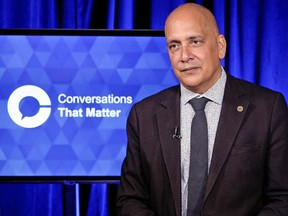
These are excerpts from Stuart McNish’s interview with Pete Fry, the Vancouver Green party’s candidate for mayor. You can watch the entire interview online at vancouversun.com/conversations. We’ll be reporting Saturday on the interview with Ken Sim, who is seeking re-election with ABC.

Subscribe now to read the latest news in your city and across Canada.
- Unlimited online access to articles from across Canada with one account.
- Get exclusive access to the Vancouver Sun ePaper, an electronic replica of the print edition that you can share, download and comment on.
- Enjoy insights and behind-the-scenes analysis from our award-winning journalists.
- Support local journalists and the next generation of journalists.
- Daily puzzles including the New York Times Crossword.
Subscribe now to read the latest news in your city and across Canada.
- Unlimited online access to articles from across Canada with one account.
- Get exclusive access to the Vancouver Sun ePaper, an electronic replica of the print edition that you can share, download and comment on.
- Enjoy insights and behind-the-scenes analysis from our award-winning journalists.
- Support local journalists and the next generation of journalists.
- Daily puzzles including the New York Times Crossword.
Create an account or sign in to continue with your reading experience.
- Access articles from across Canada with one account.
- Share your thoughts and join the conversation in the comments.
- Enjoy additional articles per month.
- Get email updates from your favourite authors.
Create an account or sign in to continue with your reading experience.
- Access articles from across Canada with one account
- Share your thoughts and join the conversation in the comments
- Enjoy additional articles per month
- Get email updates from your favourite authors
Sign In or Create an Account
Stuart McNish: Let’s project four years out. You’ve been elected mayor, and you’re seeking re-election. How does Vancouver look different four years from now?

tap here to see other videos from our team.
Video: Pete Fry places priority on affordability and accountability Back to video
tap here to see other videos from our team.
Pete Fry: I think Vancouverites feel better about the city for a variety of reasons.
The city feels more transparent and accountable as a government. I think that people feel they have a place in the city and that it’s affordability needs are met. … I think that people feel that they are welcomed in the city. … I should say that we’ve also engaged and supported robust business development in the face of what we’re experiencing right now with the Trump tariffs … and that we’ve built in the resilience.
But the big one for me is also that we’ve really addressed some of the issues around community safety in and around the Downtown Eastside.
McNish: So, is community safety first for you?
Fry: The top three are cost of living, good governance and community safety.
McNish: Let’s talk about safety. It must be connected to a discussion about what amounts to a failed open use drug policy.
Fry: The reality is that consumption and trafficking of drugs is a criminal issue. So, it’s not really the jurisdiction of the city of Vancouver per se.
What I believe that we can do, and we have not done, is to better manage the public spaces. And we can do that by saying, you know what, you can’t do that there. You can do it over there. And we can create spaces that are a little bit more sanctioned and places where it’s not acceptable.
I think that Ken Sim has misstepped by trying to ban overdose prevention sites and ban supportive housing. … I think the opportunity … is to take overdose prevention sites and set some criteria around the operational conditions to run an overdose prevention site.
-
Advertisement 1Story continues belowThis advertisement has not loaded yet, but your article continues below.
Right now, there’s actually none. You have more conditions on your licence if you want to open a bar or a restaurant than you do if you open an overdose prevention site.
This is a health issue and blocking an overdose prevention site is a fool’s errand because it is actually a constitutional right.
McNish: So, you see an increase in the number of overdose prevention sites along with greater guardrails?
Fry: I think responding to the need, and I don’t know that it necessarily means an increased number or better operations. I also look within that context of your classic sort of methadone clinic, some of them are very poorly run.
I’ve got one in my neighbourhood next to my own pharmacist and he struggles. He’s had to hire private security to keep his patrons safe because he’s next door to a poorly run clinic that doesn’t care about their surroundings
McNish: The open use laws have now been changed, but they also have to be enforced. What’s your position on engaging with the Vancouver police more actively to clamp down on that open use?
Fry: This comes back to the idea of let’s give them somewhere better to go. So that there’s not a free for all. The police are somewhat constrained by the Canadian Charter of Rights and Freedoms and the fact that it’s a difficult thing to actually effectively police.
And we know that arresting people for drug possession is not actually going to solve anything. It’s going to probably make things worse.
And certainly, when we get into issues like seizing people’s drugs and then suddenly they’re indebted to some higher-up drug dealer, and there’s a whole myriad of messy situations. But what I do believe is that we can say … you’re not doing it in front of a school or a community centre or a bus stop.
McNish: When we take a look at the livability index of Vancouver right now, we’re described as impossibly unaffordable. How do we change that equation?
Fry: There’s no easy answer. And certainly, we see right now, with this imperative to build more housing, nothing’s getting built. The province has imposed targets on us to build more housing. Concrete tower construction is pretty much stalled out.
McNish: There’s completion of projects that were underway, but not new, right?
Fry: Yeah, but we’ve approved lots of stuff, and a lot of it hasn’t broken ground. So we need to see a bit of a pivot. And I think that is the more challenging conversation when we look at housing in some of the more detached-home neighbourhoods. And what does that look like? We have a great opportunity through these Trump tariffs, ironically, to really lean in on softwood lumber and do wood frame construction.
We can build up to six stories wood frame. We can build it cheaper, faster. And what we’re learning is that families and people are actually more interested in that mid-rise kind of density as opposed to the tower.
McNish: We’ve got a public service that has grown much faster than the population. What’s your position on what needs to be done as far as the ranks within city hall?
Fry: Ironically, a lot of that public service grew under Ken Sim’s watch. Then fast forward to the end of his term when he introduces a zero (per cent tax increase) budget. And I think one of the challenging pieces with the new zero budget is we haven’t had eyes on what those budget changes mean.
I used to joke about how I broke my eyes on my first budget when I was elected in 2018. We used to get a 600-page stack with line after line of fine print type. It was ridiculous, and I had to wear glasses after that. Ken Sim’s zero budget came in at about 24 pages, and half of those were blank.
I think we can certainly trim the public service in appropriate way, in places. But we need to be mindful of: Are we penny-wise, pound-foolish when we make cuts?
McNish: What’s your plan to make Vancouver more attractive for businesses? I’ve talked to CEOs who have their head office in downtown Vancouver, but none of their operations are there.
Fry: I believe that we can attract those jobs by presenting what a fantastic city we live in. You and I have been here for a long time, and we stay here because it’s a great city. Unfortunately, there’s been cynical politics that project like Vancouver is dying and it’s a horrible place.
McNish: It’s tough to do business. City hall stands in the way frequently.
Fry: I couldn’t agree more with that. … That’s a lot of the work that I end up doing is where businesses are frustrated by too much red tape, the rigmarole. Trying to get a change of use if you had a restaurant you wanted to change it into a hair salon. This could be a six-month process.
Those are problems we can fix. Those are solvable problems. And that’s about efficiency of the work. And that’s not been delivered in the last four years.
McNish: Part of that challenge for business is the ability to move around. Vancouver has become impossible. … We’ve reduced the number of lanes … Nothing’s moving.
Fry: That comes down to a very fundamental argument around induced demand. Do we build bigger roads and does that solve traffic or does that bring more traffic?
Where we can make real solutions is investment in transit. Get more cars off the road. Make it more agreeable to walk or cycle. Not the biggest fan of the scooters, but they seem to be exploding in use. And there’s a trend toward micro mobility. And we’re seeing, the next generation is far more interested in those ways to get around rather than single car owners.
Mayor Zohran Mamdani in New York just collected $6 million in unpaid traffic tickets from Amazon drivers idling and double parking. … It’s increasingly an issue here where we have a lot of these last-mile delivery trucks that are showing up and choking traffic.
Meanwhile, the bricks and mortar guys are paying the taxes that pay for our roads and our infrastructure, but they’re losing out to ecommerce.