
Inside the B.C. election: How the Conservatives won, why the NDP failed
Behind the scenes of the blue wave and the orange defeat with party insiders and candidates
Last updated 1 day ago
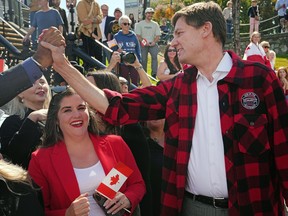
Seven weeks ago, when he was still B.C.’s premier, David Eby held a campaign-style rally in Victoria’s Inner Harbour, billed as an event to stand up against U.S. tariffs, featuring patriotic rap music and references to poutine.

Subscribe now to read the latest news in your city and across Canada.
- Unlimited online access to articles from across Canada with one account.
- Get exclusive access to the Vancouver Sun ePaper, an electronic replica of the print edition that you can share, download and comment on.
- Enjoy insights and behind-the-scenes analysis from our award-winning journalists.
- Support local journalists and the next generation of journalists.
- Daily puzzles including the New York Times Crossword.
Create an account or sign in to continue with your reading experience.
- Access articles from across Canada with one account.
- Share your thoughts and join the conversation in the comments.
- Enjoy additional articles per month.
- Get email updates from your favourite authors.
Create an account or sign in to continue with your reading experience.
- Access articles from across Canada with one account
- Share your thoughts and join the conversation in the comments
- Enjoy additional articles per month
- Get email updates from your favourite authors
Sign In or Create an Account
After a performance by OGR-Scintilla, a comedian dubbed the “Greatest Rapper in Canada,” Eby enthusiastically addressed the crowd wearing a red-and-black-checked “Salmo dinner jacket,” a gift from his Kootenay Central MLA. He promised to protect B.C. from the “unhinged” American president, with an enormous Canadian flag and the legislature behind him.
The Sept. 8 event led to speculation that the NDP was gearing up for a snap election less than two years after B.C.’s last trip to the polls.
About a week later, a source said, NDP MLAs pushed back against what they felt was a bad call to charge into a campaign. Surrey MLAs were especially concerned, according to the source.
Former NDP MLA Garry Begg, who lost his re-election bid in Surrey-Guildford, said caucus confidentiality prohibits him from disclosing any details about that meeting. But, in general, he said some people were concerned about facing an election “too soon” given the uncertainty of an electoral win.
“It was thought that you should wait, that it was intemperate to move forward,” Begg said.
Rick Glumac, who lost his NDP seat in Port Moody-Burquitlam, also declined to discuss the meeting but added: “I don’t personally believe that it’s a good idea to have a snap election. Period. I think if you’re trying to take political advantage, I think people see that and react to that in a negative way.”
The decision to call the snap election that ended the nine-year reign of the B.C. NDP came down to just Eby and two of his closest advisers: his new chief of staff, Andrew Mercier, and recently hired campaign manager Cheryl Oates, Postmedia News has learned.
The trio’s gamble backfired spectacularly, allowing a fractured Conservative party with an interim leader to form the province’s largest majority government in 25 years.

-
Advertisement 1Story continues belowThis advertisement has not loaded yet, but your article continues below.
Postmedia spoke with more than a dozen candidates and political watchers to tell the inside story of this election: Conservative strategists say they knew they had won by mid-October, while multiple NDP members feared they were going to lose on Day 1 of the campaign.
Sept. 18-20
Days after NDP MLAs were privately pushing back against Eby’s plan to go to the polls, many politicians were in Vancouver for the Union of B.C. Municipalities Conference. Rumours of a snap election were so persistent that the UBCM passed a resolution asking the province to wait until after the municipal election campaign was over.
Nonetheless, it’s believed that by Friday, Sept. 18, Eby had “the wheels in motion” to call the election, said Geoff Meggs, former chief of staff to the late NDP Premier John Horgan. That same day Eby delivered a UBCM speech, laden with electioneering promises.
At this point, Kerry-Lynne Findlay was the B.C. Conservatives’ controversial leader, who presented little opposition because her party was imploding. After four months with Findlay at the helm, much of the party and caucus staff had been fired, the party’s executive director and president had both quit and 13 MLAs had left or been kicked out over concerns about her leadership.
Spurred on by the impending election call, though, Conservative operatives struck a deal on Saturday, Sept. 19, for Findlay to step down. She resigned the next day.
Now the party needed a new leader. Lorne Doerkson, the little-known MLA from Cariboo-Chilcotin, was the caucus’s nearly unanimous selection because he was a nice guy who got along with everyone.
This, however, was news to Doerkson, who was flying back from South Africa on Sept. 20 after attending an international meeting of parliamentary speakers.
“I was first notified before we just left Cape Town (of Findlay’s resignation),” Doerkson told Postmedia on Thursday. “By the time I got to Amsterdam, I received a couple of calls from caucus members who had asked if I would allow my name to stand.”

He conditionally accepted the interim leader position while on a layover in the Amsterdam airport and held his first meeting with his caucus after landing in B.C. later that evening.
But he hadn’t taken on an easy job. Doerkson needed to quickly assemble a campaign team, and woo back the MLAs who had left under Findlay.
Sept. 21-22
At around 1 p.m. on Sept. 21, Doerkson phoned Peter Milobar, who was leading nine ex-Conservative MLAs under the CentreBC banner. They agreed to meet that evening.
“We met at the Metropolitan Hotel in downtown Vancouver in a small boardroom,” recalled pollster Dimitri Pantazopoulos, who was there with Doerkson and Milobar. After two hours, they reached an agreement to merge their parties, said Pantazopoulos.
Surrey-Cloverdale MLA Elenore Sturko was the only CentreBC MLA to refuse to return to the Tories, and took over leadership of the fledgling party.
By the next morning, eight CentreBC MLAs, as well as the five other MLAs who had also left or been kicked out by Findlay, had returned to the Conservatives.
As these negotiations played out privately, Pantazopoulos and Katy Merrifield were nervously having coffee, waiting “like expectant grandparents” for confirmation that the Conservatives had reunited.
Merrifield, former communications director to federal Conservative Leader Pierre Poilievre, was Doerkson’s new campaign manager, and she asked Pantazopoulos to be deputy manager. They anticipated an election would be called any day.
On Sept. 22, Eby made it official. He said he needed a stronger mandate, largely to fight threats posed by trade issues with the U.S. Findlay’s resignation hadn’t dissuaded Eby, which surprised many.
“I’ve been told by a couple of people that they thought if Kerry-Lynne Findlay resigned there wouldn’t be an election,” said Meggs. “Ultimately it’s (Eby’s) decision. He decided to go.”
There are several possibilities for why Eby took this electoral risk, Meggs said: A poll in August suggested his popularity was increasing while the opposition was infighting, and a few members of his slim majority were opposed to some of his key policies.

Ravi Kahlon, a longtime NDP cabinet minister who didn’t run for re-election, added that Eby wanted a stronger majority to relieve some of the pressure of getting important legislation passed. It was “heartbreaking,” he added, when MLAs receiving cancer treatment, or one who had just delivered a baby, had to log on to computers to vote electronically.
But from the very first day of the campaign, several NDP insiders were already worried that the party would lose, including Port Coquitlam Mayor Brad West and former NDP premier Glen Clark.
Glumac, the three-term MLA who lost his seat, said the government had made “good progress” on many issues, but his constituents told him they were less enamoured with the party this time around.
“From the moment the election was called, I knew that we were in trouble,” Glumac said. “You need to win elections based on hope and a positive vision of the future … and I wasn’t hearing that on the doorsteps.”
Added West: “I knew they were going to lose when Kerry-Lynne Findlay resigned … What were they left with? ‘Don’t vote Conservative because they’re scary.’ But Lorne Doerkson doesn’t seem like a scary guy.”
Despite having done good things while in power, Clark argued Eby’s NDP government, as well as the campaign launch, didn’t have “a compelling or clear story” for why voters should support the party’s vision for B.C.’s future.
First week of campaign
Two days into the campaign, a new poll showed the advantage Eby thought he had in August had already evaporated, said Meggs.
The early campaign announcements around groceries and taxes were “significant,” but also complex and didn’t resonate with voters, he added.
Although the party had “good reasons” to go to the polls early, argued re-elected NDP MLA Randene Neill, the campaign’s narrative didn’t appeal to voters, in particular the party’s justification for the early election call.
“We couldn’t shake that messaging that it was an unnecessary snap election,” said Neill, who was a cabinet minister.
The Conservatives, though, were confident from the outset, with internal data showing them as much as six points ahead of the NDP.

Angelo Isidorou, former executive director of the Conservatives, said he was surprised the NDP weren’t more prepared for a campaign they had jump-started.
“This government has managed the province for almost a decade, and I kept telling everybody every day: ‘You can’t just assume they’re going to go away gently,’ ” he said. ” ‘They’re going to throw everything they have at it.’ And I guess I overestimated what they had.”
Mid-campaign
By the middle of the campaign, the Conservatives were confident enough about the election to begin betting on it. Pantazopolous and four of his colleagues put their predictions on a board in the Conservative election headquarters on Oct. 13, with the veteran pollster wagering the party would win 63 seats — right on the money for how they would finish on election night.
“There were five of us who put them up on the whiteboard, for posterity,” he said.
Isidorou said his guess was more cautious, predicting the party would get between 50 and 54 seats, still a majority but not a runaway victory.
The Tories did face some challenges, though, with Doerkson ejecting two candidates over racist posts and dealing with an anti-Islam comment posted on social media by Merrifield.
The difference between the 2024 election and the 2026 campaign, said strategists, is that the leader decided quickly how to handle problematic situations.
“By virtue of making those decisions fast, you cauterize any negativity that may arise from it,” said Isidorou.
Meanwhile, many NDP candidates said their reception on doorsteps continued to be frostier than in 2024.

“Probably halfway thought the campaign, it became very apparent that there were people who were resistant to the NDP and our path forward,” Begg said.
When he was door-knocking, Glumac said voters repeatedly asked him about past NDP election promises that hadn’t been delivered, such as universal $10-a-day child care and the $1,000 grocery rebate.
“You have to build trust … by following through on your commitments,” Glumac said. “We lost our way as the NDP in terms of being able to express with clarity our values and vision.”
Because the municipal and provincial campaigns overlapped, residents asked West about the NDP while he was campaigning to be re-elected as Port Coquitlam’s mayor: ” ‘What are they doing for me?’ ‘What are they delivering?’ ”
Voters thought the party had lost credibility because it seemed like affordability and health care had worsened under the NDP’s watch, West said.
Last-minute campaign efforts to woo back voters just didn’t work, Meggs said, such as promising to build the second phase of the Burnaby hospital expansion after previously cancelling the project. The party would go on to lose two seats in that NDP-friendly city.
Conservative insiders, on the other hand, point to two moments when they say they knew they were going to win.
For some, like Pantazopolous, it was two days after the Oct. 14 leaders’ debate, when people told party canvassers that Doerkson had won, as polls continued to show them ahead by a sizable margin.
For others, like Isidorou, it was the Oct. 22 Surrey rally, when cars lined up outside because the venue was full.
“It was just something that felt spectacular,” Isidorou said. “I felt like, ‘OK, we’re going to sweep Surrey.’ ”
And they would.

End of campaign
On election night, Doerkson paced and drank coffee in a small room inside the Rocky Mountaineer Station in Vancouver.
Early election results showed his party with a massive lead. Doerkson didn’t think they could be real. Then he got the concession call from Eby, at about 9:30 p.m.
“He congratulated me. I congratulated him on winning a seat. And certainly, it was a respectful conversation,” said the premier-designate.
There was far less celebration in the NDP camp.
Kahlon had campaigned with the NDP candidate who replaced him in Delta North, but the seat he had held since 2017 flipped blue. On the doorsteps, he said, constituents hadn’t wanted to talk about issues, but expressed “frustration and anger” over the early election.
“The election call wasn’t the right one, and in the end the election became a referendum on the election call itself,” Kahlon said.
On Monday, Glumac posted a blunt Facebook message harshly criticizing his own party, saying it had “made decisions that were difficult to reconcile with our values or were out of touch with the everyday concerns of most people.”
The party needs to earn back voters’ trust by focusing on key issues such as affordability, homelessness and addiction, and hospital wait times, Glumac wrote.

The future
Power River-Sunshine Coast’s Neill said the NDP now needs to figure out why voters were so “upset and disappointed” in the party. “A really honest and transparent look at what happened and what went so wrong is needed.”
Sources say much of the blame is being placed on Eby, Oates and Mercier for making the early election call.
Postmedia requested interviews with Oates and Mercier, but they weren’t made available.
Eby addressed caucus and party staff on Monday when, according to someone present, he apologized but said he didn’t regret calling the election.
On Wednesday, the NDP held its final caucus meeting with the MLAs of the previous government.
“There was fatigue, there was sadness, there was some anger,” Kahlon said. But he added there were also plans for how to move forward, as the NDP has longtime supporters who will depend on MLAs to fight for their interests in Victoria.
The meeting was “reflective and thoughtful,” Begg added.
“It’s safe to say that there certainly were people who were angered by the results and certainly some who were angered by the process that got us to where we were.”
New Westminster-Coquitlam MLA Jennifer Whiteside was selected Thursday as the interim NDP leader, until a permanent leader is chosen.
As for Doerkson, the premier-designate has been busy in meetings, including with Prime Minister Mark Carney. He said he will set high standards for the central team he’s building, and avoid the problems the party faced under Findlay.
“I’ve said repeatedly, I’m going to lead from a position of respect and dignity,” he said.