
Natural habitat diversity key to protecting threatened salmon in B.C.’s Indian River watershed: report
Recommendations in the report include restoring large woody debris and investigating spawning habitats to understand egg survival
Last updated 10 hours ago
You can save this article by registering for free here. Or sign-in if you have an account.
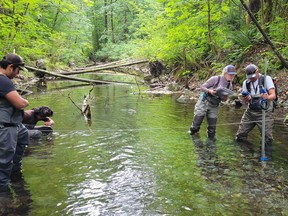
There are many reasons salmon are struggling in B.C., including toxins, landslides caused by industrial activity, and warming temperatures and drought caused by climate change.

Subscribe now to read the latest news in your city and across Canada.
- Unlimited online access to articles from across Canada with one account.
- Get exclusive access to the Vancouver Sun ePaper, an electronic replica of the print edition that you can share, download and comment on.
- Enjoy insights and behind-the-scenes analysis from our award-winning journalists.
- Support local journalists and the next generation of journalists.
- Daily puzzles including the New York Times Crossword.
Subscribe now to read the latest news in your city and across Canada.
- Unlimited online access to articles from across Canada with one account.
- Get exclusive access to the Vancouver Sun ePaper, an electronic replica of the print edition that you can share, download and comment on.
- Enjoy insights and behind-the-scenes analysis from our award-winning journalists.
- Support local journalists and the next generation of journalists.
- Daily puzzles including the New York Times Crossword.
Create an account or sign in to continue with your reading experience.
- Access articles from across Canada with one account.
- Share your thoughts and join the conversation in the comments.
- Enjoy additional articles per month.
- Get email updates from your favourite authors.
Create an account or sign in to continue with your reading experience.
- Access articles from across Canada with one account
- Share your thoughts and join the conversation in the comments
- Enjoy additional articles per month
- Get email updates from your favourite authors
Sign In or Create an Account
Now researchers say a diverse natural habitat may be key in their fight for survival.
A new report by the xʔəl̓ilwətaʔɬ (Tsleil-Waututh) First Nation and the federal Fisheries Department finds that different species of salmon rely on different habitats at various stages of life.
For example, off-channel wetlands and floodplain habitats are important for juvenile coho while cooler groundwater-fed side channels provide important spawning habitat for chum. Woody debris, such as fallen trees, provide deep pools that act as safe havens for fish during storms.
But industrial activities have disrupted many of these natural habitats, says Haley Crozier, co-author of the report and lead natural resource specialist with the Tsleil-Waututh Nation.
“It’s really hard to replicate and recreate natural habitat, and because of logging in B.C. and industrialization, there are very few watersheds left in the province that are intact, fully functioning as how they would have been historically,” she said.
“One of the biggest things we can do in river systems is really try and work with the river and put those large woody debris-like structures back in the river.”
Before industrial logging, the trees were much larger, and they would fall into the rivers, stabilizing the river, holding back gravel and creating deep pools, said Crozier.
The woody structures provide refuge during storms and from drought.
“It gives them areas to go and hide when the water is getting warmer and there’s less of it. So they’ve got these big deep holes they can kind of go sit in, and a lot of rivers are missing that.”
-
Advertisement 1Story continues belowThis advertisement has not loaded yet, but your article continues below.
Over several years, the researchers studied salmon habitat in the Indian River watershed, which is in xʔəl̓ilwətaʔɬ territory on the northern end of Indian Arm in Burrard Inlet. It is home to chum, coho, and pink salmon, as well as rainbow, cutthroat and dolly varden trout.
“With climate change they are all at risk. Yes, pink salmon are abundant right now, but it’s getting tough for them, too, as summers are hotter and drought is getting worse.”
In 2023, for example, there was a massive die-off because of drought. Where the river had gone underground, fish were “getting stuck and piling up,” she said. Emergency work was done with the Fisheries Department to reconnect the river to save some of the fish.
But B.C.’s worsening drought keeps her up at night. She said the team had to rescue fish from dried-up sections of the river three times in the past three years.
“It just shows the severity and how quickly things are happening, and it’s really scary to see.”
The goal of the research was to better understand the challenges different species face and to come up with a plan for long-term stewardship of the watershed to protect the fish.
Researchers conducted habitat assessments, minnow trapping, streamflow measurements, and continuous water temperature monitoring to provide data that show which conditions support healthy salmon populations.
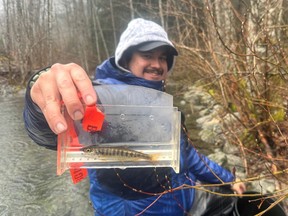
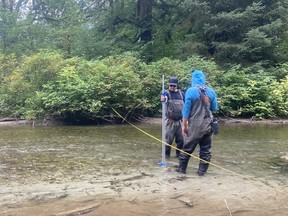
Recommendations include expanding habitat monitoring, restoring large woody debris and pool habitat where appropriate, continuing long-term water temperature monitoring, and investigating groundwater-fed spawning habitats to better understand egg survival and habitat quality. Crozier said many of the recommendations match those found in the Indian River watershed integrated stewardship plan.
The greatest number of coho were observed where large woody debris structures likely provided ideal rearing habitat, highlighting the importance of these structures for juvenile fish in the watershed, the report says.
Coho, in particular, have lost a lot of spawning habitat, said Crozier, noting that more off-channel sites will support faster juvenile coho growth rates.
For chum, especially adults, they like to spawn in the cold groundwater-fed channels, so more monitoring and conservation efforts can help, said Crozier. Restoration and protecting wetlands, the marshy areas at the sides of rivers, are also key to survival as they provide nutrient dense habitat for juvenile fish.
The report also recommends continued work with Fisheries and others to monitor other stressors, such as poor slope stability and landslides — also the result of years of intense forestry practices.
Within the watershed, 15 per cent of slopes are considered unstable, with another 25 per cent of slopes designated as potentially unstable, the report says.
Unstable slopes lead to landslides on a near yearly basis, depositing sediment into areas where salmonids spawn.
“Salmon are really the backbone of the B.C. coast for both people and for the environment,” said Crozier. “This is a keystone species that we cannot risk losing.”