B.C. climate news: More than 100 wildfires burning in B.C. | Federal government sets aside $34.2 million for climate adaptation | Report finds climate change made Canada’s forests more likely to burn
Here’s all the latest local and international news concerning climate change for the week of Aug. 10 to Aug. 16, 2026.
You can save this article by registering for free here. Or sign-in if you have an account.
Here’s the latest news concerning climate change and biodiversity loss in B.C. and around the world, from the steps leaders are taking to address the problems, to all the up-to-date science.

Subscribe now to read the latest news in your city and across Canada.
- Unlimited online access to articles from across Canada with one account.
- Get exclusive access to the Vancouver Sun ePaper, an electronic replica of the print edition that you can share, download and comment on.
- Enjoy insights and behind-the-scenes analysis from our award-winning journalists.
- Support local journalists and the next generation of journalists.
- Daily puzzles including the New York Times Crossword.
Subscribe now to read the latest news in your city and across Canada.
- Unlimited online access to articles from across Canada with one account.
- Get exclusive access to the Vancouver Sun ePaper, an electronic replica of the print edition that you can share, download and comment on.
- Enjoy insights and behind-the-scenes analysis from our award-winning journalists.
- Support local journalists and the next generation of journalists.
- Daily puzzles including the New York Times Crossword.
Create an account or sign in to continue with your reading experience.
- Access articles from across Canada with one account.
- Share your thoughts and join the conversation in the comments.
- Enjoy additional articles per month.
- Get email updates from your favourite authors.
Create an account or sign in to continue with your reading experience.
- Access articles from across Canada with one account
- Share your thoughts and join the conversation in the comments
- Enjoy additional articles per month
- Get email updates from your favourite authors
Sign In or Create an Account
Check back every Saturday for more climate and environmental news or sign up for our Sunrise newsletter HERE.

tap here to see other videos from our team.
B.C. climate news: More than 100 wildfires burning in B.C. | Federal government sets aside $34.2 million for climate adaptation | Report finds climate change made Canada’s forests more likely to burn Back to video
tap here to see other videos from our team.
In climate news this week:
• Federal government sets aside $34.2 million for climate adaptation
• Report finds climate change made Canada’s forests much more likely to burn
• More than 100 wildfires continue to burn in B.C.
• Natural habitat diversity key to protecting threatened salmon in B.C.’s Indian River watershed: report
Human activities like burning fossil fuels and farming livestock are the main drivers of climate change, according to the UN’s intergovernmental panel on climate change. This causes heat-trapping greenhouse gas levels in Earth’s atmosphere, increasing the planet’s surface and ocean temperature.
The panel, which is made up of scientists from around the world, including researchers from B.C., has warned for decades that wildfires and severe weather, such as the province’s deadly heat dome and catastrophic flooding in 2021, would become more frequent and intense because of the climate emergency. It has issued a code red for humanity and warns the window to limit warming to 1.5 C above pre-industrial times is closing.
According to NASA climate scientists, human activities have raised the atmosphere’s carbon dioxide content by 50 per cent in less than 200 years, and “there is unequivocal evidence that Earth is warming at an unprecedented rate.”
As of Aug. 5, 2026, carbon dioxide in the atmosphere was 429.12 parts per million, down slightly from 431.44 ppm the previous month, according to the latest available data from the NOAA measured at the Mauna Loa Observatory, a global atmosphere monitoring lab in Hawaii. The NOAA notes there has been a steady rise in CO2 from under 320 ppm in 1960.

-
Advertisement 1Story continues belowThis advertisement has not loaded yet, but your article continues below.
Quick facts:
• The global average temperature in 2023 reached 1.48 C higher than the pre-industrial average, according to the EU’s Copernicus Climate Change Service. In 2024, it breached the 1.5 C threshold at 1.55 C.
• 2025 was the third warmest on record after 2024 and 2023, capping the 11th consecutive warmest years.
• Human activities have raised atmospheric concentrations of CO2 by nearly 49 per cent above pre-industrial levels starting in 1850.
• The world is not on track to meet the Paris Agreement target to keep global temperature from exceeding 1.5 C above pre-industrial levels, the upper limit to avoid the worst fallout from climate change including sea level rise, and more intense drought, heat waves and wildfires.
• UNEP’s 2025 Emissions Gap Report, released in early December, shows that even if countries meet emissions targets, global temperatures could still rise by 2.3 C to 2.5 C this century.
• In June 2025, global concentrations of carbon dioxide exceeded 430 parts per million, a record high.
• There is global scientific consensus that the climate is warming and that humans are the cause.
Latest News
B.C. firefighters battle 122 wildfires, as hot and dry weather continues
Fire officials said Saturday there are 122 wildfires burning in B.C., as hot and and dry weather continues in the northwestern and southern regions.
Of those, half are out of control and four are considered wildfires of note.
In an update Saturday, the B.C. Wildfire Service said the coastal fire region and southern portions of the Cariboo fire region may see thunderstorms, bringing the potential for precipitation and gusty winds.
Fire officials said wildfire smoke is expected to gradually move back into central areas of the province. While smoke can impact visibility and air quality, it may also help moderate fire behaviour by reducing the amount of radiant heat reaching the landscape.
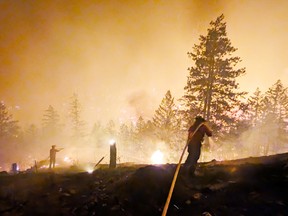
When Ron Kubek finally drove back up to his Summerland winery, the feeling wasn’t quite relief.
“You drive into town and your stuff’s safe, but then you know that there are people whose lives are completely affected,” said Kubek, who owns Lightning Rock Winery and got temporary access to his property after nearly a week away. Five people he knows have lost their homes to the Bald Range wildfire.
“It was almost a melancholy feeling,” he said, describing his return to Summerland. Kubek was among the first Summerland residents who got access to town.
More residents are now being allowed to return home as the first openings appear in an evacuation zone that still covers thousands of properties. The District of Summerland partly rescinded its evacuation order at noon Friday, downgrading the Trout Creek neighbourhood east of Highway 97 to an evacuation alert.
The initial evacuation, signed by Mayor Doug Holmes in the early hours of Aug. 8, had covered the entire town since it was issued. The change clears about 400 properties to return. The order stays in place for the rest of Summerland — including Trout Creek west of the highway.
—Oksana Shtohryn
Report finds climate change made Canada’s forests much more likely to burn
The planet’s warming had a strong influence on destructive wildfires in Canada that have raged across Ontario and the Northwest Territories since late June, making the extreme fire weather that fuelled them at least twice as likely, according to a report published Thursday by World Weather Attribution.
With global temperatures roughly 1.4 C above pre-industrial levels, Canada is experiencing a notable rise in extremely hot and dry weather — the ingredient required to turn minor ignitions into infernos.
Researchers found that the severe conditions behind the recent blazes in Ontario are now twice as probable as they would be in a world untouched by human-caused greenhouse gas emissions. The change is even more stark in the Northwest Territories: There, a week of fire weather as extreme as this year’s — which would occur once-a-decade without global warming — is now estimated to return every two years.
Doubling of the likelihood is “really bad,” said Friederike Otto, a professor in climate science at Imperial College London and a co-author of the study. Given the immense challenge of containing wildfires, “even if just a little bit worse, it would mean that everything is even stretched further,” she said.
The findings come as Canada endures another catastrophic burn season. More than 4,000 fires have been recorded nationwide so far this year, scorching a collective area roughly the size of Switzerland — a nearly 45 per cent increase over the 30-year average spanning 1994 to 2023.
Canada is part of a global pattern. Recent blazes across France, Spain, Portugal and Greece forced hundreds of thousands of people to evacuate, while earlier this year, fires in Chile and Argentina claimed at least 20 lives and devastated wide swaths of Patagonia.
—Bloomberg News

Federal government sets aside $34.2 million for climate adaptation
The federal government has set aside $34 million to help communities adapt to climate change.
The announcement this week comes as B.C. battles more 100 wildfires across the province that have forced tens of thousands of residents from their homes.
According to a news release, the funds will go to 141 municipal adaptation projects aimed at building long-term climate resilience. The projects were selected following a call for applications that was launched in June 2024.
Environment Minister Julie Dabrusin said Canada’s climate is changing and the projects will help make communities more resilient, so that people are protected from flooding, extreme heat and other risks.
One of the biggest chunks of the money in B.C.— $789,600— will go to Port Coquitlam to advance flood-resilient Infrastructure while $735,630 is set aside for the Habitat Acquisition Trust in Victoria. Nanaimo will get $508,220 to improve potable water supply.
There are many reasons salmon are struggling in B.C., including toxins, landslides caused by industrial activity, and warming temperatures and drought caused by climate change.
Now researchers say a diverse natural habitat may be key in their fight for survival.
A new report by the xʔəl̓ilwətaʔɬ (Tsleil-Waututh) First Nation and the federal Fisheries Department finds that different species of salmon rely on different habitats at various stages of life.
For example, off-channel wetlands and floodplain habitats are important for juvenile coho while cooler groundwater-fed side channels provide important spawning habitat for chum. Woody debris, such as fallen trees, provide deep pools that act as safe havens for fish during storms.
But industrial activities have disrupted many of these natural habitats, says Haley Crozier, co-author of the report and lead natural resource specialist with the Tsleil-Waututh Nation.
“It’s really hard to replicate and recreate natural habitat, and because of logging in B.C. and industrialization, there are very few watersheds left in the province that are intact, fully functioning as how they would have been historically,” she said.
—Tiffany Crawford
A B.C. camper is crying foul after B.C. Parks refused to refund his Lightning Lake campground reservation fees in Manning Park, even though intense wildfire smoke made it impossible for him to camp.
B.C. Parks cited data from a provincial air-quality monitoring station located nearly 70 km away near Hope, where the air was significantly clearer, as its reason for refusing the refund.
Dmitri Berlin had reserved two nights at the Manning Park campground, and arrived on July 29 at around 4 p.m.
“I was aware there were wildfires around that area, but I couldn’t see how bad it was until I got there. It was impossible to breathe. It was unhealthy.”
He decided to camp elsewhere.
There are currently four wildfires in and around Manning Park, which began after a lightning storm hit the area on July 17. On July 31, shortly after Berlin’s scheduled camping reservations, air quality around Manning Park was so poor the well-known Fat Dog trail race, scheduled to run from Aug. 7-9 was cancelled by organizers citing smoke, safety and air-quality concerns.
—Denise Ryan
AI giants are quiet on climate in sign of post-ESG Wall Street
In a few short years, U.S. artificial intelligence startups have grown into some of the most powerful and influential businesses in the world, reaching near-trillion-dollar valuations. As two of them, Anthropic and OpenAI, prepare for initial public offerings, there’s a notable absence: The companies haven’t disclosed their greenhouse gas emissions, made net-zero pledges or published sustainability reports. (Anthropic did join a carbon-removal coalition called Frontier.)
Not long ago, investors would have cried foul. Even fossil-fuel stalwarts like ExxonMobil Holdings Corp. have been voluntarily producing sustainability reports for years. The Big Tech companies scaling up AI infrastructure — Alphabet Inc.’s Google, Meta Platforms Inc., Amazon.com Inc. and Microsoft Corp. — have net-zero goals and report their emissions, which are now spiking due to the data-centre boom.
But in an era of climate backlash, many investors have fallen quiet on the issue and U.S. regulators have retreated. So the public is left guessing about how much climate pollution is tied to the large language models of OpenAI, Anthropic and SpaceX’s SpaceXAI, and whether the companies plan to curb it. While they aren’t yet public companies, their scale dwarfs what people associate with startups.
Although precise numbers are lacking, it’s clear that the sector’s emissions are enormous. New gas plants for data centres in the U.S. alone could soon generate as much climate pollution as the entire country of Australia, according to research by the nonprofit Environmental Integrity Project.
—Bloomberg News