
Vancouver entrepreneur builds consignment empire spanning 48 years
Turnabout Luxury Resale turns 48 this year
Last updated 6 hours ago
We independently select everything we recommend. Buying through us may earn us a commission, which supports our work.

Subscribe now to read the latest news in your city and across Canada.
- Unlimited online access to articles from across Canada with one account.
- Get exclusive access to the Vancouver Sun ePaper, an electronic replica of the print edition that you can share, download and comment on.
- Enjoy insights and behind-the-scenes analysis from our award-winning journalists.
- Support local journalists and the next generation of journalists.
- Daily puzzles including the New York Times Crossword.
Subscribe now to read the latest news in your city and across Canada.
- Unlimited online access to articles from across Canada with one account.
- Get exclusive access to the Vancouver Sun ePaper, an electronic replica of the print edition that you can share, download and comment on.
- Enjoy insights and behind-the-scenes analysis from our award-winning journalists.
- Support local journalists and the next generation of journalists.
- Daily puzzles including the New York Times Crossword.
Create an account or sign in to continue with your reading experience.
- Access articles from across Canada with one account.
- Share your thoughts and join the conversation in the comments.
- Enjoy additional articles per month.
- Get email updates from your favourite authors.
Create an account or sign in to continue with your reading experience.
- Access articles from across Canada with one account
- Share your thoughts and join the conversation in the comments
- Enjoy additional articles per month
- Get email updates from your favourite authors
Sign In or Create an Account
As a young twenty-something working the front counter of a Vancouver camera shop, Joy Mauro found herself stopping by a local consignment store that she had read about in a newspaper ad.
Looking to recoup some money from her closet, she took a pile of her garments in to sell. They didn’t want any of them.
“They didn’t like any of my stuff,” she recalls with a laugh. “They made it very clear.”
That denial got Mauro thinking about reimagining the idea of resale.
“I said … you could do this differently. You could do it in a useful way. You could do it in a professional way. And you could be nice to people,” she says.
So, she decided to start her own consignment shop in 1978. With a $5,000 loan from a friend, she opened Turnabout on South Granville Street. (She recalls being turned away from a first planned location on Davie Street after the landlord said they didn’t want a business selling second-hand.)
Fast-forward 48 years, and Mauro now operates nine Turnabout locations across the Lower Mainland, including one on Vancouver Island. The Vancouver-based, family owned business employs her three sons and other assorted family members, along with a team that numbers some 120 people and growing.
Raised in a modest home in Richmond, Mauro grew up feeling embarrassed by the fact that her family often shopped at thrift stores. But shifting the perception of “preloved” has been a major motivator for her business model, which includes a non-profit location on 4180 Fraser St. called Turnabout Community, over the years.
“It wasn’t about going, ‘Oh, I can get rich doing this.’ It was never that,” she says of her motivation. “It was for the love of it.”
-
Advertisement 1Story continues belowThis advertisement has not loaded yet, but your article continues below.
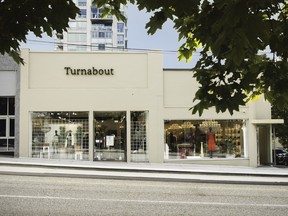
This fall, Mauro expanded her footprint in the original South Granville neighbourhood, taking over almost an entire city block with the new Granville Luxe store at 3101 Granville St. and the first Turnabout Men’s location at 3135 Granville St.
Her overarching appreciation for fashion and retail is easy to identify when you encounter Mauro in person. A stylish woman in her early 70s, she sports statement jewelry such as a shimmering gemstone ear cuff and stacked rings, paired with polished pieces like blazers and cashmere knits.
“Let’s put it this way: I approve all of the designer stuff,” she says with a sly smile when asked how often she shops her own stores. “But I love jewelry.”
She can often be found in one of her stores, chatting with customers and employees and seeing what’s new. The success of the business, she says, rests on the relationships she has with those who both buy and sell to her, so she likes to be around to chat.
“We sell things for people. You build a store; it’s just empty, and your service is that people want to clean out their closets and bring you stuff, and you want to sell things for them,” she says. “So, my job is to do the best I can for them.
“You’re only as good as what you get.”

In recent years, there’s been a boom in demand for used and vintage clothing and accessories. The global second-hand market is expected to grow at twice the pace of traditional retail, hitting US$393 billion by 2030, according to the 14th-annual ThredUp Resale Report.
It’s a shift in consumer habits that Mauro could never have predicted nearly 50 years ago — but she’s more than happy to be a part of.
“The world is being evolving and changing,” she say of the motivation behind the rise of second-hand. “People are aware that there are all these piles of clothes in foreign countries that are being dumped there.”
While the bestsellers for the business include garments from Aritzia and Lululemon — last year, the company accepted some 200,000 items for resale from sellers — Mauro says there’s big business in designer resale of brands such as Dior, Gucci and Max Mara.
Shopping second-hand is often about accessibility to luxury as much as it is about sustainability.
Accepting items from sellers primarily located in and around the stores, the business sells internationally thanks to the introduction and expansion of its e-commerce, which launched in 2016. Though, Mauro says only about 20 per cent of what they receive ends up on the website as many things sell too quickly to get them online.
“That’s always been the treasure of Turnabout, is that you never know what you’re going to find in store because it’s quite simply not all online,” she says.
On the day Mauro sat down with Postmedia News for an interview, her team had come back from a West Vancouver estate with a van full of designer goods to be sold. Closet clean-outs, she says, are a big part of the business. And, with several locations offering goods at a variety of prices and categories, they’re able to offer a full-service operation that ends with a clean closet — and a cheque.
“Even if you’re not that sustainably aware and aren’t worrying about the environment, the fact is, if you get a $5,000 cheque, you’re suddenly paying attention,” she says of the draw of earning money back on clothes, jewelry and other assorted accessories. “We have people that make $20,000 to $30,000 cheques. Each season.”

Item authenticity is a primary concern for the Turnabout team. Mauro says they use third-party authentication platforms such as LegitGrails to authenticate designer items.
“There are some things that are so obvious … ,” Mauro says, noting that some people bring in items not even realizing they’re fake. “You have to be careful.”
Operating primarily using a model of consignment, they do buy some items upfront for a lesser rate. There’s a sliding scale for consignment rates based on the brand. And, once something sells, a consignor can choose a cash payout or they can opt to keep their money in Turnabout and buy something that’s new to them.
“Everyone likes to do the trades now,” Mauro says. “With the designer bags in particular. People will find a Birkin in here or a Chanel that they want, and they’ll go home and they’ll pull a few things out of the cupboard and bring it in and do a trade.”
When asked what’s one of the biggest challenges amid the resale boom, Mauro said it comes down to salability.
“Our bad reviews are all about, ‘They didn’t take anything,’ ” she says. “Main Street right now has almost 50 per cent rejection rate.
“Shoppers don’t buy anything if it has an ‘as-is’ on the tag. They don’t want marks or stains. They don’t want a repair job. Even in our charity store, stuff that’s left on the clearance rack is the stuff that there’s something wrong with it.”
Instead, what shoppers buy (and, therefore, what Turnabout buyers accept) are in-demand branded items that are in good-to-excellent condition.
After nearly 50 years in business, and with no sign of slowing down, Mauro has ambitious plans for where she would like to see her company go from here.
“I would like to figure out more ways that I can help people with their closets. How can I make it less daunting? How can I help them learn how to rotate? … Because a lot of people don’t know and they’re overwhelmed by it,” she says. “We’re moving our Broadway store to a very exciting location … and then I’m turning my attention to our website.”